The Anatomy of Harness Engineering: How to Evaluate, Iterate, and Guard AI Coding Agents- Google Developers Blog
Sep 9, 2026Taylor Mullen, Christian Gunderman
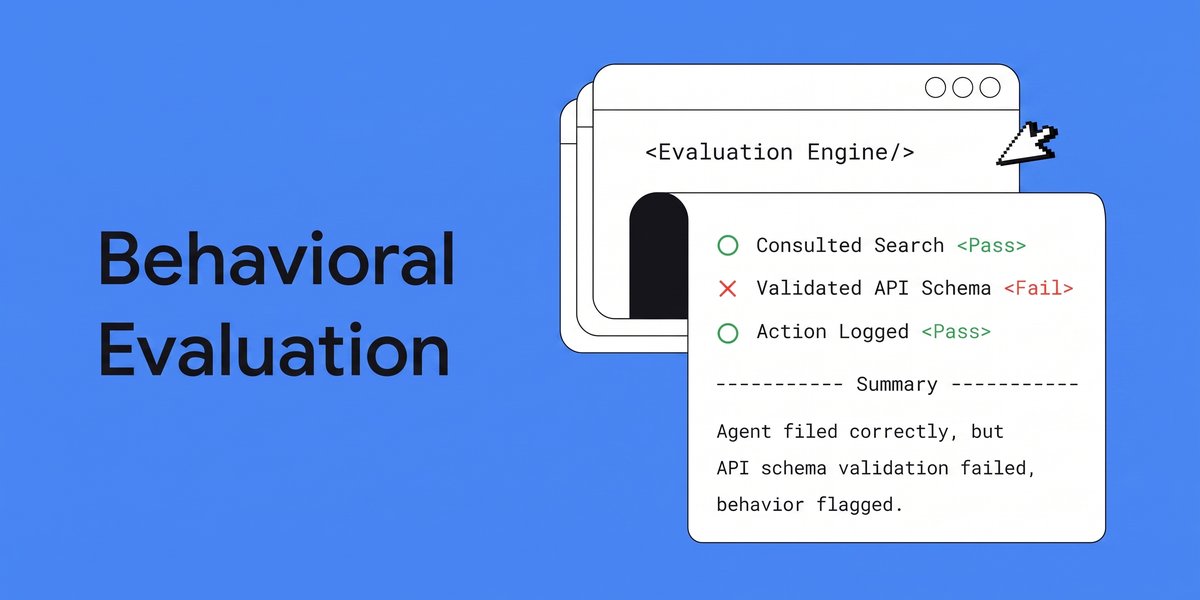
Summary
This post introduces the concept of 'harness engineering' for AI coding agents, focusing on behavioral evaluations as a more reliable measure of confidence than end-to-end benchmarks. It details a paradigm shift from 'report cards' to 'behavioral guideposts', emphasizing discrete, observable actions rather than composite scores. The post outlines a three-step behavioral testing loop: picking one failure mode, writing flexible assertions based on task complexity (strict single-turn for simple tasks, LLM-as-a-judge for complex ones), and automating batch evaluations for stability monitoring. It provides a Python code example using the Antigravity SDK for a behavioral eval and a shell command for running local tests.
More from the AI-Assisted Spec-Driven Development trail
- Agent and Model Evaluations in Gemini Enterprise Agent Platform are now GA- Google Developers Blog
- Enable on-demand expertise with Agent Skills in Genkit Go- Google Developers Blog
- How to use Google microbenchmarks for evaluating TPU performance- Google Developers Blog
- Evolving Spec-Driven Development: Conductor Now Supports Antigravity- Google Developers Blog
- Building scalable AI agents with modular prompt transpilation- Google Developers Blog