Building Express Backbone: Facebook’s new long-haul network
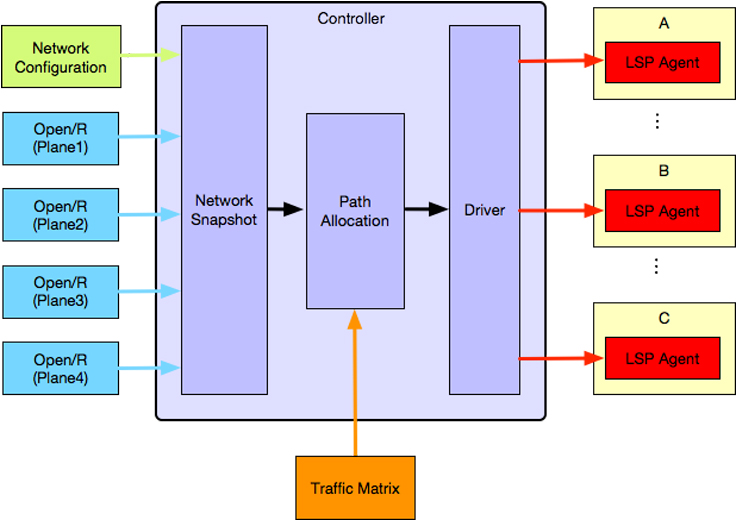
This post details the design and implementation of Facebook's Express Backbone (EBB), a new long-haul network designed to handle the rapidly increasing bandwidth demand for cross-data center replication of rich content. EBB separates inter-data center traffic from internet-facing traffic, optimizing them individually. Key technical contributions include: a hybrid traffic engineering (TE) model combining distributed control agents (Open/R) with a central controller, a four-plane physical topology inspired by data center fabrics, the use of commodity network gear by keeping the number of network prefixes small, and an iterative development approach allowing for fractional capacity deployment and A/B testing between planes. The control stack comprises BGP route injectors, an sFlow collector for traffic matrix estimation, a TE controller for path computation, Open/R agents for IGP and messaging, and LSP agents for programming forwarding tables. The controller operates in periodic cycles, computing optimal routes based on traffic demand and network state, and programming MPLS segment routes using segment routing (SR) at the headend.