Blogs
DataRobot logo

DataRobot

Engineering blog · datarobot.com/blog

19posts0this week0watchers

Feature trails

5
Feature trailActive

Agentic AI Governance

This post details the evolution of agentic AI governance from manual review for a few agents to a robust infrastructure problem for hundreds. It emphasizes the need for centralized identity, reusable policy propagation, and cross-environment enforcement to manage agent sprawl. Key takeaways include treating agents as distinct actors, enforcing least-privilege access, using deterministic controls for high-impact actions, capturing full execution paths, and testing failure modes. The goal is to provide a framework for managing agentic AI in production, addressing governance, operational ownership, and integration debt.

19 posts · 2026

Timeline

Feature trailActive

Workload API for AI Services

The Workload API provides a unified layer for deploying and governing AI services, abstracting away Kubernetes complexity. It allows developers to deploy containerized AI workloads (agents, inference servers, RAG pipelines) with a single command, offering autoscaling, monitoring, and secure credential management. The API supports various AI service types and integrates with NVIDIA NIM and Hugging Face models. Day-two operations like promotion to production, diagnostics, observability, and access control are managed through this API. DataRobot OpenCode leverages this API to provide a flexible coding agent that supports model choice across closed, open, and bring-your-own options, ensuring rigorous governance and simplifying the adoption of new models.

1 post · 2026

Timeline

Feature trailActive

Local CLI Tracing

Introduced local tracing capabilities within the DataRobot CLI (dr xp) to enable developers to debug agentic applications in their local environment before deployment. This feature leverages OpenTelemetry for live tracing, showing tool calls, latency, token counts, and error logs, mirroring the platform's post-deployment tracing.

1 post · 2026

Timeline

Feature trailActive

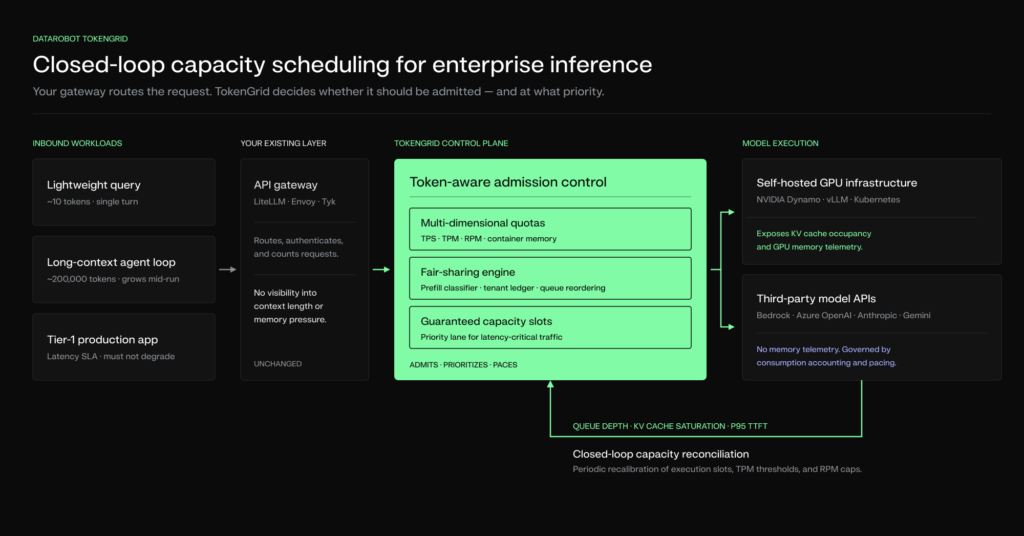
TokenGrid: LLM Token Scheduling and Capacity Management

TokenGrid is a stateful, token-aware capacity scheduler for managing LLM inference costs and resource utilization. It operates in the admission path, bridging gateways and compute resources. Features include dynamic rate limiting based on multi-dimensional quotas (tokens per second, monthly token budgets, container memory), a fair-sharing engine that classifies workloads, enforces tenant quotas, and applies memory-based throttling. It also supports various service classes (dedicated, guaranteed, elastic, spot, and preemptible). This post details its application in multi-tenant inference environments, addressing issues of stranded GPU capacity, undifferentiated rate limiting, and production latency spikes during traffic bursts. It introduces debt-based fairness for temporarily throttled workloads and capacity expressed in inference-native units like token throughput, KV cache, and concurrency, running as a Kubernetes-native layer above vLLM or TensorRT-LLM.

1 post · 2026

Timeline

Feature trailActive

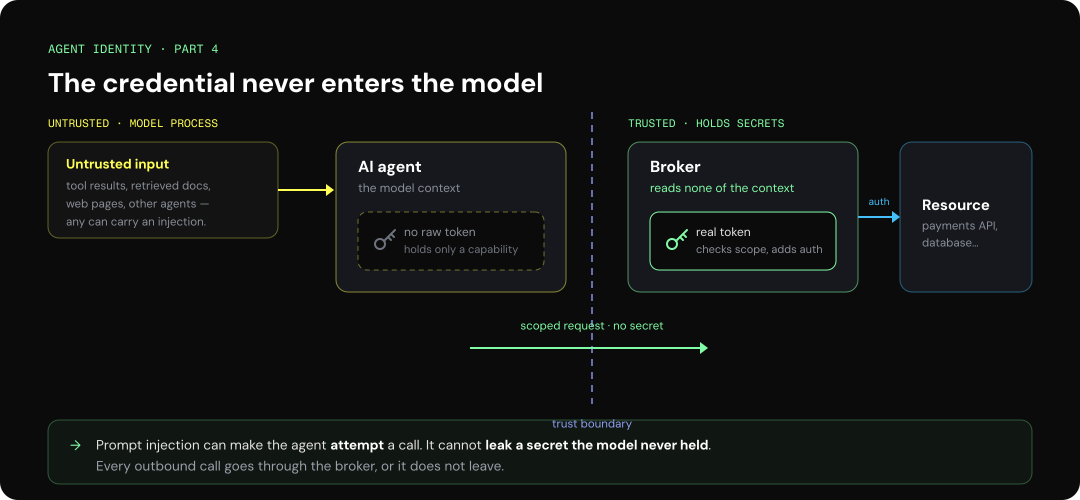
Credential Broker for Agent Egress

The Credential Broker for Agent Egress system has been enhanced to support delegation chains, ensuring that the original principal's identity is preserved throughout multi-hop agent calls. This is achieved by adhering to RFC 8693 token exchange standards, specifically utilizing `sub` and `act` claims to maintain the original requester's identity and track the acting agent at each step. The system now actively prevents the 'confused deputy' problem by avoiding flattened tokens and enforcing scope. This post highlights the critical security implications of agents inheriting human credentials, leading to privilege escalation, lack of scoping, attribution issues, and difficult revocation. It argues for a shift from static, passport-like identity models to dynamic, runtime-decided authority for non-deterministic agents, emphasizing the need for a new IAM category to address this gap.

1 post · 2026

Timeline