Blogs
Exa logo

Exa

Engineering blog · exa.ai/blog

29posts1this week0watchers

Feature trails

9
Feature trailActive

Exa Agent

Exa Agent is a revamped agentic search endpoint offering optimized query expansion and LLM reasoning for high-quality search results. It is faster, cheaper, and provides structured outputs with field-level grounding. Exa Deep utilizes Exa Instant search and LLM reasoning to generate multiple search agents in parallel and synthesize results with citations. Benchmarks show it outperforms competitors in speed and accuracy. It is used for financial research, scientific literature surveys, and now, evaluating agentic search performance with the ATLAS benchmark. The ATLAS benchmark itself is a significant contribution, designed to rigorously evaluate agent accuracy and completeness on search-intensive tasks, focusing on the trade-off between cost and performance, and highlighting the critical role of the search backend in agentic workflows.

9 posts · 2023–2026

Timeline

20232026
Feature trailActive

Search Pipeline Orchestration

Exa has developed Canon, a search pipeline orchestrator designed to manage the increasing complexity of its search engine. Canon represents search pipelines as Directed Acyclic Graphs (DAGs), enabling automatic parallelism, durable execution, introspectability, and decoupling of definition from execution. The runtime evaluates these DAGs using a pull-based system, maximizing compute efficiency through automatic cancellation propagation and memoization, and providing comprehensive observability. This post details the runtime's pull-based execution model, memoization for diamond dependencies, and automatic cancellation propagation. It also elaborates on the observability benefits, including tracing individual query paths and decisions made by the search engine, and how this enables agents to inspect graphs and identify root causes of unexpected behavior.

13 posts · 2024–2026

Timeline

20242026
Feature trailActive

Exa Instant

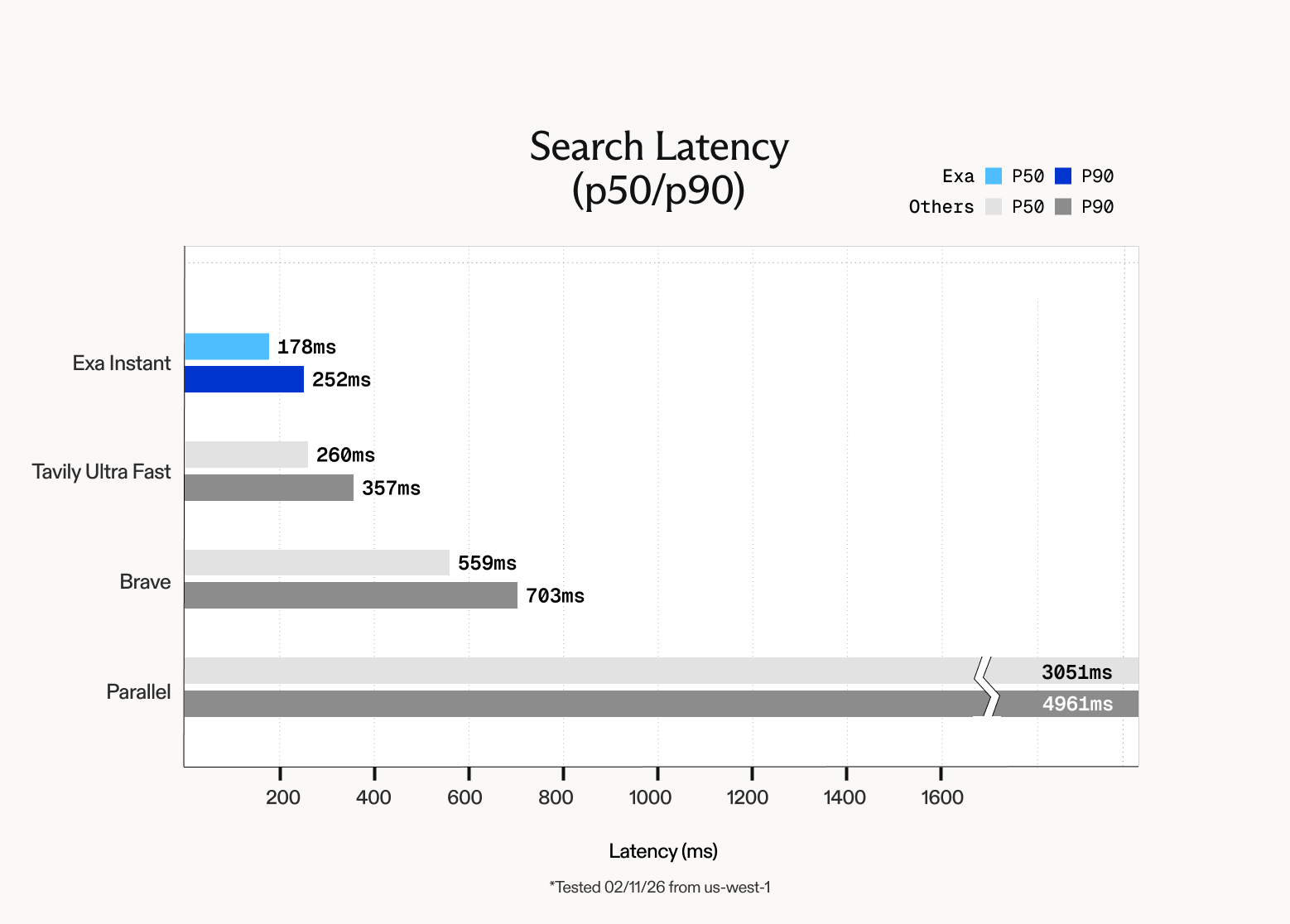
Exa 2.0 significantly enhances search capabilities with Exa Fast (sub-425ms P50 latency), Exa Auto (optimized balance of latency and quality), and Exa Deep (agentic retrieval for highest quality results). The underlying infrastructure includes a larger index (tens of billions of webpages refreshed every minute), a fine-tuned embedding model trained on a 144x H200 cluster using new embedding techniques, and a significantly updated in-house vector database with new clustering algorithms, lexical search optimizations, and advanced memory/speed optimizations including Matryoshka embeddings, binary quantization, optimized dot-product calculations with lookup tables, hardware register utilization, and clustering for efficient search. The system also supports efficient metadata filtering via inverted indexes and reranking for recall recovery.

1 post · 2024–2026

Timeline

20242026
Feature trailActive

Web Data Processing Framework

Exa has developed exa-d, a data processing framework designed to ingest and process the entire web at scale. It represents data transformations as a dependency graph of typed columns, enabling declarative updates and efficient, parallel execution. exa-d utilizes Lance on S3 for storage, allowing for precise, incremental updates at the fragment and column level, minimizing write amplification and supporting dynamic data modification for ML-driven features. This post details the construction of a framework that allows engineers to declare relationships between data, rather than the steps to update them, ensuring strict typing and catching invalid transformations early. The storage layer leverages Lance for fragment-level updates, enabling precise modifications without rewriting entire datasets. The execution layer focuses on efficient and parallel processing, scaling from tens to thousands of nodes and minimizing waste by computing only what is necessary.

1 post · 2024–2026

Timeline

20242026
Feature trailCooling

ML Compute Cluster Infrastructure

Exa has deployed a new, large-scale GPU cluster (the Exacluster) to power its ML research and training workflows. This infrastructure is built using a five-layer stack: Pulumi for Infrastructure as Code, Ansible/Kubespray for bare-metal build automation, NVIDIA GPU/Network Operators for hardware management, Alluxio for a distributed high-throughput cache, and Flyte for workflow orchestration. This setup enables efficient training of large neural network models, including retrieval models and rerankers, and allows for rapid iteration and scaling of ML workloads.

1 post · 2025

Timeline

20252026
Feature trailCooling

BM25 Index Optimization

Exa has significantly optimized its BM25 index, reducing memory overhead by over 50% across billions of documents. This was achieved through a combination of algorithmic improvements like smart candidate selection and dynamic pruning, and low-level memory structure optimizations. Key techniques include frequency-based organization, variable-length + delta encoding for document IDs, Zstd compression, consolidated buffers, singleton optimization, and further consolidation of buffers into a single consolidated buffer. This optimization has also led to a 10% average query latency drop.

1 post · 2025

Timeline

20252026
Feature trailQuiet since 2024

Real-time Embedding Serving

Exa has developed a high-throughput system for serving real-time embeddings, crucial for features like Exa Highlights. This system has evolved from Python to Rust, significantly improving performance and addressing bottlenecks related to CPU-GPU communication and GIL contention. The current iteration focuses on efficient parallel processing across multiple GPUs and optimizing CUDA operations to prevent fragmentation and out-of-memory errors.

1 post · 2024

Timeline

20242026