Blogs
Lyft logo

Lyft

Engineering blog · eng.lyft.com

12posts0this week0watchers

Feature trails

11
Feature trailActive

Neighborhood Reachability Signal

Lyft rebuilt its Neighborhood Reachability Signal dataset, which estimates travel times between geohash cells, to address outdated data from 2018-2019. The redesign focused on generating more accurate and complete ETAs by incorporating drivable geohashes derived from the road network data, implementing a gentler pruning strategy for geohashes based on rider sessions, and introducing new fields to allow downstream systems to shape the data. This resulted in improved marketplace operations, including more accurate pricing and supply heatmaps. The new system also moves towards time-aware travel times that change with the rhythm of the day.

1 post · 2026

Timeline

Feature trailActive

Analytics & Rides Intelligence Assistant (ARIA)

Lyft launched the production frontend for its AI-powered Analytics & Rides Intelligence Assistant (ARIA), enabling employees to explore ride analytics data through natural language. This involved migrating from a prototype Streamlit interface to a production-grade web client using Node.js and Next.js, integrating with Lyft's authentication, deployment infrastructure, and observability tools. The project also involved establishing Server-Sent Events (SSE) for real-time data streaming and improving the overall user experience.

2 posts · 2026

Timeline

Feature trailActive

Quasi-Experimental Causal Inference Platform

Lyft developed and continues to enhance its Quasi-Experimental Causal Inference Platform, which leverages Augmented Inverse Propensity Weighting (AIPW) models to estimate Average Treatment Effects (ATE) in scenarios where randomized experiments are not feasible. The platform emphasizes rigorous validation through mandatory confounder management, including pre-defined and customizable confounder sets with leakage prevention, and advanced diagnostics. Key features include propensity score correction, outcome reweighting to address downsampling bias, and a diagnostic scorecard with common support and covariate balance checks. The platform's performance is validated against A/B tests.

2 posts · 2026

Timeline

Feature trailActive

Metric Semantic Layer

Lyft built and launched an internal Metric Semantic Layer (MSL) as a Python package to standardize metric definitions. This layer provides a single source of truth for metric definitions, including plain-English descriptions and definitive SQL code, ensuring consistency across teams. It simplifies onboarding and change management through flexible YAML configurations and Jinja SQL templates, and enforces intentional governance with clear selection criteria for 'Golden Metrics' and a dual ownership model. The MSL is integrated with Amundsen for discoverability and a self-service UI for custom SQL generation. It also serves as a knowledge base for AI Agents and Skills, enabling natural language querying of metrics.

1 post · 2026

Timeline

Feature trailActive

Support Operations Ticketing System

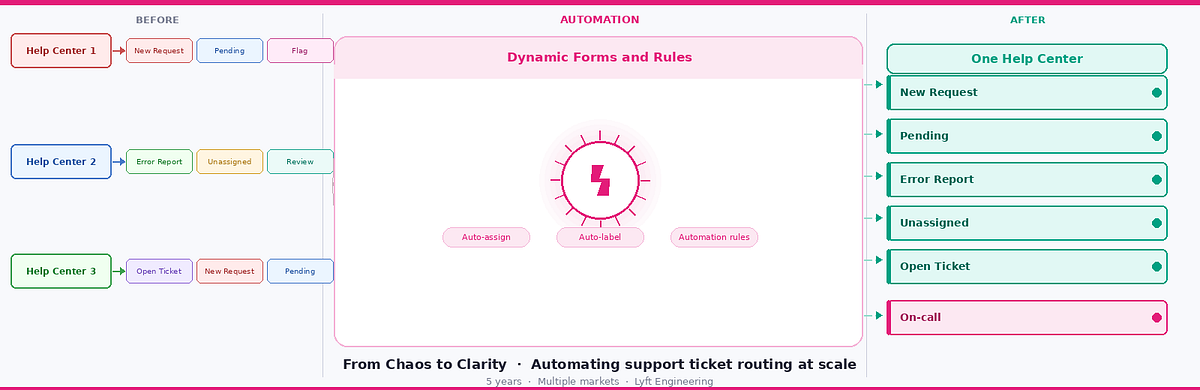
Lyft built and launched a unified, self-routing Support Operations Ticketing System. This system consolidated fragmented ticketing processes into a single, dynamic Help Center, leveraging Jira's Proforma for conditional logic in intake forms. It automates ticket routing, labeling, and PagerDuty alerts for P0 incidents. The system also incorporates ticket cloning and auto-linking to consolidate workflows from different Jira projects into the unified portal. Advanced visibility and analytics are provided through Jira Structures and a Mode ETL pipeline.

1 post · 2026

Timeline

Feature trailActive

Gated Community Pickup Experience

Lyft developed and launched an end-to-end solution to improve the pickup experience for riders in gated communities. This involved enhancing map data to identify gate areas and entrances, providing riders with smarter pickup spot selections (including options to meet drivers outside the gate), routing drivers to the correct gate as an intermediate stop, and implementing a streamlined system for riders to share gate access information (codes and instructions) at the right time. Privacy controls were implemented to protect rider data.

1 post · 2026

Timeline

Feature trailActive

Bayesian Trees for Rider Conversion Prediction

Lyft developed and implemented a novel modeling framework using Bayesian Trees to predict rider conversion in sparse data environments. This system addresses the challenge of data sparsity by leveraging a hierarchical tree structure and Bayesian smoothing with Gaussian priors. It allows for robust and accurate predictions even with limited data for specific contexts, while also ensuring behavioral consistency and interpretability by enforcing monotonic relationships where domain knowledge dictates.

2 posts · 2026

Timeline

Feature trailActive

AI-Powered Localization Pipeline

Lyft re-architected its localization pipeline to leverage AI, specifically Large Language Models (LLMs), to significantly reduce translation latency from days to minutes. This new pipeline involves a dual-path architecture where AI generates draft translations in parallel with human oversight. The process includes a 'Drafter' component for generating multiple translation candidates and an 'Evaluator' component that rigorously assesses these candidates for accuracy, fluency, brand alignment, and technical correctness. The system treats prompts as version-controlled production code and aims for a 30-minute SLA for 95% of batch translations.

1 post · 2026

Timeline

Feature trailActive

Lyft's Feature Store

Lyft's Feature Store is a core infrastructural pillar within its Data Platform, designed to optimize the management and deployment of ML features at massive scale. It centralizes feature engineering, guaranteeing uniformity across diverse models and workflows. The system streamlines feature creation, storage, low-latency access, and high-throughput processing for effective offline and online model training and inference. The architecture includes batch, online, and streaming feature components. This post details recent architectural evolution, performance tuning, and improvements in developer experience, including integration with Kyte for accelerated local development and enhanced feature governance through metadata and versioning.

1 post · 2026

Timeline

Feature trailActive

Python Memory Leak Debugging and Mitigation

Lyft engineers encountered and resolved a memory leak during a Python version upgrade from 3.8 to 3.10. The issue manifested as increased latency and frequent container restarts. The investigation involved using a custom memory profiling tool based on tracemalloc and identifying an incompatibility between gevent's monkey patching and urllib3's connection pooling, specifically related to weakref.finalize. Downgrading urllib3 to 1.26.15 resolved the issue. The post also details challenges with gunicorn's preload setting when using signal handlers.

1 post · 2025

Timeline

20252026