BlogsReplicate Feature Trails

Replicate logo

Replicate Feature Trails

See how major capabilities shipped, upgraded, and evolved across Replicate's engineering blog.

Feature trails

12

Image Generation Optimization

Active

Replicate has introduced support for Stable Diffusion 3 (SD3) and provides instructions for running it locally using ComfyUI. This involves installing Cog, cloning a ComfyUI repository, and running ComfyUI with specific commands to download weights and load an SD3 workflow. The post details the prerequisites and step-by-step process for users to generate images with SD3 on their own machines. This post extends this by showing how to push a custom version of SD3 to Replicate using Cog, enabling users to leverage models with specific aesthetic qualities like Krea 2, which offers distinct styles for portraits, cinematic frames, illustrations, and product shots with minimal prompting.

26 posts

Timeline

20222026

Video Generation Prompting and Control

Active

Replicate's Veo 3 model for video generation from text prompts has seen significant development in its prompting capabilities. This includes detailed guidance on structuring prompts to control visual elements like subject, context, action, style, camera motion, composition, and ambiance. A key focus is on achieving character consistency by repeating detailed descriptions across generations, as the model exhibits high similarity between runs with the same prompt. The platform also provides extensive examples and guides for advanced prompting techniques, including detailed sound design, intensity modifiers, camera movement descriptions, and focused scene composition. The latest iteration, Grok Imagine Video 1.5, further refines these capabilities, emphasizing realistic video with synchronized audio, complex motion handling, and precise prompt adherence. New prompting strategies for Grok Imagine Video 1.5 include detailed sound design sections, the use of intensity modifiers for scale, explicit camera movement descriptions, and keeping prompts focused on specific actions. The post also highlights the benefit of starting with a dialed-in still image and then using the video prompt to describe motion and changes.

4 posts

Timeline

20252026

Language Model Deployment and Fine-tuning

Active

Replicate continues to expand its support for large language models, now featuring an even wider array of models including Meta's Llama 3.1 (405B parameters) and Mistral 7B. The platform also highlights new tools and projects like OpenPlayground, AI Playground, and ShareGPT for comparing and experimenting with these models. The post provides detailed examples of how to run Llama 3.1 405B and Mistral 7B via API using JavaScript, Python, and cURL, including streaming output and model schema reference. This post introduces server-sent event streams for language models, enabling live updates in applications as models generate tokens. It provides examples for Node.js and cURL, and details how to add streaming support to custom Cog models by yielding tokens instead of returning a final result.

21 posts

Timeline

20222026

Document Parsing and OCR

Active

Replicate now offers advanced document parsing and text extraction capabilities through the integration of Datalab Marker and OCR models. Marker processes various document formats (PDF, DOCX, PPTX, images) into markdown or JSON, handling tables, math, and code, and supporting structured field extraction via JSON Schema. OCR detects text in 90 languages from images and documents, providing reading order and table grid data. Both models offer high performance, outperforming established tools like Tesseract, with Marker achieving up to 120 pages per second when batched. Performance benchmarks show Marker (Balanced mode) achieving an overall score of 82.7 ± 0.9 on the olmOCR-Bench, surpassing other models including GPT-4o and Deepseek OCR.

1 post

Timeline

20252026

Search API

Active

Replicate has introduced a new Search API to help users find models, collections, and documentation. This API provides enhanced search capabilities with richer metadata, including generated descriptions and tags. It is integrated into the TypeScript and Python SDKs, and the MCP servers, with sophisticated response filtering to optimize LLM context windows. The older search endpoint remains active but is deprecated in favor of the new API. This post introduces the Model Context Protocol (MCP) server, which allows language models to interact with Replicate's HTTP APIs. It details the MCP standard for tool use, provides examples of querying and running models via natural language, and introduces both hosted remote and local MCP server options. A key feature highlighted is JSON response filtering using `jq` via WebAssembly to manage large API responses and optimize LLM context windows. The hosted server leverages Cloudflare Workers for secure authentication and storage of Replicate API tokens.

2 posts

Timeline

20252026

Torch Compile Caching

Active

Replicate has implemented caching for `torch.compile` artifacts to significantly reduce model boot times for PyTorch-based models. This optimization caches compiled code across model container lifecycles, leading to 2-3x faster cold starts for models like those in the FLUX family. The system keys cache files on model version and stores them near GPU nodes, updating the cache upon graceful container shutdown. This has been further extended to dramatically improve cold boot times for fine-tuned models, reducing them to under one second by optimizing the loading and initialization process for models like Llama 2 and SDXL.

2 posts

Timeline

20232026

Video Style Transfer with LoRAs

Cooling

Replicate has introduced support for fine-tuning open-source video models, specifically adapting the Musubi Tuner for HunyuanVideo. This allows users to train custom video generation models on their own visual content, enabling personalized video stylization with in-motion style transfer. The process involves creating training data using a dedicated model (`zsxkib/create-video-dataset`), training the LoRA model on Replicate, and then generating videos via the browser, Playground, or API. This post highlights further advancements in fine-tuning experiments, including custom LoRAs for effects like "cakeify", "squish", and "dissolve" on Wan2.1, enabling flexible transformations and creative control over video generation. It also introduces specific LoRA trainers for Wan2.1, such as Ostris's and zsxkib's, facilitating fine-tuning with images and applying styles to existing videos. The post also notes upgrades to text-to-video models like Luma, which now generates 720p video faster, and Kling v1.6 Pro, which adds end frame support for enhanced control over video generation.

7 posts

Timeline

20232026

GPU Hardware Support and Migration

Cooling

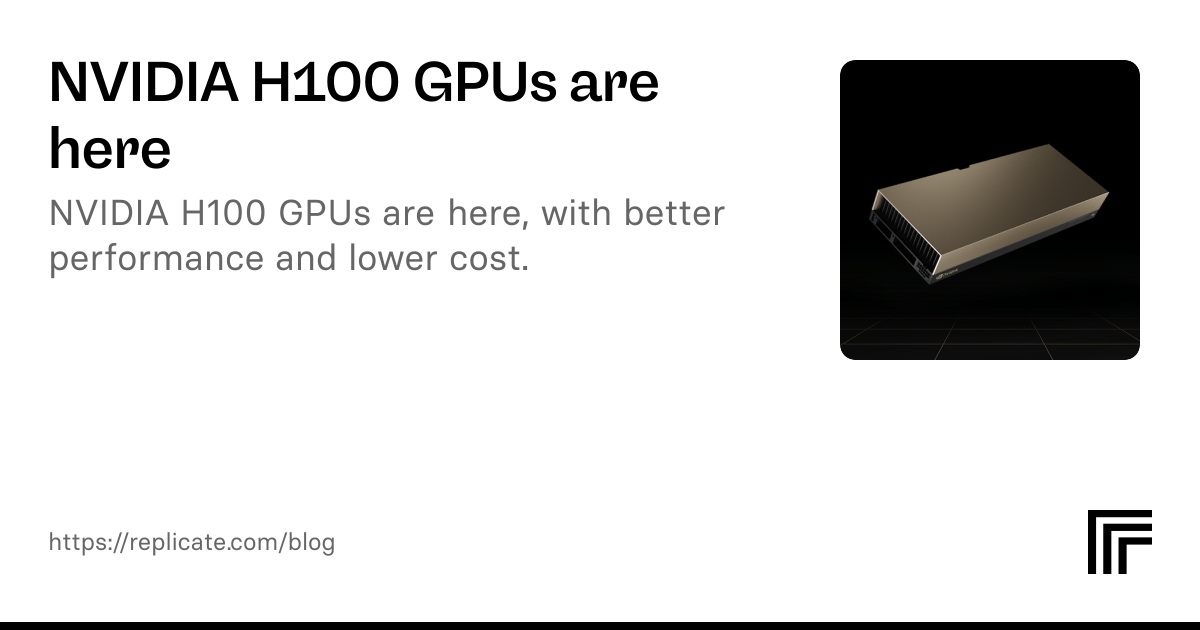
Replicate has introduced support for NVIDIA H100 GPUs, offering significant performance improvements. Additionally, multi-GPU configurations (2x, 4x, 8x) for A100 and L40S GPUs are now available for regular models and training runs, expanding beyond deployments. Pricing details for these new hardware options have been released, and users can now create models and update deployments to utilize H100s and the expanded multi-GPU setups via the web interface and API.

3 posts

Timeline

20242026

Network Security and Isolation

Quiet since 2024

Replicate has implemented enhanced network security measures for model containers, including encrypting all internal traffic and restricting privileged network access. This follows the disclosure of a vulnerability where model containers could eavesdrop on internal communications due to shared network namespaces and unencrypted traffic. The company has mitigated this by dropping NET_ADMIN and NET_RAW capabilities from model containers and encrypting all internal TLS traffic.

1 post

Timeline

20242026

Incident Response and Observability

Quiet since 2023

Replicate has launched a public status page and is publishing detailed incident reports to improve transparency and communicate system health. The first report details a significant outage on May 11th caused by connection pool exhaustion due to stacked INSERT queries on their PostgreSQL database, triggered by new asynchronous prediction update features. The incident highlights the challenges of complex systems failures, the interplay between performance improvements and new hazards, and the need for robust database connection management and lock contention analysis. The asynchronous update feature has been temporarily disabled and is being redesigned.

1 post

Timeline

20232026

Machine Learning Tooling and Deployment

Quiet since 2023

Replicate aims to democratize machine learning by providing tools and infrastructure that abstract away the complexities of GPUs, CUDA, and dependency management. The introduction of Cog, described as 'Docker for machine learning,' allows models to be packaged into standard containers for easy sharing and deployment. This enables software engineers, who significantly outnumber ML engineers, to integrate ML capabilities into their applications without deep ML expertise, similar to how web frameworks simplified web development. The platform hosts a library of open-source models and provides an API for running them, as well as a service for deploying custom models.

1 post

Timeline

20232026

Image Collection and Retrieval

Quiet since 2022

Replicate has introduced tools and techniques for automating image collection and retrieval, leveraging CLIP embeddings and k-NN search over large datasets like LAION-5B. This enables users to curate custom datasets for fine-tuning models, steer text-to-image generation with specific aesthetics, and find images similar to a given input image. The `clip-retrieval` Python package is highlighted as a key tool for this capability, with integrations into Replicate's platform for running text-to-image models using collected images as initialization.

1 post

Timeline

20222026