Bringing Sequential Testing to Experiments with Longitudinal Data (Part 1): The Peeking Problem 2.0
Jul 1, 2023Sebastian Ankargren (Sr. Data Scientist), Mattias Frånberg (Sr. Data Scientist), and Mårten Schultzberg (Sr. Manager/Staff Data Scientist)
Summary
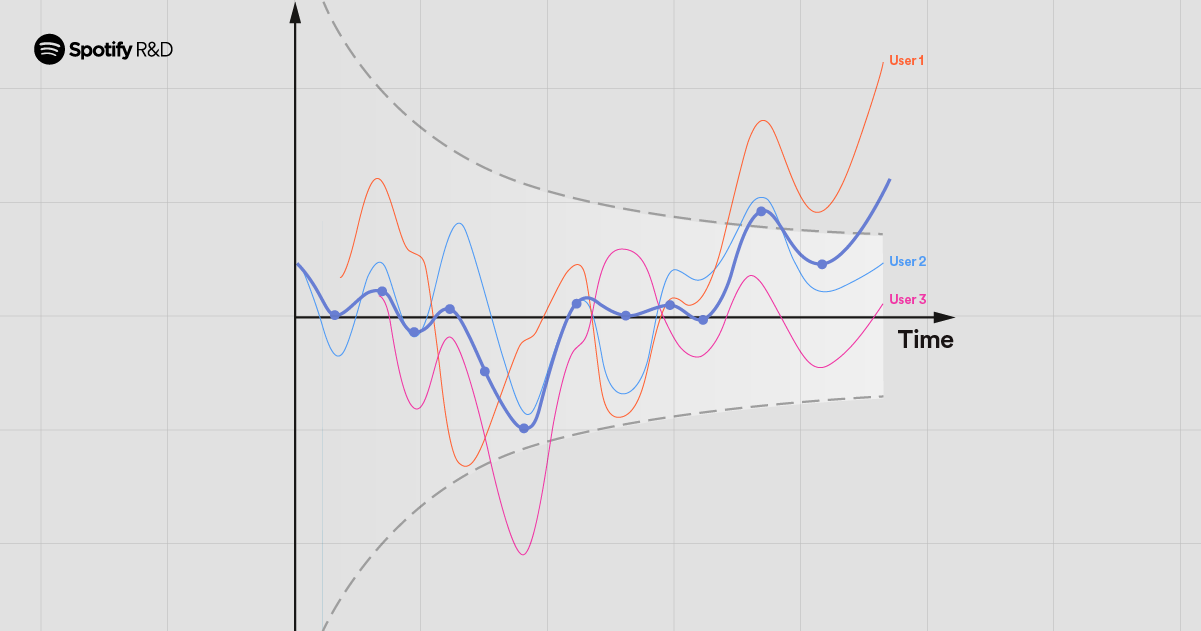
This post introduces the 'peeking problem 2.0,' which arises in sequential testing with longitudinal data (multiple observations per unit). It details the challenges of analyzing open-ended metrics where within-unit peeking can inflate false positive rates, even with sequential tests. The post outlines the need to separate measurements, metrics, estimands, estimators, and statistical tests, and uses potential outcomes notation to precisely define the statistical goal. It also includes a Monte Carlo simulation study demonstrating the inflated FPRs of standard sequential tests on open-ended metrics.
More from the Experimentation Platform trail
- Why Spotify Is Not Using Bayesian A/B Testing | Spotify Engineering
- When Can LLMs Replace Humans in A/B Tests? | Spotify Engineering
- Better Experiments with LLM Evals — A funnel, not a fork | Spotify Engineering
- Why We Use Separate Tech Stacks for Personalization and Experimentation
- Beyond Winning: Spotify’s Experiments with Learning Framework