Blogs
Coreweave logo

Coreweave

Engineering blog · coreweave.com/blog

172posts0this week0watchers

Feature trails

20
Feature trailActive

Agentic Workflow Infrastructure

CoreWeave enhances its AI infrastructure for scaling complex agentic workloads by integrating serverless reinforcement learning (RL), production inference at scale, fleet-wide observability for agents and infrastructure, and autonomous improvement to continually boost agent reliability using real-time data. This post details the integration of serverless RL for post-training LLMs, CoreWeave Inference for predictable production execution, W&B Weave for end-to-end observability and failure mode de. The post introduces CoreWeave Model Distillation for turning production signals into training data, a programmable training API for custom training loops, and RL Rollouts on CoreWeave Inference for seamless integration of inference into the training loop, enabling faster iteration and model improvement.

36 posts · 2026

Timeline

Feature trailActive

Distributed Training Resiliency

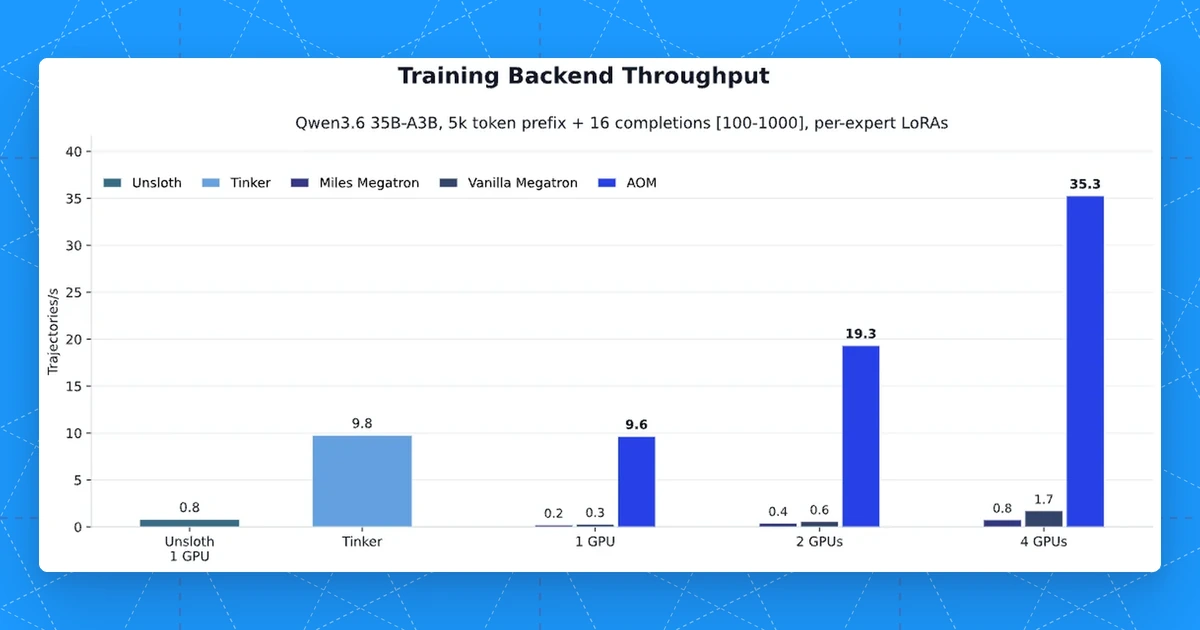
CoreWeave enhances its AI infrastructure for large-scale model training and inference by focusing on optimizing NVIDIA GPU clusters for both performance and reliability. This involves a multi-layered approach including bare-metal hardware, a dual-fabric network architecture (InfiniBand for compute, Ethernet for storage), topology-aware scheduling with automated node eviction and job rescheduling via SUNK (Slurm on Kubernetes), and optimized asynchronous checkpointing using Tensorizer. The SUNK system is further optimized with ART-Optimized Megatron (AOM), a new backend for the ART training library that achieves 12X higher training step throughput than previous backends by implementing shared prefix training, maximizing packed sequence length, and tuning parallelism configurations. This shared prefix approach, implemented using PyTorch's FlexAttention and custom GDN layer modifications, significantly increases trajectory density and reduces compute, memory, and memory bandwidth requirements per rollout, bringing performance closer to theoretical bounds.

23 posts · 2026

Timeline

Feature trailActive

Liquid Cooling Infrastructure

CoreWeave enhances its AI infrastructure by deploying NVIDIA Spectrum-X SN6600-LD liquid-cooled Ethernet switches, doubling per-rack network bandwidth to 1.64 Pb/s. This enables a non-blocking, multi-plane, multi-rail spine and leaf fabric for Vera Rubin NVL72 GPUs, reducing network latency and keeping GPU idle time near zero. The deployment integrates with CoreWeave Mission Control's Valvey and Racky for unified thermal management and operational control, and the Rack Lifecycle Controller (RLCC). This post details customer validation of the Vera Rubin NVL72 platform, showing a 4.8x increase in total token throughput for SWE-2 inference workloads and a 3.8x boost in output token throughput for Reinforcement Learning (RL) compared to previous generation GB200 NVL72, demonstrating the performance benefits of the new hardware and liquid cooling for agentic AI workloads.

13 posts · 2026

Timeline

Feature trailActive

AI Infrastructure Security

CoreWeave enhances its AI infrastructure security by integrating NVIDIA BlueField-4 DPUs for hardware-enforced tenant isolation, offloading security functions, and extending zero-trust principles. This provides enhanced performance, scale, security, and efficiency for AI workloads, with telemetry flowing into existing SIEMs and automated enforcement of security states. This post details the integration of federated identity management (SAML/OIDC) via CoreWeave IAM with existing IdPs (e.g., Microsoft Entra, Okta) for automated user provisioning (AUP) and authorization. It also introduces Remote Key Encryption (RKE) for encrypting data at rest using keys managed entirely within customer-controlled key stores (e.g., HashiCorp Vault, KMS, HSM), ensuring CoreWeave only handles ciphertext. RKE supports automated key lifecycle management (rotation, expiration, revocation) and integrates with existing KMS/HSM infrastructure.

4 posts · 2026

Timeline

Feature trailActive

ML Inference Benchmarking

CoreWeave enhances its AI infrastructure for scaling complex workloads, focusing on production inference and training performance. This post details the selection of NVIDIA GPUs for inference workloads, mapping specific GPU platforms (GB300 NVL72, GB200 NVL72, HGX B300, HGX B200, HGX H200, HGX H100, RTX PRO 6000 Blackwell Server Edition) to common inference patterns based on model size, context window, concurrency, batching behavior, latency SLOs, and deployment shape. It highlights the comparison of MLPerf® Inference v6.1 results across various models and NVIDIA platforms, demonstrating leading performance in throughput and efficiency for multimodal, MoE, and large language models on production clusters.

47 posts · 2025–2026

Timeline

20252026
Feature trailActive

AI Object Storage Cost Optimization

CoreWeave AI Object Storage (CAIOS) is generally available (GA) with enhanced performance and cost-efficiency for AI workloads. It integrates seamlessly with CoreWeave's NVIDIA GPU compute clusters, supporting performance up to 7 GB/s per GPU and scaling to hundreds of thousands of GPUs. The Local Object Transport Accelerator (LOTA™) caches frequently used data, achieving 7 GB/s per GPU throughput. New automated usage-based pricing levels (Hot, Warm, Cold) reduce storage costs by over 75% for ty. This post details configuration for LOTA caching, pre-staging, cross-region writes, and Archive tiering, providing Python examples for faster reads and writes at lower cost.

15 posts · 2026

Timeline

Feature trailActive

Data Center Expansion and Network Infrastructure

CoreWeave enhances its AI infrastructure by expanding its data center footprint with the opening of LGA1 in NYC, improving network infrastructure with ultra-low latency and high-bandwidth connectivity, and offering regional availability of GPU and CPU instances with high-performance storage. This expansion serves compute-intensive workloads across North America, leveraging purpose-built data centers for AI with superior networking services using NVIDIA Quantum-2 InfiniBand and Spectrum switches. The deployment of thousands of NVIDIA A40 GPUs further strengthens their offering for visual computing and AI workloads.

3 posts · 2026

Timeline

Feature trailActive

AI Cloud Infrastructure

CoreWeave enhances its AI infrastructure by integrating Red Hat AI Enterprise and NVIDIA Cloud Functions (NVCF) on its Kubernetes Service (CKS). This provides a supported path for running open-source inference stacks, including NVIDIA NIM microservices, on CoreWeave's bare-metal performance, observability, and automated node lifecycle management. The integration supports model serving gateways, distributed LLM serving, KV cache management, and various inference servers. This enables customers to build and deploy AI applications more efficiently. The platform now emphasizes the distinction between raw GPU capacity and a comprehensive AI cloud platform, highlighting the importance of orchestration, observability, security, and development tools. Diversification of the customer base across various industries is presented as evidence of platform depth beyond mere hardware provision. The platform aims to provide a durable foundation for AI innovation, moving beyond commodity GPU rental to a full-service AI cloud.

4 posts · 2026

Timeline

Feature trailActive

Customer Cloud Solutions

CoreWeave enhances its cloud solutions to cater to specific customer needs, focusing on scalability, security, and high-performance compute for demanding workloads. This involves providing tailored infrastructure, direct connections, dedicated storage, and upgrade options to enable customers to design, execute, and scale proprietary models efficiently. The goal is to deliver timely access to cutting-edge technologies in a fully managed fashion, leading to rapid deployment, increased compute, and improved collaboration for virtual production and other real-time rendering applications. The integration of WebRTC-based streaming allows for high-fidelity experiences to be rendered in the cloud and streamed directly to users, solving challenges of remote collaboration and on-set visualization.

15 posts · 2026

Timeline

Feature trailActive

Quant Research Infrastructure

CoreWeave enhances its AI infrastructure for quantitative research by providing mission-critical infrastructure that combines on-prem-grade determinism with cloud-scale elasticity. This includes bare-metal Kubernetes, Slurm integration, high-throughput storage and networking, proactive alerting, and immediate access to next-generation GPUs. The platform aims to deliver performance consistency, elasticity with control, reliability under load, and a first-mover advantage for quant teams, translating to faster model training and deployment.

8 posts · 2025–2026

Timeline

20252026
Feature trailActive

Model Context Protocol Integration

CoreWeave enhances its AI infrastructure by integrating the Model Context Protocol (MCP) to streamline the connection between models and real-world systems. This involves providing MCP documentation servers that allow agents to discover and interact with CoreWeave's Kubernetes infrastructure, deploy applications using Helm, create public endpoints, and verify outcomes. This aims to reduce bespoke glue code and enable more robust operational workflows for AI agents. The MCP server is now available, simplifying agent-to-infrastructure interaction.

1 post · 2026

Timeline

Feature trailActive

AI Workload Total Cost of Ownership (TCO) Evaluation

CoreWeave enhances its AI infrastructure by providing detailed guidance on evaluating the Total Cost of Ownership (TCO) for AI workloads. This involves a holistic approach that goes beyond simple GPU hour pricing to consider the full stack of compute, storage, networking, and orchestration. The focus is on translating GPU efficiency into economic efficiency through metrics like Model FLOPs Utilization (MFU) and Goodput, aligning storage architecture with GPU throughput requirements, and prioritizing performance consistency and scalability. CoreWeave ARENA is introduced as a production-ready AI lab for teams to run their actual workloads under production-like conditions, providing insights into performance, scaling, and cost over extended evaluation periods. It integrates with Weights & Biases for experiment tracking and CoreWeave Mission Control for operational visibility, supporting Kubernetes-native and Slurm-based workflows. The goal is to enable data-driven infrastructure decisions for AI workloads.

7 posts · 2026

Timeline

Feature trailActive

Serverless Kubernetes

CoreWeave SUNK (Slurm on Kubernetes) is enhanced with self-service capabilities and SUNK Anywhere for multi-environment deployment. This simplifies the creation and operation of AI research clusters by integrating Kubernetes primitives, schedulers, identity systems, and observability tools. New features include Automated User Provisioning (AUP) and SUNK User Provisioning (SUP) for streamlined access management, and GPU straggler detection for improved observability of distributed training performance. This post details the production-grade AI training capabilities of SUNK, emphasizing its intelligent, topology-aware scheduling, automated health management and failure mitigation, deep operational visibility, and unified lifecycle management. It highlights metrics such as up to 96% goodput, 10x longer MTTF for thousand-GPU clusters, and ~90 seconds to job restart, demonstrating its effectiveness at scale. The integration with CoreWeave Mission Control for continuous health management and observability is also emphasized.

1 post · 2026

Timeline

Feature trailActive

Concierge Render Product Updates

CoreWeave's Concierge Render platform continues to evolve, offering enhanced flexibility and efficiency for rendering workflows. Recent updates include a redesigned scheduler and render manager for multi-step processes, incremental file uploads with resume capabilities, and expanded hardware options with the latest NVIDIA GPUs. The platform now supports both CPU and GPU rendering, with integrated renderers like Blender Cycles, providing a robust solution for studios seeking cloud-agnostic render.

1 post · 2026

Timeline

Feature trailActive

GPU Rendering Performance Benchmarking

CoreWeave enhances its AI infrastructure by providing detailed benchmarks for GPU rendering performance on its platform, comparing it against other major cloud providers. This involves evaluating runtime and cost-effectiveness for VFX, animation, and design projects using tools like Conductor, Cinema4D, Redshift, and Arnold. The benchmarks highlight CoreWeave's advantages in offering a wider range of modern NVIDIA GPUs, consistent pricing, and faster instance spin-up times due to its bare-metal

7 posts · 2026

Timeline

Feature trailActive

Cloud XR Streaming

CoreWeave Cloud now offers NVIDIA CloudXR, enabling enterprises and end-users to stream virtual reality (VR), augmented reality (AR), and mixed reality (MR) content from any OpenVR XR application on a remote server—cloud, data center, or edge. This integration leverages CoreWeave's high-performance NVIDIA A40 GPUs and infrastructure, designed for compute-intensive use cases, to provide best-in-class immersive experiences and streaming capabilities.

1 post · 2026

Timeline

Feature trailActive

CPU Performance Enhancements

CoreWeave is enhancing its CPU infrastructure by offering new 4th Gen Intel Xeon Scalable processors. These processors feature built-in accelerators like Intel AMX, Intel DSA, Intel IAA, Intel DLB, and Intel SGX to boost performance, efficiency, and security across AI, analytics, networking, storage, and HPC workloads. This aims to provide faster spin-up times and improved overall performance for CPU-intensive tasks.

1 post · 2026

Timeline

Feature trailActive

Flexible Capacity Models

CoreWeave enhances its AI infrastructure with Flexible Capacity Plans, introducing Flex Reservations and Spot instances to better align with fluctuating AI workload demands. This post details 'Burst Compute', a model for on-demand GPU scaling across thousands of GPUs, enabling instant scaling up and down for workloads like batch simulations, inference, and VFX rendering. It highlights rapid spin-up times (as little as 5 seconds) enabled by container image caching and specialized schedulers.

6 posts · 2026

Timeline

Feature trailActive

Observability and Billing Integration

CoreWeave integrates with Datadog to provide enhanced observability and billing insights for its cloud platform, enabling users to monitor infrastructure stability, track resource consumption, and optimize costs.

1 post · 2026

Timeline

Feature trailActive

Scalable Pixel Streaming

CoreWeave enhances its AI infrastructure to support scalable Pixel Streaming applications for Unreal Engine creators. This involves leveraging CoreWeave's high-performance GPU cloud, Kubernetes-native infrastructure, and rapid auto-scaling capabilities to provide a cost-effective and accessible platform for deploying real-time interactive content. The integration with TensorWorks' Scalable Pixel Streaming (SPS) solution aims to simplify deployment and management of these demanding workloads, and CoreWeave's infrastructure is specifically designed for high-performance, compute-intensive workloads served on-demand with high availability, offering responsive auto-scaling and lightning fast spin-up times.

2 posts · 2026

Timeline