Blogs
Cursor logo

Cursor

Engineering blog · cursor.com/blog

78posts0this week0watchers

Feature trails

16
Feature trailActive

Bugbot Code Review Agent

Bugbot has evolved into a fully agentic design, allowing it to reason over diffs, call tools, and dynamically decide where to dig deeper. This shift has enabled more aggressive prompting for deeper investigation and richer experimentation with dynamic context. The agentic architecture also allows for direct iteration on the toolset itself, significantly impacting outcomes. Bugbot now reviews over two million PRs per month and is being extended with Autofix for automatic bug fixing and the ability to guide reviews using custom knowledge about the codebase via BUGBOT.md rules.

11 posts · 2025–2026

Timeline

20252026
Feature trailActive

Cloud Agents for AI Development

Cloud agents have evolved from simple extensions of local agents to sophisticated systems running on dedicated VMs with full development environments, the ability to test their changes, and produce artifacts. They can now run many in parallel, build and interact with software directly in their own sandbox, and iterate until they've validated their output. Reliability has been significantly improved by migrating to Temporal for durable execution. Agents can now control their own computers, enabli. This post introduces plugins, which bundle capabilities like MCP servers, skills, subagents, rules, and hooks that extend agents with custom functionality. These plugins allow agents to connect to external tools and learn new knowledge, spanning the product development lifecycle and enabling tasks like deploying services, implementing payments, and running advanced testing.

35 posts · 2024–2026

Timeline

20242026
Feature trailActive

Model Quality Evaluation Framework

Composer 2 builds on Composer 1.5 with significant improvements in intelligence and behavior, excelling at sustained long-running tasks, complex instructions, and collaborative interaction. Training advancements include scaling reinforcement learning 20x further, surpassing pre-training compute, and incorporating self-summarization for longer context handling. It demonstrates predictable intelligence improvements through scaled RL for coding. Composer is a mixture-of-experts (MoE) language model.

6 posts · 2025–2026

Timeline

20252026
Feature trailActive

Intelligent Model Routing

Cursor Router is an intelligent model routing system for teams and enterprises that automatically routes requests to the most capable and cost-effective model based on query, context, task complexity, and domain. It is trained on live request data and evaluated through online A/B tests to optimize for user satisfaction and cost savings. The router is cache-aware and designed to improve alongside the model frontier, with modes like Intelligence, Balance, and Cost to adjust the trade-off between p

2 posts · 2026

Timeline

Feature trailActive

MXFP8 Kernel Optimization for MoE Training

Warp decode is an optimization for MoE inference on Blackwell GPUs that reorganizes parallelism around outputs rather than experts, achieving 1.84x throughput improvement and better accuracy by reducing bookkeeping steps, eliminating intermediate buffers, and leveraging warp independence for efficient scheduling. This accelerates the research and training pipeline for Composer. This post details the implementation of custom MXFP8 kernels for MoE training on Blackwell GPUs, achieving significant performance gains by optimizing dequantization and quantization processes, and overcoming hardware-specific challenges like TMEM latency.

8 posts · 2025–2026

Timeline

20252026
Feature trailActive

Shadow Workspaces for AI Code Iteration

Introduced shadow workspaces to enable AI code iteration within a development environment without affecting the user's primary coding experience. This involves creating isolated, hidden instances of the development environment to allow AI agents to receive language server protocol (LSP) feedback and execute code independently. The initial implementation uses a hidden Electron window, with future plans for a kernel-level folder proxy. This post details the design criteria, the current hidden Elec

12 posts · 2023–2026

Timeline

20232026
Feature trailActive

Agent Sandboxing

Agent sandboxing has been rolled out on macOS, Linux, and Windows to provide agents with execution boundaries. Sandboxed agents run freely inside a controlled environment and only request approval when they need to step outside it, reducing interruptions and improving security. This involves dynamic policy generation for macOS using Seatbelt, direct use of Landlock and seccomp on Linux, and running Linux sandboxes within WSL2 on Windows. Agents are taught to use the sandbox by updating Shell tool descriptions and surfacing sandbox constraints in failure messages. This has led to a 40% reduction in agent interruptions and is being adopted by enterprise customers.

3 posts · 2026

Timeline

Feature trailActive

Visual Editor for Web Applications

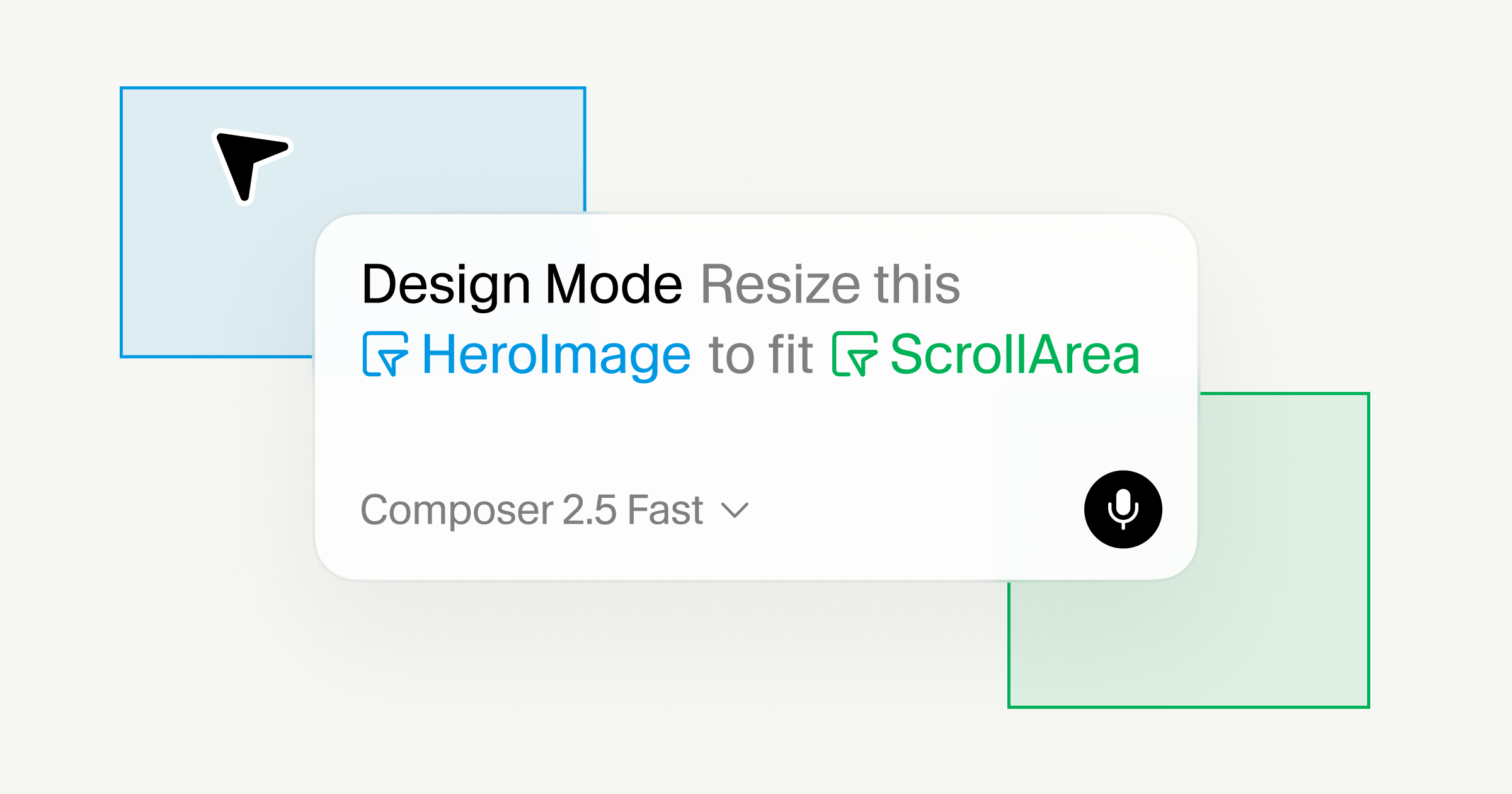
Introduced a visual editor for the Cursor Browser, integrating web app interfaces, codebase, and visual editing tools. This allows users to manipulate web page layouts and structures via drag-and-drop, test component states and properties directly, and fine-tune styles using visual controls. The editor also enables direct interaction with interface elements through natural language prompts, which are then translated into code changes by AI agents. This feature aims to bridge the gap between design and code.

2 posts · 2025–2026

Timeline

20252026
Feature trailActive

Application Stability and Memory Management

Introduced systems for observability on crashes and memory pressure, high-confidence fixes and optimizations for hot paths, and guardrails to catch regressions before they ship. Implemented dual debugging strategies (top-down and bottom-up) involving crash stack analysis, heap snapshots, and continuous heap allocation profiling. Developed targeted mitigations for acute and slow-and-steady OOMs, and leveraged process isolation for extension stability. Focused on preventing regressions through Bugbot rules, skills for stress testing, and eliminating footguns by replacing manually managed resources with garbage collection. Automated rollbacks on metric regressions are also employed.

1 post · 2026

Timeline

Feature trailActive

Cursor Tab Model Improvement with Online RL

Cursor Tab, a system predicting user actions in the codebase, has been significantly improved through the application of online reinforcement learning. This new model reduces the number of suggestions made by 21% while increasing the accept rate of the remaining suggestions by 28%. The system handles over 400 million requests daily, leveraging user interaction data to continuously refine its predictions. The core innovation lies in the frequent rollout of new models and the use of on-policy data. The Fusion model offers instant, higher quality cursor jumps, longer context windows (13000 tokens vs 5500), and lower server latency (260ms p50 vs 475ms).

1 post · 2025–2026

Timeline

20252026
Feature trailActive

Secure Codebase Index Sharing

Secure codebase index sharing has been enhanced with Merkle trees for efficient change detection and simhash-based vector search for reusing teammate indexes. Content proofs ensure local access, maintaining security and privacy. This system accelerates regex search for agent tools by indexing text using trigrams and inverted indexes, building upon existing secure codebase indexing capabilities.

2 posts · 2026

Timeline

Feature trailActive

Enterprise AI Agent Controls

Enterprise AI agent controls have been rolled out, offering organizations enhanced capabilities to observe, control, and extend Cursor's agent loop through custom scripts. These hooks can be integrated before or after defined stages of the agent loop, allowing for observation, blocking, or modification of agent behavior. This enables seamless integration with security tooling, observability platforms, secrets managers, and internal compliance systems via partnerships with ecosystem vendors. Sandbox Mode executes agent terminal commands in a restricted environment, blocking network access and limiting file access to the workspace and /tmp/ by default, with enterprise admin controls over sandbox availability and team-wide git and network access.

6 posts · 2025–2026

Timeline

20252026
Feature trailActive

AI Programming Problems

Cursor continues to push the boundaries of AI-programming by exploring advanced problem areas. This includes developing next-action prediction models for low-latency user intent execution, enabling perfect and multi-file edits through scaled inference compute and advanced reasoning, and optimizing context ingestion with multi-hop retrieval and novel codebase-level indexing. The team is also focused on improving bug detection and debugging capabilities through better calibration, AI code review, and agent sandboxing. NVIDIA has adopted Cursor to embed AI across every phase of the SDLC, leading to a three-fold increase in committed code and automation of core production workflows. This includes using Cursor for code generation, code reviews, generating test cases, QA, debugging rare bugs, and automating git flow (branch creation, code commits, CI debugging, issue tracking). Custom rules have been built to automate entire workflows, starting from pulling context from tickets and documentation to implementing bug fixes and running tests. This has also led to faster ramp times for new hires and enabled senior developers to tackle new challenges across different programming languages and tech stacks.

2 posts · 2023–2026

Timeline

20232026
Feature trailCooling

Java Language Server Protocol (LSP) Performance

Cursor is making a significant investment to improve Java support by building a dedicated team focused on enhancing the Java Language Server Protocol (LSP) performance. This includes contributing open-source improvements to the VS Code ecosystem and partnering with LSP authors from Red Hat, Microsoft, and IBM. Early results show 10% faster project imports and a reduction in debugger scans from over 5 seconds to under 200 ms in large codebases, addressing key scaling challenges for enterprise Java.

1 post · 2025

Timeline

20252026
Feature trailCooling

Character Prefix Conditioning for Code Completion

This post introduces character prefix conditioning, an algorithm for sampling tokens from a language model conditional on a character prefix, rather than a token prefix. This is crucial for accurate code completion where cursor position may not align with token boundaries. The goal is to minimize calls to the original language model while ensuring the output starts with the user's typed characters. This capability is foundational for accurate and seamless code completion.

1 post · 2025

Timeline

20252026
Feature trailQuiet since 2023

LLM Inference Cost and Performance Analysis

This post analyzes the inference characteristics of Llama, comparing its cost and latency to GPT-3.5. It details the mathematical underpinnings of transformer inference, including FLOPs and memory bandwidth calculations for both prompt processing and token generation. Key findings indicate that Llama is significantly cheaper for prompt-dominated tasks but more expensive for completion-heavy workloads compared to GPT-3.5. The analysis also touches upon memory requirements for KV cache and model weights.

1 post · 2023

Timeline

20232026