Blogs›Fireworks AI Feature Trails
See how major capabilities shipped, upgraded, and evolved across Fireworks AI's engineering blog.
Publishing pulse
2026–2026 · peak 2026
34 posts mapped

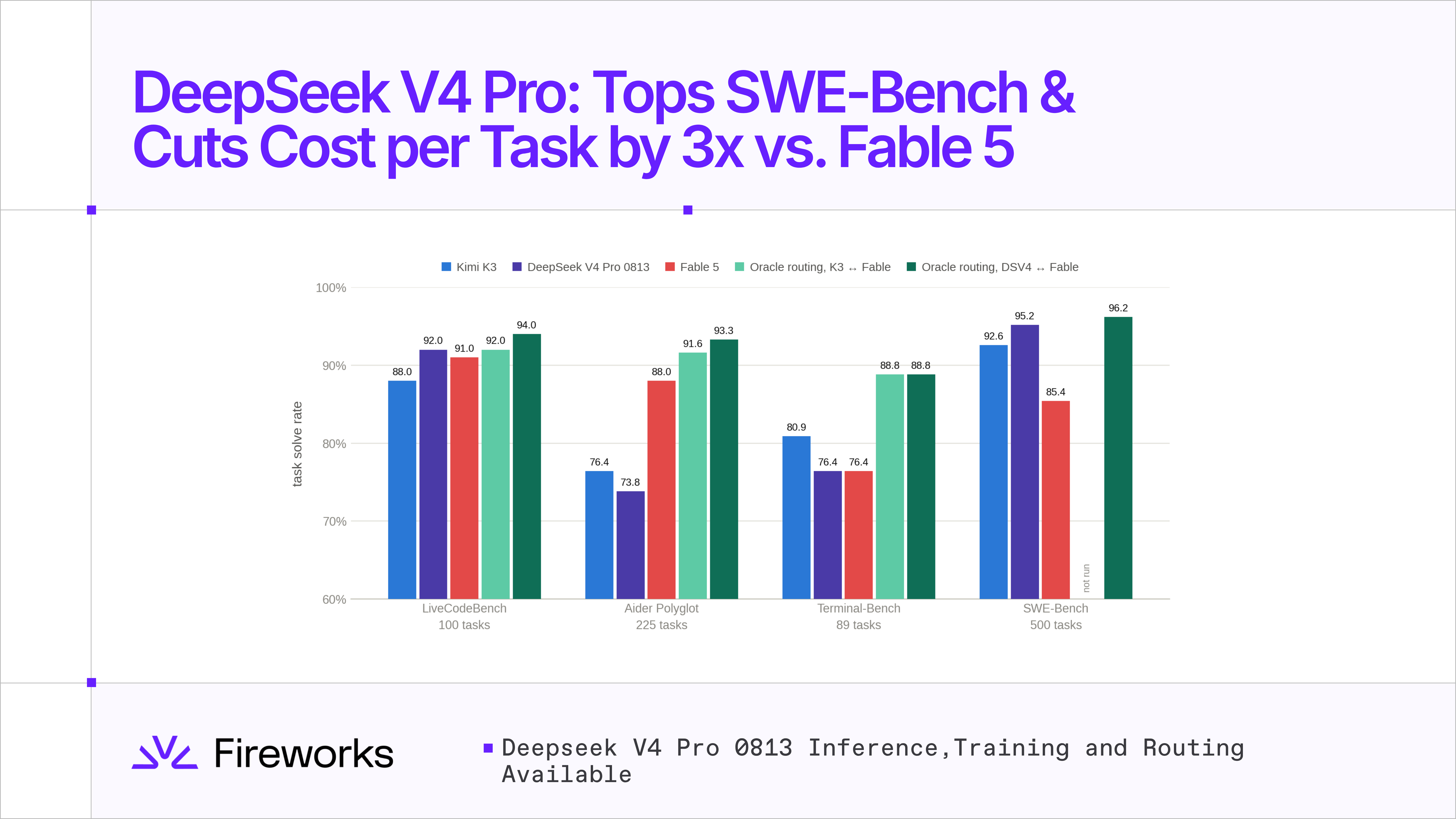
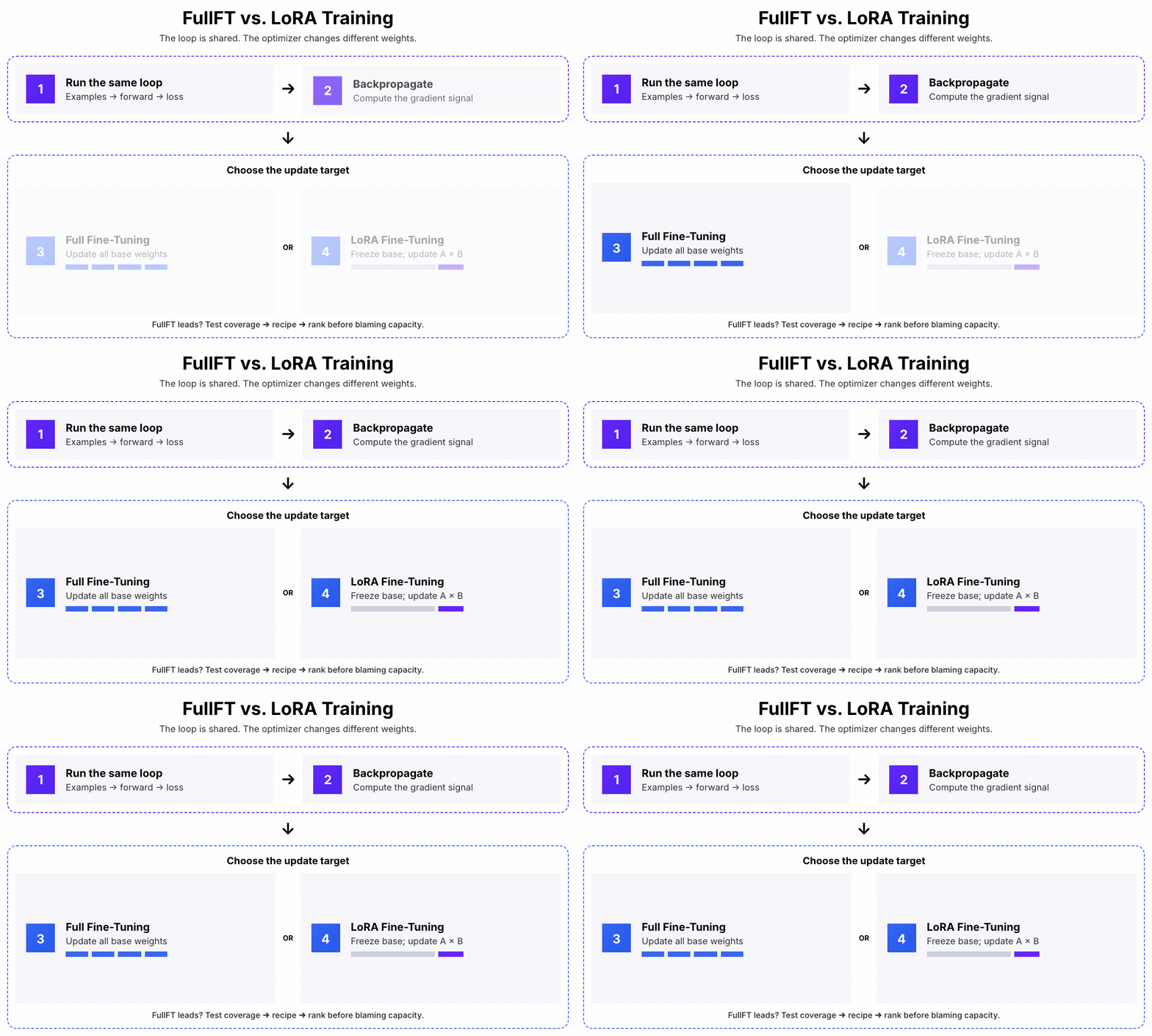
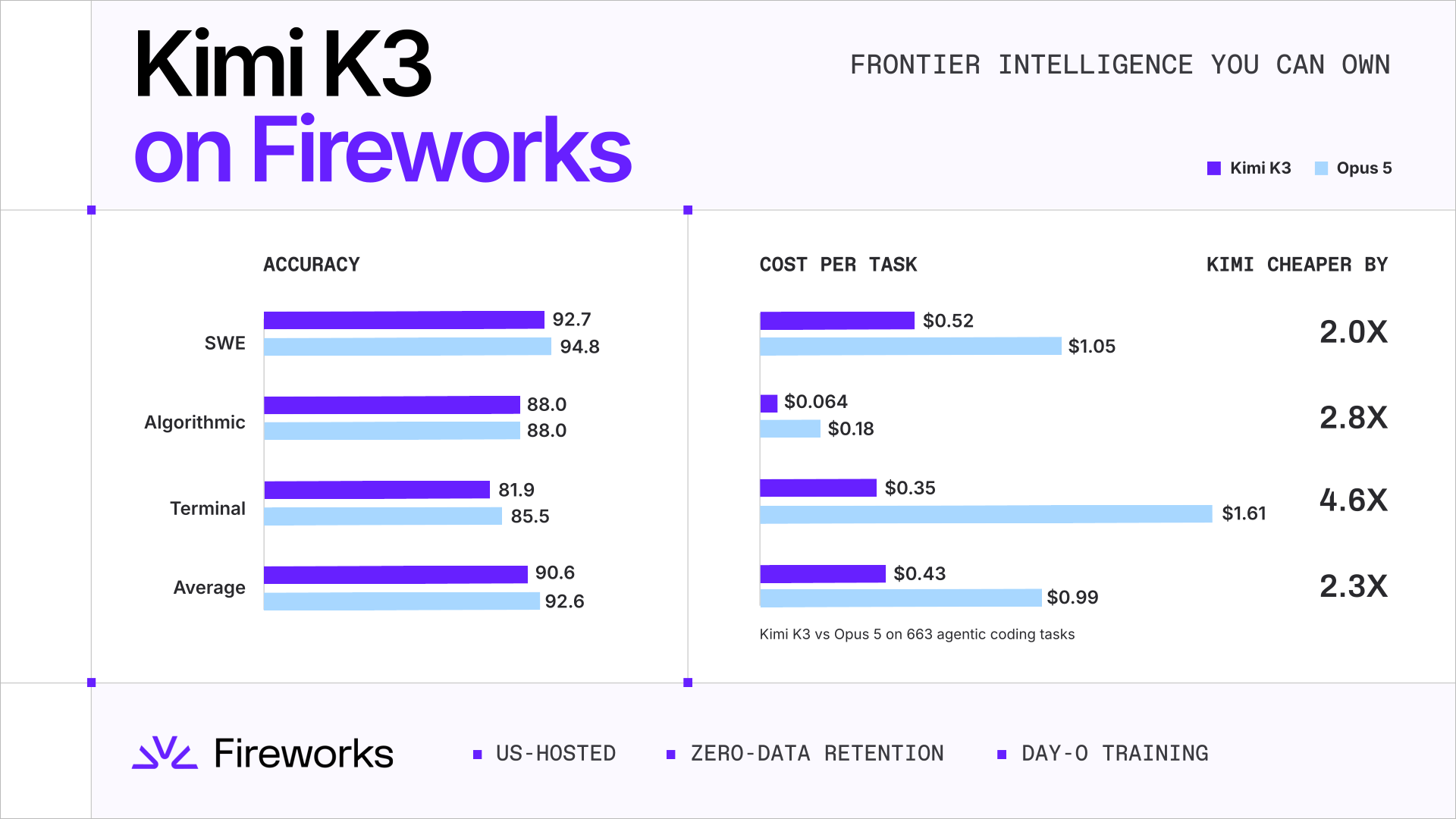
Introduced Kimi K2.7 Code, a 1T parameter model with a 256K context window, optimized for long-horizon agentic coding. It achieves higher coding benchmark scores while using approximately 30% fewer reasoning tokens than K2.6, leading to lower task completion costs. Kimi K3, a 2.8T parameter model with a 1M context window, is also discussed as a frontier model awaiting full weights and Fireworks listing. The post also covers GLM 5.2, DeepSeek-V4-Pro, DeepSeek-V4-Flash, MiniMax M3, Qwen3.7 Plus, and details experiments comparing LoRA and Full Parameter Fine-Tuning (FullFT) on Qwen3.5-9B. It outlines three tests to determine when to switch from LoRA to FullFT: data coverage, optimization (learning rate tuning), and adapter capacity (rank). The experiments showed that data coverage and learning rate tuning were often the primary drivers of performance differences, rather than just adapter size.
Timeline

Fireworks AI now offers its frontier-lab training infrastructure as a managed service, starting with GLM 5.2. This service provides end-to-end batch invariance and zero KLD alignment between training and serving, enabling reliable reinforcement learning on large models. Previously, these capabilities were exclusive to top frontier labs.
Timeline

Introduced a hybrid AI architecture combining open-source worker models with closed-source advisor models. This approach leverages the cost-efficiency of open-source models for task execution while utilizing frontier models for targeted review and quality assurance, demonstrating improved performance across various benchmarks like SWE-bench Pro, Terminal-Bench 2.1, and the Legal Agent Benchmark. This post details the application of this architecture to the Legal Agent Benchmark, showing how a GLM 5.1 worker can selectively invoke Claude Opus 4.7 as an advisor to improve outcomes and reduce costs compared to end-to-end frontier model usage. Additionally, it explores the impact of Fireworks-native post-training (SFT and RFT) on Kimi K2.6 for improving performance on the Legal Agent Benchmark.
Timeline

The billing system has been migrated from a postpaid to a prepaid model. Users can now purchase credits upfront, which are deducted as they use the platform. Auto-reload functionality is available to ensure continuous service. Contracted customers are unaffected.
Timeline

The inference platform now offers a "Deployment Readiness Scorecard" to evaluate models based on task accuracy, cost per successful task, and inference latency. It highlights the "Agent Execution Tax" as a key metric, representing wasted inference due to malformed output or retries. The platform's serving layer contributes to reducing this tax through structured output consistency and predictable latency, enabling more reliable agent deployments. Specific model profiles (GLM-5, MiniMax M2.5, Kimi K2.5) are provided with performance data on accuracy, cost, and latency in agentic tasks.
Timeline