Blogs›Meilisearch Feature Trails
See how major capabilities shipped, upgraded, and evolved across Meilisearch's engineering blog.
Publishing pulse
2025–2026 · peak 2026
47 posts mapped

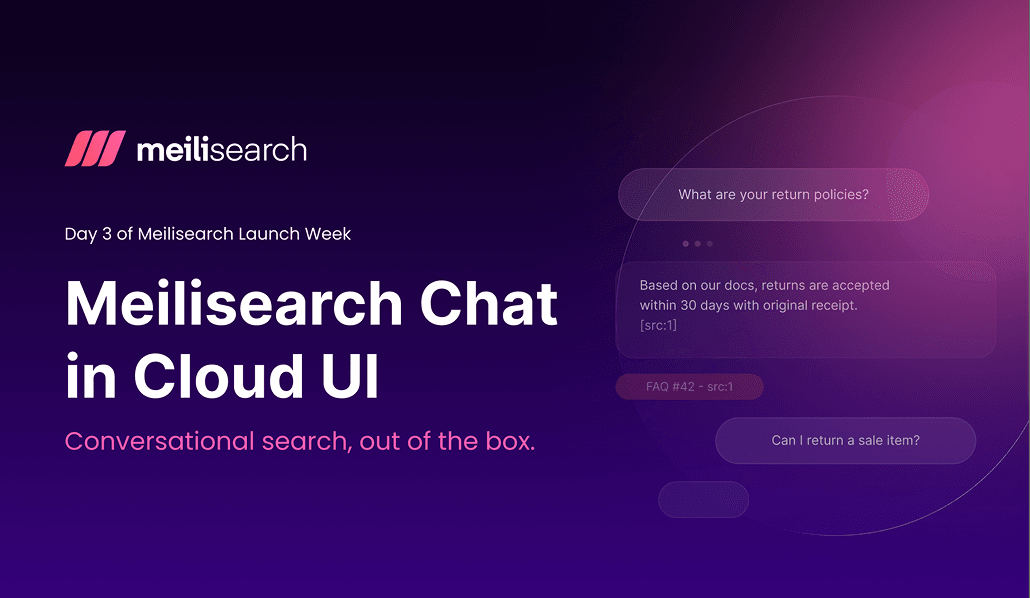
Meilisearch Chat has been enhanced with a Cloud UI for easier production readiness. This includes auto-generated system prompts and guardrails based on index data, an inspector tab for debugging RAG pipeline execution (tool calls, LLM messages, search queries, and retrieved documents), and an integrate tab with code snippets for application integration. The goal is to simplify the setup and debugging of RAG workflows for use cases like support portals, internal knowledge bases, and documentation. This post further enhances RAG capabilities by detailing 13 strategies for chunking data before storing it in a vector database, directly impacting retrieval accuracy. It covers fixed-size, sentence-based, semantic-based, paragraph-based, sliding-window, recursive, hierarchical, context-enriched, topic-based, modality-specific, agentic, subdocument, and hybrid chunking methods, along with advice on choosing the best strategy, best practices, performance evaluation, and common pitfalls.
Timeline

This post compares Meilisearch to Elasticsearch and Qdrant, highlighting Meilisearch's strengths in developer experience, ease of use, and out-of-the-box relevance for general search needs. It contrasts Elasticsearch's comprehensive search and analytics capabilities with its operational complexity and cost, and Qdrant's specialized vector search for AI applications with its focus on vector operations. Meilisearch is positioned as a solution for those seeking powerful search without significant operational overhead, offering hybrid search capabilities and flexible pricing. The post details the philosophical differences and primary use cases for each platform.
Timeline

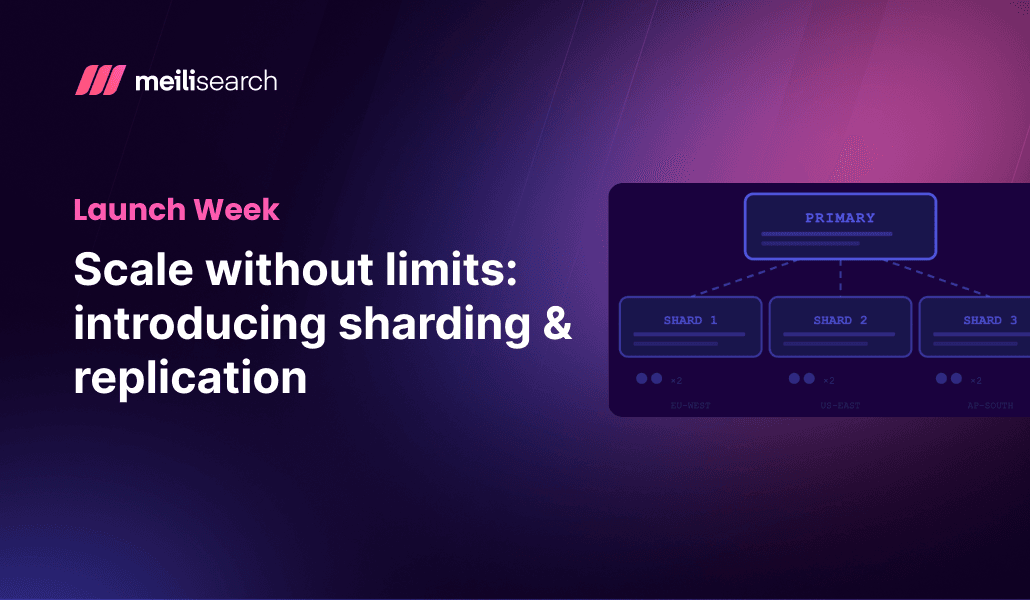
Meilisearch Cloud now offers sharding for horizontal scaling and replication for high read availability and geo-distribution. Sharding distributes data across multiple nodes, with queries fanning out and results merged. Replication keeps multiple nodes synchronized with the same dataset, enabling seamless failover during updates and geo-routing. These capabilities are composable, allowing for configurations like sharding-only, replication-only, or a combination of both for scalability and availa. Scenario leverages Meilisearch's capabilities to handle tens of millions of indexed assets and 35 million monthly searches, focusing on performance at scale, cost and operational overhead reduction, and meeting growing user expectations for faster, more relevant discovery. The implementation involves continuous indexing, custom embeddings for text and image search, and vector search integration for an "Exploration" feature.
Timeline

This post introduces RAG guardrails as a foundational element for trustworthy AI applications. It details what RAG guardrails are, why they are necessary to mitigate risks like hallucinations, data leakage, and prompt injection, and how they function across the RAG pipeline (pre-retrieval, during retrieval, and post-generation). The post also discusses tools that support guardrails (Guardrails AI, NVIDIA NeMo Guardrails, LangChain, OpenAI APIs), common metrics for measuring their effectiveness, best practices for implementation, and common mistakes to avoid. It highlights how Meilisearch's hybrid search and structured filtering capabilities contribute to robust RAG guardrails by ensuring contextual grounding and controlled data access.
Timeline

This post details the fundamental concepts and workflow of document indexing, explaining its importance for efficient information retrieval across various industries. It covers document ingestion, text processing, metadata extraction, and index building. The post also differentiates indexing from scanning, outlines common indexing methods (manual, metadata-based, OCR-based, automated), and discusses the types of information used for indexing. Challenges like inconsistent tagging, human error, and the need for robust query understanding are highlighted. Meilisearch's chat route is introduced as a native solution for intent understanding, automatically parsing natural language queries into structured search parameters by leveraging the existing data schema, thus reducing engineering effort for conversational search interfaces.
Timeline

Proximity search is a technique that improves search relevance by ranking documents where search terms appear close to each other. This capability allows for more context-rich matches by considering word order and distance between terms, going beyond simple keyword matching. It is implemented through various operators and is crucial for applications requiring nuanced result ranking, such as academic research, legal search, and AI-driven search experiences. Meilisearch's implementation complements this by providing efficient full-text search capabilities.
Timeline

Meilisearch has addressed an authenticated, blind Server-Side Request Forgery (SSRF) vulnerability in versions v1.8 to v1.34.0. The fix, implemented in v1.34.1, prevents Meilisearch instances from making requests to non-global IP addresses. For specific use cases requiring such functionality, an experimental parameter `--experimental-allow-ip-networks` is available, with a strong recommendation to review security implications and apply defense-in-depth principles. Meilisearch Cloud customers are unaffected.
Timeline