Blogs
Meilisearch logo

Meilisearch

Engineering blog · blog.meilisearch.com

51posts1this week0watchers

Feature trails

12
Feature trailActive

Retrieval-Augmented Generation (RAG) for Medical Data

Meilisearch Chat has been enhanced with a Cloud UI for easier production readiness. This includes auto-generated system prompts and guardrails based on index data, an inspector tab for debugging RAG pipeline execution (tool calls, LLM messages, search queries, and retrieved documents), and an integrate tab with code snippets for application integration. The goal is to simplify the setup and debugging of RAG workflows for use cases like support portals, internal knowledge bases, and documentation. This post introduces RAPTOR RAG, a hierarchical retrieval method that organizes document chunks into a tree structure for improved accuracy and performance in RAG systems, particularly for long documents.

21 posts · 2025–2026

Timeline

20252026
Feature trailActive

Sharding and Replication

Meilisearch Cloud is evolving to support large SaaS platforms with millions of tenants requiring per-tenant search isolation. This involves distributed search capabilities like sharding and replication for horizontal scaling and high availability, and the introduction of serverless indexes. Serverless indexes will significantly reduce costs by moving inactive indexes to object storage and only spinning them up when queried, making per-tenant isolation affordable at scale and enabling a real free. The engine now includes replicated sharding, a step towards one-click replication in the Cloud UI.

13 posts · 2026

Timeline

Feature trailActive

Search Engine Comparison and Positioning

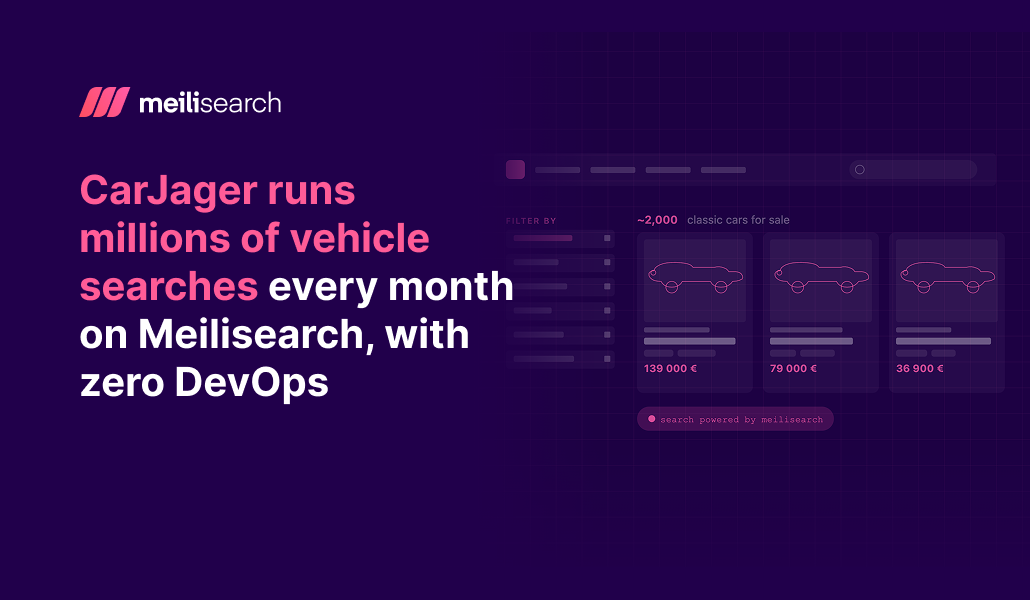
Meilisearch is positioned as a user-friendly, performant, and cost-effective alternative to complex search solutions. This post details CarJager's migration from Algolia to Meilisearch for their vehicle marketplace search. Key benefits include overcoming Algolia's hard sorting limits (1,000 entities per replica), enabling autoscaling for traffic peaks without dedicated DevOps, and a more favorable pricing model aligned with usage. The migration was phased, starting with lower-stakes content sear. Touchless uses Meilisearch to deliver fast, faceted inventory search across multi-location dealer marketplaces, integrating cleanly with their edge infrastructure and custom rendering engine. They switched from Algolia due to API flexibility, cost-efficiency, and seamless integration with their Cloudflare edge worker-based EXO platform. Each dealer group gets a dedicated Meilisearch index, with new ones spinning up in milliseconds. The system powers instant interactivity and infinite scroll for large dealer inventories.

1 post · 2025–2026

Timeline

20252026
Feature trailActive

Indexing Fundamentals

This post provides a comprehensive guide to building a search engine from scratch, detailing the core components: crawlers, indexers, ranking algorithms, and user interfaces. It emphasizes the benefits of building custom search solutions, such as customization, privacy, and learning opportunities. The guide also includes a practical walkthrough of setting up and using Meilisearch with Python to create a functional search engine, demonstrating its capabilities in handling indexing, searching, and typo tolerance. The post also touches upon programming language choices for search engine development, highlighting JavaScript and Python.

3 posts · 2026

Timeline

Feature trailActive

RAG Guardrails

Meilisearch Chat has been enhanced with RAG guardrails to ensure trustworthy AI applications. This includes structured controls for validating user input and constraining LLM outputs to prevent hallucinations, data leakage, and prompt injection. Guardrails are implemented across the RAG pipeline: pre-retrieval (query validation, prompt injection detection), during retrieval (data source management, metadata filtering), and post-generation (response accuracy, compliance). The post details tools like Guardrails AI, NVIDIA NeMo Guardrails, and integrations with LangChain or OpenAI APIs, and emphasizes the importance of search quality for effective guardrails. Meilisearch supports these guardrails through its fast hybrid search, structured filtering, metadata filtering for access controls, and schema-aware indexing for document consistency.

1 post · 2026

Timeline

Feature trailActive

Memory Allocator Optimization

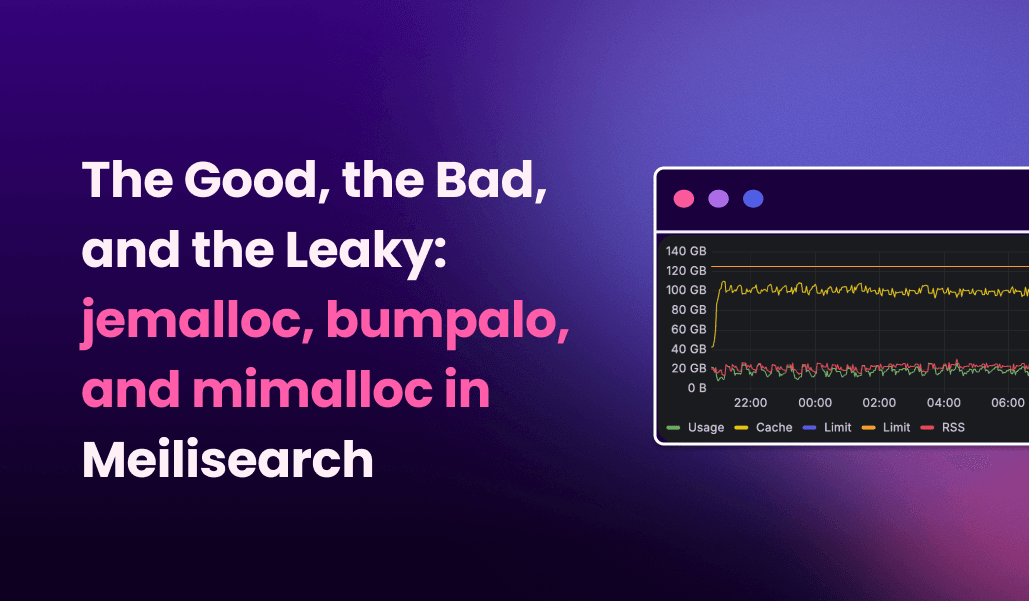
Meilisearch has undergone significant memory allocator optimization, moving from mimalloc v2 to mimalloc v3 and investigating the interaction with LMDB. This has resulted in reduced memory usage and improved performance, particularly on network-attached storage. The investigation revealed issues with allocator cooperation between Meilisearch and LMDB, leading to memory bloat. Unifying the allocator (mimalloc v3) resolved these issues and improved performance.

1 post · 2026

Timeline

Feature trailActive

Document Indexing

Meilisearch continues to evolve its document indexing capabilities, now supporting hybrid search that combines keyword matching with vector embeddings for enhanced asset discovery. This allows for more nuanced search experiences, enabling users to find assets not only by text but also by visual similarity. The platform handles continuous indexing of high-velocity data, custom embeddings, and integrates vector search for features like 'Exploration' to find similar assets. This evolution aims to p This post details text clustering as a method to organize unstructured data by grouping similar documents based on meaning. It covers the stages of text clustering: preprocessing, embedding (using TF-IDF, Word2Vec, BERT), and clustering algorithms (K-means, DBSCAN, hierarchical clustering). It highlights benefits like automated organization, discovery of hidden patterns, and better search results. A Python workflow is provided for building, visualizing, and evaluating clusters, with integration into Meilisearch for searchable clusters. Challenges such as high dimensionality, ambiguous language, and scaling are discussed, along with common mistakes like neglecting preprocessing and evaluation.

5 posts · 2026

Timeline

Feature trailActive

Search Engine Comparison

Meilisearch continues to be positioned as a user-friendly, performant, and cost-effective alternative to complex search solutions. This post compares Meilisearch's pricing and operational simplicity against Algolia's complex, tiered, and usage-based pricing, highlighting Meilisearch's suitability for teams seeking powerful search without complexity and vendor lock-in. It details Meilisearch's transparent pricing with subscription-based and resource-based options, including a free self-hosted option and cloud pricing starting at $30/month, contrasting it with Algolia's Build, Grow, Premium, and Elevate plans which involve complex metrics like search requests and records, and often require annual contracts and significant investment for advanced AI features.

13 posts · 2025–2026

Timeline

20252026
Feature trailActive

SSRF Vulnerability Fix

Meilisearch has addressed an authenticated, blind Server-Side Request Forgery (SSRF) vulnerability in versions v1.8 to v1.34.0. The fix, implemented in v1.34.1, prevents Meilisearch instances from making requests to non-global IP addresses. For specific use cases requiring such functionality, an experimental parameter `--experimental-allow-ip-networks` is available, with a strong recommendation to review security implications and apply defense-in-depth principles. Meilisearch Cloud customers are protected.

1 post · 2026

Timeline