Blogs
OpenAI logo

OpenAI

Engineering blog · developers.openai.com/blog

28posts0this week0watchers

Feature trails

7
Feature trailActive

Agentic Execution Environment

This post continues the evolution of OpenAI's capabilities for building and running long-horizon, knowledge-work-oriented agents. It focuses on refining how agents interact with their environment through improved skills and `AGENTS.md` configurations, specifically for more capable models like GPT-5.6 Luna. The Responses API provides a structured loop for reasoning and acting, preserving the model's reasoning state across turns, emitting multiple output items (tool calls, structured outputs, intermediate results). This iteration demonstrates moving agentic capabilities from a development machine to a dedicated embedded device (Raspberry Pi) for real-time, interactive applications like a voice-controlled LED display, integrating local audio processing, wake word detection, and rendering services.

18 posts · 2025–2026

Timeline

20252026
Feature trailActive

AI-Assisted Content Generation and Documentation

This post continues the evolution of OpenAI's capabilities for leveraging AI models to assist in the creation, refinement, and translation of technical content and documentation. It details how Dagster Labs uses Codex to accelerate documentation, translate content across mediums, and measure documentation completeness. Key aspects include using CONTRIBUTING.md files as structured input for AI, leveraging Codex for code explanation and PR review, and utilizing the monorepo structure for comprehensive context. The post also explores using Codex to generate code from documentation as a measure of coverage and to translate content between mediums like tutorials and video transcripts.

11 posts · 2025–2026

Timeline

20252026
Feature trailActive

AI-Assisted Game Development

This feature thread tracks the evolution of OpenAI's capabilities for leveraging AI models to assist in the creation and development of complex software systems, specifically focusing on game development. Initially, this involved using models like Astra to translate high-level concepts into gameplay mechanics, art direction, and technical implementation details. The process includes AI-driven prompt refinement, architectural proposal, and the generation of test cases and validation tools. Subsequent updates have focused on enhancing the AI's ability to generate detailed 3D assets, environments, and even interactive elements, as demonstrated by the architectural visualization project which used Astra to create detailed 3D scenes in Blender and Unreal Engine, iterating on architecture, furniture, materials, and lighting based on user prompts and visual feedback. The system now supports generating complex, lived-in environments with detailed objects and responsive materials, and can be directed to produce camera tours and detailed material studies.

1 post · 2026

Timeline

Feature trailActive

Codex Security

This post continues the evolution of OpenAI's capabilities for enhancing cybersecurity defenses through AI-powered tools and workflows. It details the integration of ChatGPT, Codex Security, and the open-source Codex Security CLI to streamline the process of working through a security backlog. New workflows include investigating findings in ChatGPT, reviewing pull requests with Codex Security Review, conducting repository-wide investigations with the Codex Security plugin, setting up continuous analysis with Codex Security cloud, triaging existing alerts, and generating verified fixes. The post also emphasizes building security checks into existing tools via the CLI and SDK, and introduces a bulk-scanning workflow for multiple repositories and large codebases.

1 post · 2026

Timeline

Feature trailActive

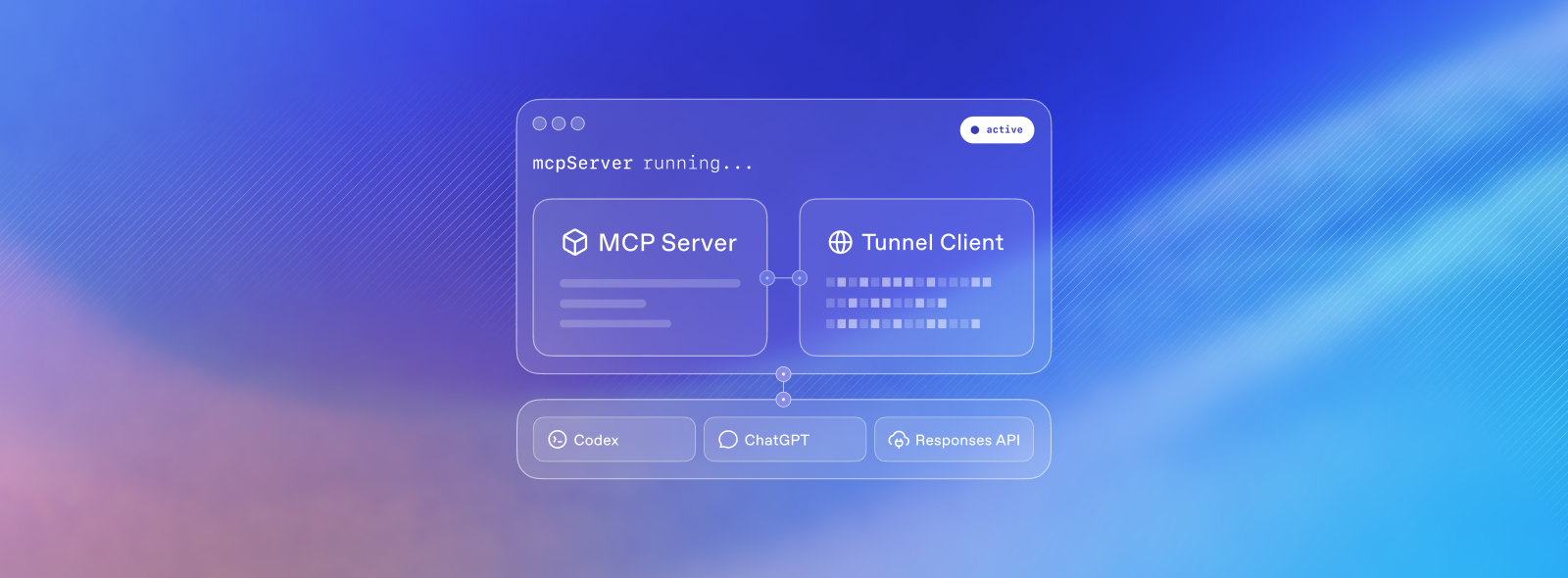
Secure MCP Tunnels

This feature thread tracks the evolution of OpenAI's capabilities for securely connecting private MCP servers to hosted AI products. Initially, the focus was on enabling private servers to be reachable without exposing them to the public internet. This involved developing the Secure MCP Tunnel, which allows customers to run a client within their private environment that establishes an outbound HTTPS connection to OpenAI. The client receives MCP requests, forwards them to local servers, and returns responses and notifications through the same connection. This post extends the capability to support REST APIs via Harpoon, allowing controlled access to non-MCP private services without opening inbound network access.

1 post · 2026

Timeline

Feature trailActive

AI-Powered Voice and Audio Capabilities

This post continues the evolution of OpenAI's AI-powered voice and audio capabilities, encompassing speech-to-text, text-to-speech, and real-time speech-to-speech interactions. The Realtime API and its associated speech-to-speech model have graduated to General Availability (GA) with significant improvements in model quality, reliability, and developer ergonomics. Key updates include API shape changes with a new GA interface, removal of the `temperature` parameter from the GA interface due to its unique behavior with this model architecture, and the introduction of several new features. These new features include conversation idle timeouts for better turn detection, extended session lengths (up to 60 minutes) and larger token windows (32,768 tokens) for the `gpt-realtime` model, configurable truncation settings for managing long conversations and their impact on prompt caching, asynchronous function calling with placeholder responses for improved UX, EU data residency support, enhanced tracing capabilities in the developer console, hosted prompts for easier prompt management and versioning, and sideband connection options for secure server-side logic integration via WebRTC or SIP.

3 posts · 2025–2026

Timeline

20252026
Feature trailActive

AI-Assisted Frontend Development

This feature thread tracks the evolution of OpenAI's capabilities for leveraging AI models to assist in the creation of high-quality, visually appealing, and functionally complete frontends. Initially, the focus was on improving model understanding of UI capabilities, image integration, and the use of tools for inspection and verification. Subsequent updates have concentrated on enhancing the model's ability to produce production-ready frontends with subtle touches, well-crafted interactions, and seamless integration with design tools like Figma. This post introduces the Figma MCP server, enabling bidirectional synchronization between Figma designs and code generated by Codex, facilitating a fluid roundtrip workflow for UI development.

1 post · 2026

Timeline