BlogsCerebras Feature Trails

Cerebras logo

Cerebras Feature Trails

See how major capabilities shipped, upgraded, and evolved across Cerebras's engineering blog.

Feature trails

7

Disaggregated AI Inference

Active

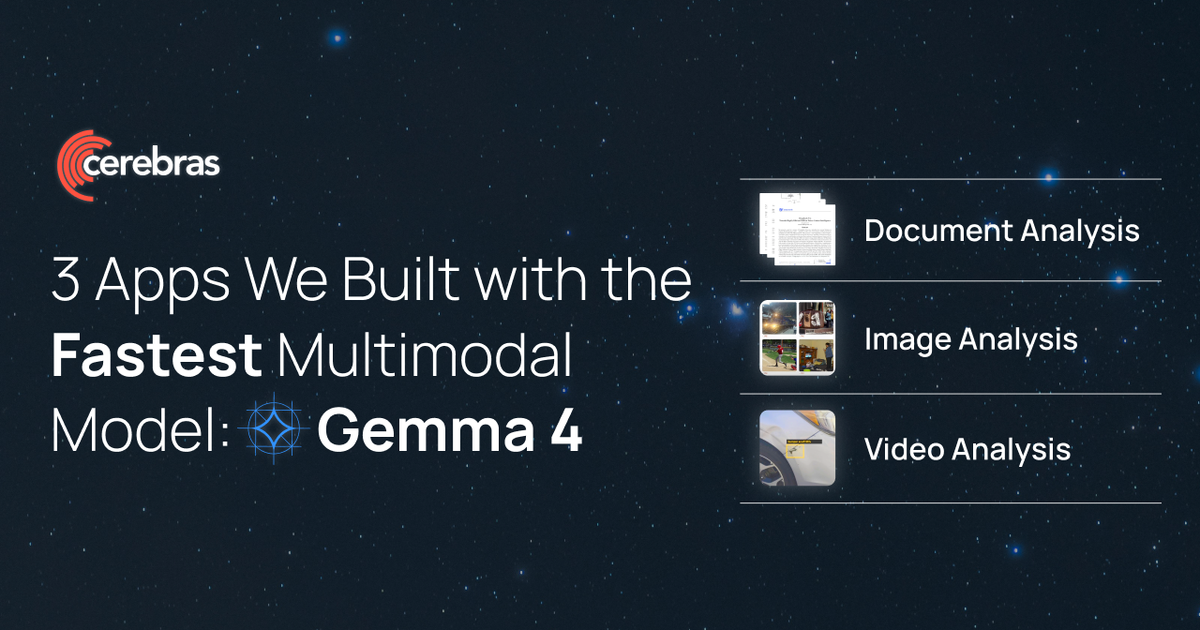
This post details advancements in AI inference latency optimization and its application to cybersecurity. It explores how faster inference enables deeper reasoning, more context retrieval, and enhanced validation within security workflows, both for AI-driven security products and for securing AI applications themselves. The post highlights a tiered architecture where initial classification is fast, with more complex reasoning escalated to powerful models. Cerebras's wafer-scale architecture is particularly effective for multimodal models like Gemma 4, achieving over 1,800 tokens per second and enabling real-time, agentic workflows by combining image understanding with high-speed text generation. This extends the platform's capabilities to new product experiences such as screenshot-to-insight, long-context summarization, and screenshot-to-patch generation.

9 posts

Timeline

AI-Assisted Engineering Interviews

Active

This post details the adaptation of Cerebras's technical interview process to incorporate AI tools. It outlines how interviews now resemble real engineering tasks, with candidates expected to use AI for implementation, debugging, and testing. The evaluation focuses on AI collaboration skills, including problem framing, verification, and ownership, rather than just the final code. The goal is to identify engineers who can leverage AI effectively and responsibly in an AI-native environment.

1 post

Timeline

Autonomous Agent Loops with Verification

Active

This post introduces the concept of autonomous agent loops that leverage multimodal inputs (eyes), tools (hands), large context windows (memory), and improved reasoning (brain) to achieve verifiable goals. It highlights the critical role of verification in preventing loops from spiraling or cheating, and demonstrates a practical application in generating 3D CAD instructions from an image using Gemma 4 on Cerebras hardware. The post emphasizes the importance of specific prompting and explicit constraints for effective loop design.

1 post

Timeline

AI Inference Latency Optimization

Active

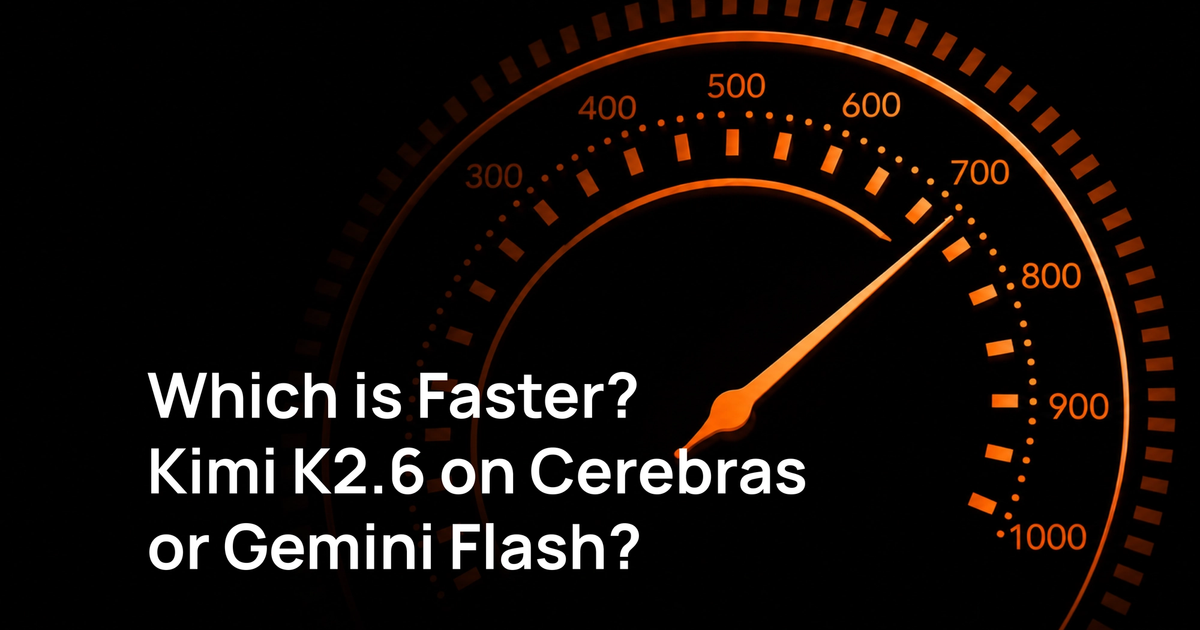
This post details advancements in AI inference latency optimization and the application of autoresearch for autonomous experimentation. It explores how autoresearch can be used to optimize training and inference, and discusses the challenges and best practices for its implementation. The post introduces the Implicit Chain Transformer (ICT) architecture for improved state tracking in LLMs and showcases how autoresearch can be applied to model compression and dynamic expert swapping for efficient inference. This post further compares the inference speed of Kimi K2.6 on Cerebras hardware against Google's Gemini 3.5 Flash, demonstrating significantly higher tokens per second, faster end-to-end response times, and lower latency for real-time voice applications, highlighting Cerebras's advantage in high-speed inference by leveraging on-chip model storage.

25 posts

Timeline

20252026

Multi-Agent Figma Design Generation

Active

This post details advancements in AI-assisted UI generation, focusing on improving the quality and control of AI-generated designs. It explores techniques for setting clear intentions, leveraging design systems like shadcn/ui with MCP integrations, and using Tailwind CSS for enforcement. The post highlights the benefits of faster iteration cycles enabled by faster models and vision capabilities, and discusses methods for generating specific effects and mockups. It also touches upon the use of AI in interviewing for style guide creation and the importance of prompt engineering for achieving desired outcomes.

3 posts

Timeline

Clinical Variant Interpretation Benchmark

Active

ExomeBench is a new benchmark for clinical variant interpretation in exome regions, designed to help researchers evaluate and improve models for health-relevant predictions. It includes five supervised classification tasks derived from ClinVar, focusing on pathogenicity, phenotype association, and gene attribution. The benchmark provides a standardized, reproducible dataset with baseline results and experimental artifacts to support transparent evaluation.

1 post

Timeline

SWE Agent Data Collection and Execution Environment

Active

This post details the technical journey in transforming OpenHands from a SWE-Bench evaluation tool into a general-purpose RL training platform capable of handling thousands of diverse Python repositories. The system dynamically loads arbitrary Docker images, parses metadata at runtime, and executes tests in containerized environments with full isolation. A unified workflow maintains a persistent runtime context, eliminating container duplication and reducing overhead by ~95%. This enables multi-turn interaction support, fast rollout generation, sparse reward evaluation, and comprehensive trajectory logging, providing all essential components for training code-repair agents via RL.

2 posts

Timeline

20252026