Blogs
Cerebras logo

Cerebras

Engineering blog · cerebras.ai/blog

149posts0this week0watchers

Feature trails

25
Feature trailActive

Broadening Access to Fast AI Inference

This post details advancements in broadening access to ultra-low-latency AI inference, making it broadly accessible through Cerebras's ecosystem. It highlights the company's focus on pairing unmatched speed with ecosystem scale, offering support for a wide range of open models, expanding cloud availability through self-serve and enterprise-ready procurement, and integrating deeply into the modern AI toolchain. Integrations span agentic frameworks, chatbot platforms, container tools, coding tools, and enterprise research platforms like AlphaSense, which leverages fast inference for interactive agentic workflows by decomposing complex research tasks into smaller, specialized model calls for planning, retrieval, and evidence evaluation while maintaining responsiveness.

5 posts · 2025–2026

Timeline

20252026
Feature trailActive

AI for Cybersecurity Inference

This post details how faster AI inference speeds can provide a competitive advantage in cybersecurity. It discusses two main areas: AI for Security (using AI to improve detection, investigation, etc.) and Security for AI (protecting AI applications themselves). The post highlights a tiered architecture pattern where initial filtering is done by simpler models, with more complex reasoning models used as an escalation point. Faster inference is crucial at both levels to maintain responsiveness and enable rapid response to evolving threats. Cerebras's platform offers significant speedups for these AI-powered cybersecurity workflows.

2 posts · 2026

Timeline

Feature trailActive

Autonomous Agent Loops with Verification

This post details advancements in autonomous agent loops, emphasizing the critical role of verification in achieving reliable and effective AI-driven task completion. It highlights the evolution from early, unverified loops to more disciplined approaches incorporating tests, builds, and external checks. The post introduces the concept of 'eyes' (multimodal models, computer vision) and 'hands' (CLIs, plugins, harnesses) enabling agents to interact and inspect their environment. It stresses the importance of a robust execution environment for AI-generated code, leveraging tools like Docker Compose and Playwright MCP for controlled interaction and verification. The system automates QA for the Cerebras Cloud Console by using an LLM agent to drive a real browser, interpreting plain English test descriptions, and self-healing flaky tests due to UI drift. It also automates test generation from PDFs and UI baselines, assesses PR coverage, and acts as a release gate by scoring risk and drafting release notes. The architecture is skill-based, scalable via EKS pods, and employs a strict separation between AI proposals and deterministic execution for safety.

7 posts · 2025–2026

Timeline

20252026
Feature trailActive

AI Inference Latency Optimization

This post details advancements in AI inference latency optimization by enabling LLMs to efficiently leverage extended contexts through strategic planning and iterative steps to access and integrate relevant information from extended data sources. This approach, ReadAgent, effectively manages and processes information beyond inherent context windows, supporting long-context tasks by decomposing complex tasks and utilizing iterative planning steps. It achieves improved performance on long-context tasks. Cerebras DocChat, a new iteration of models for document-based conversational QA, is released. Cerebras Llama3-DocChat was trained in hours on a single Cerebras System, and Cerebras Dragon-DocChat was fine-tuned in minutes. These models incorporate insights from research on document-based Q&A, synthetic data generation for unanswerable questions, Chain of Thought for arithmetic tasks, and instruction tuning for entity extraction. The models and training recipes are open-sourced.

52 posts · 2025–2026

Timeline

20252026
Feature trailActive

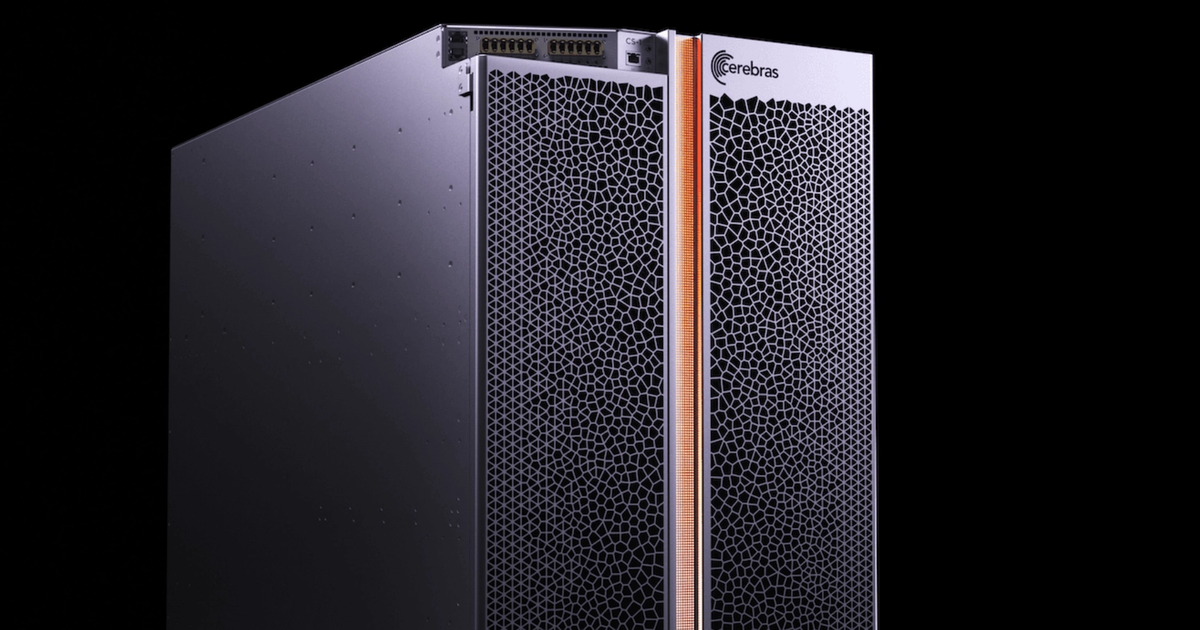
Wafer-Scale AI Accelerator Architecture Evolution

This post details the evolution of Cerebras's wafer-scale AI accelerator architecture, focusing on the WSE-3. It highlights the cluster-scale capabilities within a single chip, featuring 900,000 AI cores and 27 PB/s aggregate fabric bandwidth. The design incorporates a disaggregated memory architecture with MemoryX, enabling up to 1.2PB of external memory for trillion-parameter models. The CS-3 system is a 15U server consuming up to 23kW of power, offering 125 petaflops of AI performance and significantly improved scalability with up to 2048 systems linked via SwarmX interconnect. It can train models up to 24 trillion parameters and offers 2x performance over CS-2 at the same power and cost. The Condor Galaxy 3 supercomputer, powered by 64 CS-3 systems, exemplifies exa-scale performance with single-device simplicity. Cerebras also partners with Qualcomm for accelerated inference.

1 post · 2025–2026

Timeline

20252026
Feature trailActive

Disaggregated AI Inference

This post details advancements in disaggregated AI inference, splitting prefill and decode onto different machines, potentially using heterogeneous hardware. This architecture aims to significantly improve throughput per kilowatt and reduce latency, especially tail latency, by optimizing hardware for each phase of LLM inference. The partnership with AWS, utilizing Trainium for prefill and Cerebras CS-3 for decode, is highlighted as a key enabler of this new paradigm, offering substantial improvements. This post further details hardware-aware training and fine-tuning techniques (Microscaling Mx formats, speculative sampling, unstructured sparsity) to optimize LLM inference on Qualcomm Cloud AI 100, aiming for up to 10x acceleration by reducing memory footprint and compute requirements without impacting accuracy.

37 posts · 2025–2026

Timeline

20252026
Feature trailActive

Large Model Training on Cerebras Hardware

This post details advancements in using Maximal Update Parameterization (μP) to improve AI model training stability and efficiency across different model scales. μP enables stable hyperparameters, reduces tuning costs, and improves loss at large scale by ensuring training dynamics are invariant to model width. This leads to more predictable scaling and robust research by alleviating the 'Parameterization Lottery'. The post provides a practical guide to μP's mathematical underpinnings and implementation, including a port to nanoGPT.

42 posts · 2025–2026

Timeline

20252026
Feature trailActive

AI-Assisted Engineering Interviews

This post details advancements in the adaptation of Cerebras's technical interview process to incorporate AI tools. Interviews now resemble real engineering tasks, with candidates expected to use AI for implementation, debugging, and testing. The evaluation focuses on AI collaboration skills, including problem framing, verification, and ownership, rather than just the final code. The goal is to identify engineers who can leverage AI effectively and responsibly in an AI-native environment. The post emphasizes that AI assistance does not lower the hiring bar but allows for a more comprehensive evaluation of an engineer's ability to navigate ambiguity, make tradeoffs, and deliver reliable software.

2 posts · 2025–2026

Timeline

20252026
Feature trailActive

Interactive Frontend Development Companion

This post details advancements in AI-assisted UI generation, focusing on improving the quality and control of AI-generated designs. It explores techniques for setting clear intentions, leveraging design systems like shadcn/ui with MCP integrations, and using Tailwind CSS for enforcement. The post highlights the benefits of faster iteration cycles enabled by faster models and vision capabilities, and discusses methods for generating specific effects and mockups. It also touches upon the use of AI as an intermediary tool that elevates, reinterprets, and broadens the creative perspective, emphasizing intention-setting and iterative refinement with AI. Specific methods include using design systems like shadcn/ui with MCP, defining design tokens and Tailwind configurations for enforcement, and iterating with small, specific changes informed by visual feedback.

1 post · 2025–2026

Timeline

20252026
Feature trailActive

Multi-Agent Figma Design Generation

This post details advancements in AI-assisted UI generation, focusing on improving the quality and control of AI-generated designs. It explores techniques for setting clear intentions, leveraging design systems like shadcn/ui with MCP integrations, and using Tailwind CSS for enforcement. The post highlights the benefits of faster iteration cycles enabled by faster models and vision capabilities, and discusses methods for generating specific effects and mockups. It also touches upon the use of AI agents for orchestrating design tasks and improving the efficiency of frontend development workflows. The latest iteration focuses on using multi-agent orchestration to parallelize the process of cloning website designs into Figma, significantly reducing the time required and improving the consistency and accuracy of the generated designs.

3 posts · 2026

Timeline

Feature trailActive

SWE Agent Data Collection and Execution Environment

This post details the integration of Cerebras inference with Docker Compose to create isolated and reproducible environments for AI-generated code. It introduces DevDuck, a multi-agent system that leverages Cerebras for code generation and Docker Compose for orchestrating components and sandboxing code execution. This enables developers to build and evaluate new code quickly while keeping experiments isolated and repeatable, balancing speed, cost, and safety. The post also details the transformation of the execution environment to support agentic workflows.

3 posts · 2025–2026

Timeline

20252026
Feature trailActive

Clinical Variant Interpretation Benchmark

This post details the release of ExomeBench, a reproducible benchmark for clinically relevant variant interpretation in exome regions. It includes five supervised classification tasks derived from ClinVar, focusing on pathogenicity, phenotype association, and gene attribution. The benchmark provides a standardized, reproducible dataset with baseline results and experimental artifacts to support transparent evaluation and model development in clinical genomics.

2 posts · 2026

Timeline

Feature trailCooling

LLM Dataset Curation and Processing

This post details advancements in LLM dataset curation and processing, introducing SlimPajama, a 627B token, extensively deduplicated, multi-corpora open-source dataset for training large language models. It details the process of cleaning and deduplicating the RedPajama dataset, removing 49.6% of bytes to improve data quality and compute efficiency. The post also releases the tools developed for this process, enabling community use for creating high-quality, deduplicated datasets at trillion-to-scale. The processing pipeline involved optimizations for distributed, multi-threaded, and memory-efficient MinHashLSH deduplication on trillion-token datasets, including rewriting parts of the datasketch library.

1 post · 2025

Timeline

20252026
Feature trailCooling

Conversational AI Latency and Throughput

This post details advancements in conversational AI, focusing on reducing latency and improving throughput for natural voice interactions. Norby leverages Cerebras' inference capabilities to achieve significant reductions in conversational response latency, enhance language switching, and speed up conversation summary processing. The system also utilizes Cerebras for incremental and parallelized reasoning during conversational pauses, enabling dynamic integration of reasoning throughout the conversation. OpenCall further demonstrates these benefits by integrating Cerebras' LLM inference API to achieve a 90% reduction in overall latency for their AI contact center, leading to faster resolutions and improved customer satisfaction.

1 post · 2025

Timeline

20252026
Feature trailCooling

Wafer-Scale Manufacturing Yield and Defect Tolerance

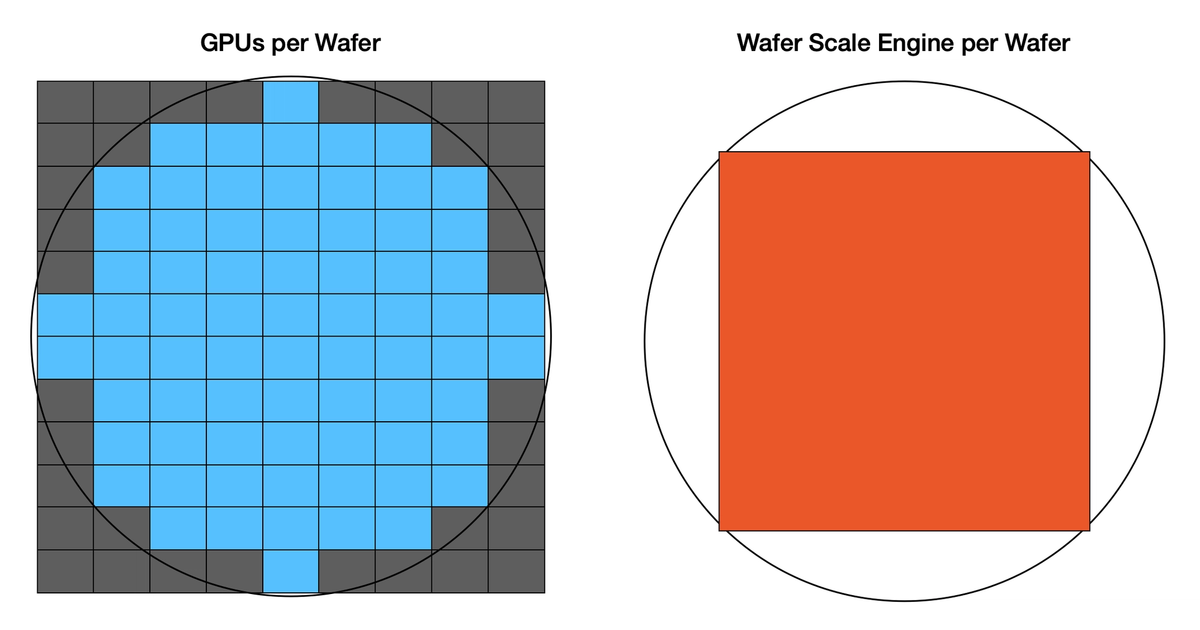
This post details advancements in wafer-scale manufacturing yield and defect tolerance. Cerebras achieves high yields for its wafer-scale processors by implementing advanced defect tolerance mechanisms. Key to this is the design of extremely small, fault-tolerant AI cores, approximately 100x smaller in affected silicon area per defect than traditional GPU cores. This, combined with a sophisticated, dynamically reconfigurable routing architecture, allows the system to route around defects and utilize 93% of silicon area, higher than leading GPUs.

1 post · 2025

Timeline

20252026
Feature trailCooling

Wafer-Scale Field Equation Modeling

This post details advancements in wafer-scale processing for computational physics and engineering simulations, specifically molecular dynamics and materials modeling. It introduces the Wafer-Scale Engine (WSE) Field-equation API (WFA) and demonstrates its application in achieving exascale performance for molecular dynamics simulations, running 800,000-atom simulations 180 times faster than Frontier. The WSE's architecture, with its high fabric bandwidth, single-cycle core-to-core latency, fine-grained computation, and energy efficiency, is highlighted as a key enabler. The WFA provides a simple Python API for programming these simulations, making wafer-scale processing accessible to a wider range of computational scientists. The updated post highlights real-time computational fluid dynamics (CFD) simulations achieved with the WSE, enabling manipulation of nearly 200 million cells in near real-time, opening up new use cases for HPC applications.

9 posts · 2025

Timeline

20252026
Feature trailCooling

High-Resolution Computer Vision Training

The Cerebras CS-2 system enables training large deep neural networks on high-resolution images (up to 50 megapixels) without the need for downsampling or tiling, overcoming GPU memory limitations. This allows for richer contextual information to be leveraged in computer vision tasks such as medical imaging and remote sensing, leading to improved accuracy and insights. The system's on-chip SRAM and weight-streaming capabilities are key enablers. This release extends support to UNet for 2D segmentation with images up to 5K x 5K pixels, a size not supported out-of-the-box on GPUs today. Additionally, performance for GPT-style models is improved by up to 1.5x, and training with unstructured sparse weights is now available in PyTorch, enabling users to convert dense checkpoints to sparse versions for reduced FLOPs and faster iteration.

1 post · 2025

Timeline

20252026
Feature trailCooling

Cerebras SDK for HPC

The Cerebras SDK enhances usability and performance for the Wafer-Scale Engine (WSE) with new collective communications primitives (broadcast, scatter, gather, add-reduce), improved generics support in CSL for IEEE floating point functions, low-level task prioritization features, and an early version of a new host runtime offering over 4x data transfer speed improvements. New examples include Cholesky decomposition and GEMV, showcasing collective communications and the debug library. This release (1.1.0) adds initial support for WSE-3.

2 posts · 2025

Timeline

20252026
Feature trailCooling

Appliance Mode for LLM Training

Appliance Mode simplifies and streamlines the process of training large language models (LLMs) on Cerebras Wafer-Scale Clusters. It abstracts away the complexities of distributed job launching, resource management, and parameter tuning, allowing users to focus on model research and results. This mode supports both pipelined and weight streaming execution, enabling training of models from small to extremely large sizes with minimal code changes. It integrates seamlessly with standard Python environments and allows for push-button linear scaling up to 192 CS-2 systems.

2 posts · 2025

Timeline

20252026
Feature trailCooling

PyTorch Support on Cerebras Wafer-Scale Engine

This post details advancements in PyTorch support on the Cerebras Wafer-Scale Engine (WSE), specifically with the release of CSoft 1.2. This version extends support for PyTorch 1.10.2 using a lazy tensor backend with XLA for optimal mapping of full model graphs onto the WSE-2. It enables users to train, evaluate, and fine-tune a wide range of NLP models with significantly higher performance. Additionally, CSoft 1.2 introduces the "Weight Streaming" execution mode, allowing for seamless scaling o Release 2.0 brings PyTorch 2.0 support to the Cerebras platform, providing generalized capability for developers to implement models, optimizers, and training scripts. A new backend based on Lazy Tensor Core (LTC) replaces the old PyTorch/XLA implementation, enabling faster support for new PyTorch versions. The Cerebras PyTorch API provides direct, generalized access to PyTorch for the first time on Cerebras hardware, allowing users to write fully custom training scripts and models. Contributions were made to the PyTorch backend for accelerators, integrating LTC with Torch-MLIR and improving PyTorch's LTC path. The release also introduces dynamic memory offload for activations, improving throughput by 50% on large GPT models, and adds support for Diffusion Transformers (DiT) and Sparse Pretraining and Dense Finetuning (SPDF). Expanded model support includes Jais, BTLM, LLaMA v2, Falcon 40B, StarCoder 15B, and U-Net 3D.

1 post · 2025

Timeline

20252026
Feature trailCooling

AI-Powered Search Assistant for Team Chat

This post details the development of an AI-powered search assistant for Zoom Team Chat, integrating Cerebras for AI inference and Exa for neural search. The assistant understands questions, decides whether to search for current information or use its knowledge base, generates contextual responses, and maintains conversation history. It leverages the Zoom Developer Platform for integration and Node.js/Express for server implementation. Future enhancements include real-time meeting intelligence using Zoom Realtime Media Streams.

1 post · 2025

Timeline

20252026
Feature trailCooling

Bfloat16 for LLM Training

This post details the benefits of using the bfloat16 data format for training large language models (LLMs) on Cerebras hardware. It explains how bfloat16, with its wider dynamic range compared to float16, improves training throughput by 18%, reduces weight growth, and leads to better evaluation scores. The post also covers how to enable bfloat16 in mixed precision mode, noting that it often doesn't require loss scaling, making it a near drop-in replacement for float32. This capability enhances the efficiency and stability of LLM training.

1 post · 2025

Timeline

20252026
Feature trailCooling

Virtual Drug Screening Acceleration

This post introduces the acceleration of virtual drug screening using Cerebras's Wafer-Scale Engine (WSE). It highlights how the WSE's architecture, with its numerous AI-optimized cores and high-speed memory, can significantly reduce the time required for AI-driven drug discovery, shrinking screening times from months to days. This capability is crucial for accelerating the identification of potential drug candidates by enabling faster and broader screening of billions of compounds.

1 post · 2025

Timeline

20252026
Feature trailCooling

Wafer-Scale HPC for Scientific Simulations

The Cerebras Wafer-Scale Engine (WSE) is being used to accelerate High-Performance Computing (HPC) tasks, demonstrating significant speedups in solving sparse linear equations for computational fluid dynamics and molecular dynamics simulations. The WSE's architecture, with its high fabric bandwidth, single-cycle core-to-core latency, and fine-grain message granularity, overcomes limitations of traditional HPC systems and enables real-time or faster-than-real-time performance in scientific simulations. This post details a specific stencil algorithm that achieves over 200x performance compared to an NVIDIA A100 GPU for seismic wave propagation modeling.

2 posts · 2025

Timeline

20252026
Feature trailCooling

Direct Preference Optimization for LLMs

This post details the application of Direct Preference Optimization (DPO) for fine-tuning Large Language Models (LLMs) to align with human preferences. It introduces BTLM-Chat, an enhanced version of BTLM fine-tuned using DPO, available on Hugging Face. The post explores the advantages of DPO over traditional Reinforcement Learning from Human Feedback (RLHF), highlighting its simpler training method and improved stability. Experimental results show that DPO leads to noticeable improvements in downstream task performance, particularly for conversational datasets, and that beta selection is key to DPO performance. The post also investigates the impact of precision settings (fp32 vs. bfloat16) and LoRA on DPO efficacy, and examines the extent of original information retention during DPO training.

1 post · 2025

Timeline

20252026