BlogsFigma Feature Trails

Figma logo

Figma Feature Trails

See how major capabilities shipped, upgraded, and evolved across Figma's engineering blog.

Feature trails

6

Figma Make Visual Editor

Active

Figma Make is now generally available, offering AI-powered features to shorten design cycles and handle repetitive tasks. A randomized controlled trial (RCT) was conducted to measure the time savings and ease of use. The study found that overall, design work became 20% faster and 16% easier with Figma Make. Product Managers (PMs) saw the biggest benefits, with tasks being 23% faster and 37% easier. The study also revealed that PMs experienced significant gains on simpler tasks, while product designers saw improvements on more complex interaction design tasks. The RCT design involved controlling for confounders through random assignment, standardized tasks, and trial moderation, addressing limitations of traditional A/B testing and causal inference methods.

6 posts

Timeline

Figma File Organization and Permissions Model

Active

Figma has introduced nested folders to improve file organization for growing teams. This required a significant overhaul of the underlying content and permissions model, impacting the file browser, admin controls, sharing, permissions, and core infrastructure. The development process shifted towards a 'lead with code' approach, with engineers making design calls and designers pushing code, fostering closer collaboration and faster iteration through early PRs and live demos. This evolution also introduced Code Connect, which enriches Figma's MCP server response by connecting Figma components to real components in the codebase, providing agents with production-relevant code snippets. This reduces token usage, improves code quality, and decreases task duration for design-to-code tasks performed by coding agents.

2 posts

Timeline

Security Alert Triage Agents

Active

Figma is building an agentic system to automate security alert triage. This system leverages retrieval-augmented generation (RAG) to provide historical context for alerts and then uses specialized agents with scoped toolkits to investigate and resolve issues. The system aims to reduce on-call burden and improve the speed and accuracy of security incident response. This post details the evolution of the security review process, focusing on improving precision and recall through agentic systems, and introduces 'skills' which are reusable sets of instructions that can be taught to the Figma agent to automate recurring workflows and apply team-specific expertise, such as simulating feedback styles, upholding UX writing standards, or providing a new user's perspective. Skills can also integrate with external tools via MCP connectors to log feedback, bring research into the room, or back design directions with data.

3 posts

Timeline

Canvas Accessibility Layer

Active

Figma has developed a comprehensive system to make its canvas-based product accessible to users of assistive technologies. This involves creating a 'Mirror DOM' that synchronizes with the internal scenegraph, an internal accessibility tree to cache accessibility details, a bidirectional synchronization system for focus and selection, and an announcement system for user actions. This system allows screen readers to navigate and operate the editor, and keyboard-only users to interact with Figma files effectively.

1 post

Timeline

Figma Motion Animation Timeline

Active

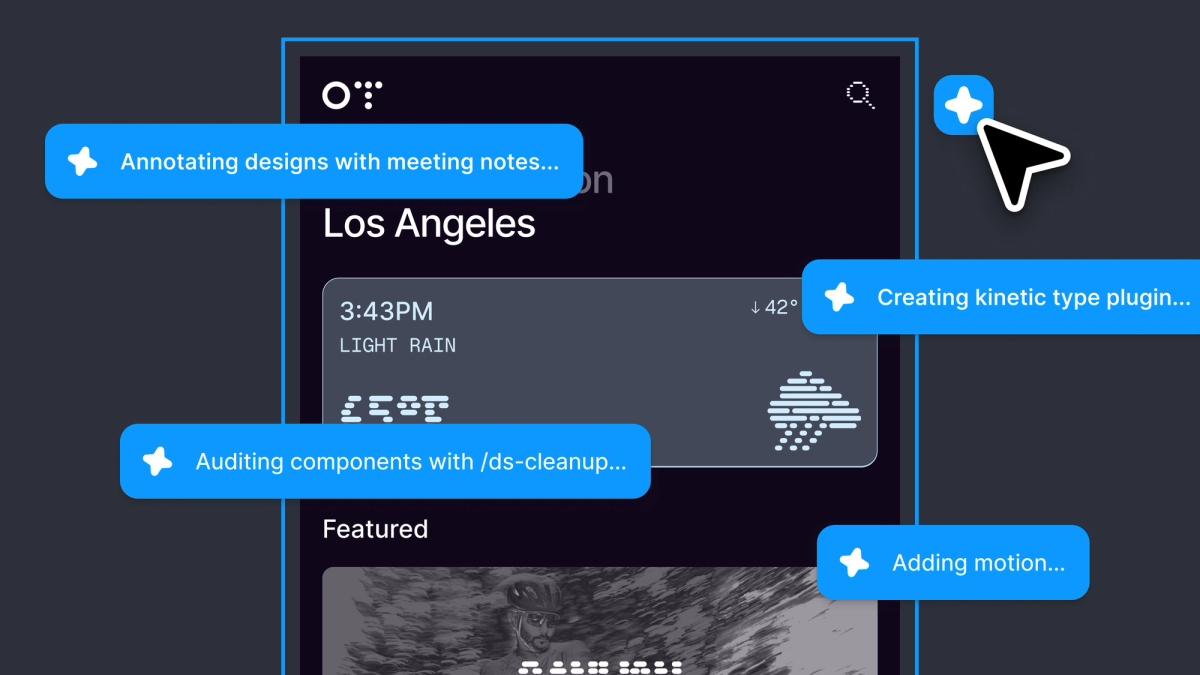
Figma has introduced a native animation timeline directly on the canvas, allowing designers to create and control motion within their designs. This feature enables keyframing of position, scale, rotation, and opacity, with auto keyframing capabilities. It also supports time-based comments for collaboration and integrates preset animation styles. The system aims to build a motion system for design components and introduce motion variables for customization. This update expands Figma Motion to include direct code export in CSS, JSON, and React, and compatibility with MCP for passing animated frames to coding agents. It also introduces new export formats like MP4, WebM, and Animated SVG, with further formats planned. Additionally, Figma Motion is now built to work in code, with the full timeline visible and inspectable in Dev Mode, allowing for direct copying of animation code.

2 posts

Timeline

Figma Weave AI Creation Platform

Active

Figma has acquired and integrated Weavy, now known as Figma Weave, a platform for generative AI and professional editing tools. This integration brings AI-native creation capabilities, including image, video, animation, motion design, and VFX media generation and editing, directly onto the Figma platform. Figma Weave offers node-based workflows for creating and editing visuals, allowing for inspection, tweaking, and repetition of processes. It provides over 20 AI image tasks accessible as Weave tools. The design agent is now enhanced with custom tools, including generative plugins and shader effects/fills powered by WebGPU. It can also leverage greater context from attached files, referenced Figma files, web searches, and external tools via MCP connectors. Custom skills can be created and shared to encapsulate reusable workflows and prompts, scaling team-wide adoption of specific design philosophies and automation.

2 posts

Timeline