Blogs
Hugging Face logo

Hugging Face

Engineering blog · huggingface.co/blog

177posts1this week0watchers

Feature trails

71
Feature trailActive

Cluster Resource Optimization

Hugging Face is developing capabilities to optimize resource utilization within compute clusters. This involves analyzing and modifying the order of operations or job scheduling to achieve higher throughput and efficiency. The goal is to maximize the effective utilization of existing infrastructure by identifying and addressing bottlenecks related to execution order. This post details the implementation of a hierarchical fair-share scheduler with GPU time budgets to prioritize high-impact research while maintaining full occupancy, shifting resource allocation from a case-by-case operational task to a transparent administrative budgeting process.

2 posts · 2026

Timeline

Feature trailActive

Agent Model Routing Optimization

Hugging Face now supports advanced agent model routing, moving beyond simple classification to a systems optimization problem. This capability allows for dynamic routing based on a multi-dimensional optimization of cost, quality, latency, compliance, and reliability, rather than just sticker price or perceived task difficulty. The system aims to make model selection an intrinsic part of the agent harness, optimizing the entire system's operating point. This post introduces Ecom-RLVE, an adaptive decision model family (d1-3B and d1-omni-600M) for edge deployment, supporting multimodal inputs (text, image, audio) and achieving high decision quality with low latency on edge devices. The models are built on Liquid Foundation Models (LFMs) and are designed for fast, structured decisions.

4 posts · 2026

Timeline

Feature trailActive

Mixture of Experts (MoE) Models

Hugging Face now supports Mixture of Experts (MoE) models, enabling more efficient and scalable large language models by selectively activating expert sub-networks for different inputs. This capability allows for models with a vast number of parameters that can be trained and served with significantly reduced computational cost compared to dense models of equivalent size. The DeepSeek-R1 model is highlighted as an example of a large MoE model available on the Hub. This post introduces Olmo-core and Falcon-Emirati-7B, a dialect-specialized model built on Falcon-H1-Arabic, demonstrating the application of advanced architectures for nuanced language understanding and generation. The Falcon-H1 architecture combines State Space Models (Mamba) and Transformer attention for efficient long-sequence processing. The development of Falcon-Emirati-7B involved a dedicated data pipeline with authentic dialectal web data, MSA data about Emirati culture, and synthetically generated data guided by glossaries and style rules. Evaluation included manual assessment by native speakers and automatic evaluation on the Alyah benchmark, with LLM-as-judge evaluation for pairwise comparisons. The 7B parameter size was chosen as a balance between quality and cost for dialect specialization.

4 posts · 2025–2026

Timeline

20252026
Feature trailActive

LoRA for Stable Diffusion Fine-Tuning

Hugging Face now supports LoRA for efficient fine-tuning of Stable Diffusion models, specifically demonstrating its application with Japanese Stable Diffusion. LoRA significantly reduces the number of trainable parameters by injecting small, trainable rank-decomposition matrices into the layers of a pre-trained model. This allows for faster training, smaller model checkpoints, and easier experimentation with different fine-tuning tasks, such as creating custom image generation models. This post also details Dreambooth, a technique for personalizing diffusion models by fine-tuning them on a small set of images of a specific subject or style, enabling the generation of novel images featuring that subject or style. The integration with the Diffusers library streamlines this process, allowing users to train and generate images with their custom subjects.

3 posts · 2023–2026

Timeline

20232026
Feature trailActive

Parameter-Efficient Fine-Tuning (PEFT)

The PEFT library continues to expand its support for parameter-efficient fine-tuning techniques. This post highlights the ongoing research and benchmarking efforts to compare various PEFT methods beyond LoRA, including their performance, memory usage, and checkpoint sizes. The goal is to provide users with more informed choices for fine-tuning models, moving beyond the default popularity of LoRA to explore techniques that offer better trade-offs for specific use cases. Benchmarks are being developed for Nemotron models, demonstrating their adaptability to specialized domains like competitive programming (IOI) and mathematical olympiads (IMO) through SFT and RL, paired with sophisticated inference systems. The Nemotron Labs IMO 2026 collection provides access to specialized checkpoints, training data, and benchmarks, while the IOI paper details the GenCorrect methodology and the Nemotron-3-Ultra-CC model is available on Hugging Face.

9 posts · 2023–2026

Timeline

20232026
Feature trailActive

Tabular Foundation Models

NVIDIA Kumo Tabular, an open foundation model for tabular data, is now available. It enables in-context learning for tabular prediction tasks (classification and regression) without training or feature engineering. The model is pretrained on artificial data, comes in various sizes, and ranks first on multiple benchmarks. It utilizes a Transformer architecture with cell, row, and in-context attention mechanisms, including Test-GQA for efficient query processing and length-aware attention temperature.

1 post · 2026

Timeline

Feature trailActive

Local Computer Use Agents

Hugging Face now supports local computer use agents, enabling agents to run directly on a user's machine for faster and more private interactions. This capability focuses on bringing AI agent functionality to the edge, reducing reliance on cloud infrastructure and improving responsiveness. The Holo3.1 collection showcases this by offering a curated set of agents designed for local execution. Holotron-12B, a multimodal computer-use model, demonstrates high-throughput inference with a hybrid SSM architecture. This post details the creation of smaller, specialized models for local execution, such as the Qwen-Image 2.1-PE-T2I-Pocket-0.8B for prompt rewriting and the Qwen-Image 2.1-viewpoint-orbit-LoRA for camera-angle control, demonstrating a workflow for generating custom models tailored for specific tasks and devices.

5 posts · 2026

Timeline

Feature trailActive

Hugging Face Inference Endpoints

Hugging Face Inference Endpoints provide a managed service for deploying machine learning models directly from the Hugging Face Hub to cloud infrastructure. The service supports public, protected, and private endpoints, offering options for authentication and network isolation. It integrates with cloud providers like AWS for deployment and allows for autoscaling and custom container deployments. The platform also provides analytics and logging for deployed endpoints. This post introduces LFM2.5-VL-DSpark, a vision-language model optimized for efficient inference on Hugging Face Inference Endpoints, demonstrating significant performance gains through architectural improvements and specialized optimizations for the DSpark inference engine.

10 posts · 2022–2026

Timeline

20222026
Feature trailActive

GPU-accelerated robotics simulation with MJWarp

Hugging Face now supports GPU-accelerated robotics simulation using MJWarp, a NVIDIA Warp implementation of MuJoCo physics. This enables users to run hundreds or thousands of parallel simulation environments on GPUs, significantly increasing aggregate throughput for large-scale sampling and reinforcement learning workloads. The integration allows for migration of existing MuJoCo scenes to a batched GPU execution model, with a focus on performance tuning and validation.

1 post · 2026

Timeline

Feature trailActive

Tokenizer Performance Improvements

The tokenizers library has undergone a significant refactor for version 1, focusing on performance improvements to address tokenization becoming a bottleneck in ML workflows. Key changes include a workspace split for modularity, a no-alloc merge working set, the use of bitstreams and SIMD instructions (bitcannon) for faster splitting instead of regex, a rewrite of the merge loop using intrusive linked lists and batch processing, a thread-local word cache for repeated words, and native parallelism allowing multiple threads to encode concurrently. These optimizations aim to significantly reduce tokenization latency and improve scaling.

1 post · 2026

Timeline

Feature trailActive

Agent Memory Calibration

Hugging Face now supports agent memory calibration, allowing agents to learn from their past trajectories by distilling reusable guidelines and injecting them back at inference time. This capability is crucial for optimizing agent performance and cost, as the optimal 'dose' of memory varies significantly based on the model's capability tier. Different strategies, such as providing the full guideline set to strong models or using curated retrieval for weaker models, are supported to maximize task completion and minimize token usage. This post details a comparison between ACE and ALTK-Evolve, highlighting that ALTK-Evolve achieves similar or better accuracy at a significantly lower inference cost by calibrating the delivery of lessons based on model capability, rather than always injecting a comprehensive playbook.

3 posts · 2026

Timeline

Feature trailActive

Universal Image Segmentation

Hugging Face now supports universal image segmentation with Mask2Former and OneFormer, enabling users to segment images into objects, instances, or scenes using a unified approach. This capability leverages advanced transformer architectures to handle diverse segmentation tasks efficiently. The post details the technical implementation of OneFormer, a unified framework for universal image segmentation, highlighting its architecture and performance on various segmentation tasks. This post introduces Falcon Perception, a 0.6B-parameter early-fusion Transformer for open-vocabulary grounding and segmentation from natural language prompts, and Falcon OCR, a 0.3B-parameter model for document understanding. Falcon Perception processes image patches + text in one sequence using a hybrid attention mask, and produces variable numbers of instances with a small, structured token interface and lightweight output heads. On SA-Co, Falcon Perception reaches 68.0 Macro-F1 (vs. 62.3 for SAM 3) with the main remaining gap being presence calibration (MCC 0.64 vs. 0.82). PBench, a diagnostic benchmark, breaks down performance by capability and by dense long-context crowded scenes. Falcon OCR reaches a score of 80.3 and 88.6 on the olmOCR benchmark and OmniDocBench respectively, while having the highest throughput of any open source OCR model. The post also discusses the architecture, training recipe (multi-teacher distillation, large-scale data), and inference optimizations (paged inference engine, Docker and MLX integration for Falcon-OCR).

2 posts · 2024–2026

Timeline

20242026
Feature trailActive

Sentence Transformers for Playlist Generation

Hugging Face now supports training and fine-tuning Sentence Transformers models for multimodal embedding and reranker tasks. This post introduces the Alibaba-NLP/gte-modernbert-base model, a modernbert-base model for sentence similarity, extending the capability by providing a concrete, high-quality model for sentence embedding generation. The `sentence-transformers/all-MiniLM-L6-v2` model is highlighted as a readily available option for sentence similarity tasks. This post further elaborates on multi-vector (late interaction) embedding models, demonstrating how to use the Alibaba-NLP/gte-modernbert-base model for tasks requiring more nuanced semantic understanding than single-vector embeddings can provide.

13 posts · 2022–2026

Timeline

20222026
Feature trailActive

AI Workflow Orchestration with Gradio

Hugging Face now supports interactive world generation for AI, enabling the creation of higher-fidelity interactive worlds for everyday GPUs. This capability leverages advanced models to generate complex and responsive environments, enhancing the possibilities for AI-driven simulations and applications. The Gradio Workflow feature has been extended to allow users to build complex, multi-model pipelines as single workflow canvases, integrating various media pipelines like text-to-image, image-to-

5 posts · 2025–2026

Timeline

20252026
Feature trailActive

Speech Synthesis and Recognition

Hugging Face now supports SpeechT5, a versatile model for speech synthesis, recognition, and more. This enables users to perform tasks like text-to-speech, speech-to-text, and speech translation directly within the Hugging Face ecosystem. This post introduces the NVIDIA Magpie TTS model, offering low-latency multilingual voice generation with open weights and full deployment control, enhancing the capabilities for speech synthesis. It also details the CohereLabs/cohere-transcribe-03-2026 model, and introduces Falcon-ASR, a 1.6 billion parameter speech recognition model for Arabic, with a particular focus on the Emirati dialect, also supporting English, French, Spanish, and Portuguese.

8 posts · 2023–2026

Timeline

20232026
Feature trailActive

Model Evaluation and Benchmarking

The Open TTS Leaderboard provides a scalable and objective evaluation framework for multilingual text-to-speech (TTS) and voice cloning models. It complements human preference scores by using objective metrics like Word Error Rate (WER) for intelligibility, inverse real-time factor (RTFx) and time-to-first-audio (TTFA) for speed, and speaker similarity (SIM) for voice identity preservation. The leaderboard allows for comparison across languages and supports voice cloning evaluation, with a 'Listen' tab for direct comparison of model outputs and a 'Streaming' tab for interactive application performance. Community feedback is encouraged to shape future evaluations.

7 posts · 2026

Timeline

Feature trailActive

CLI for AI Agents

The Hugging Face CLI (`hf`) has been re-architected to optimize for both human and AI agent usage, including agent-specific output formats, next-command hints, non-blocking operations, and discoverable commands. The Agentic Resource Discovery (ARD) specification is introduced as a discovery layer for agents to find capabilities at runtime. Hugging Face's Discover Tool implements ARD, providing search access to Skills, ML applications, and MCP Servers. The Hub's existing semantic search is leveraged for agentic workflows. This post introduces ProvenanceGuard, a source-aware verification layer for MCP agents that ensures claims are attributed to the correct source, preventing cross-source conflation. It breaks down agent answers into claims, identifies relevant sources, verifies support, checks attribution, and can trigger a repair loop for blocked answers. The system uses local models for verification and can be adapted for cloud services.

16 posts · 2024–2026

Timeline

20242026
Feature trailActive

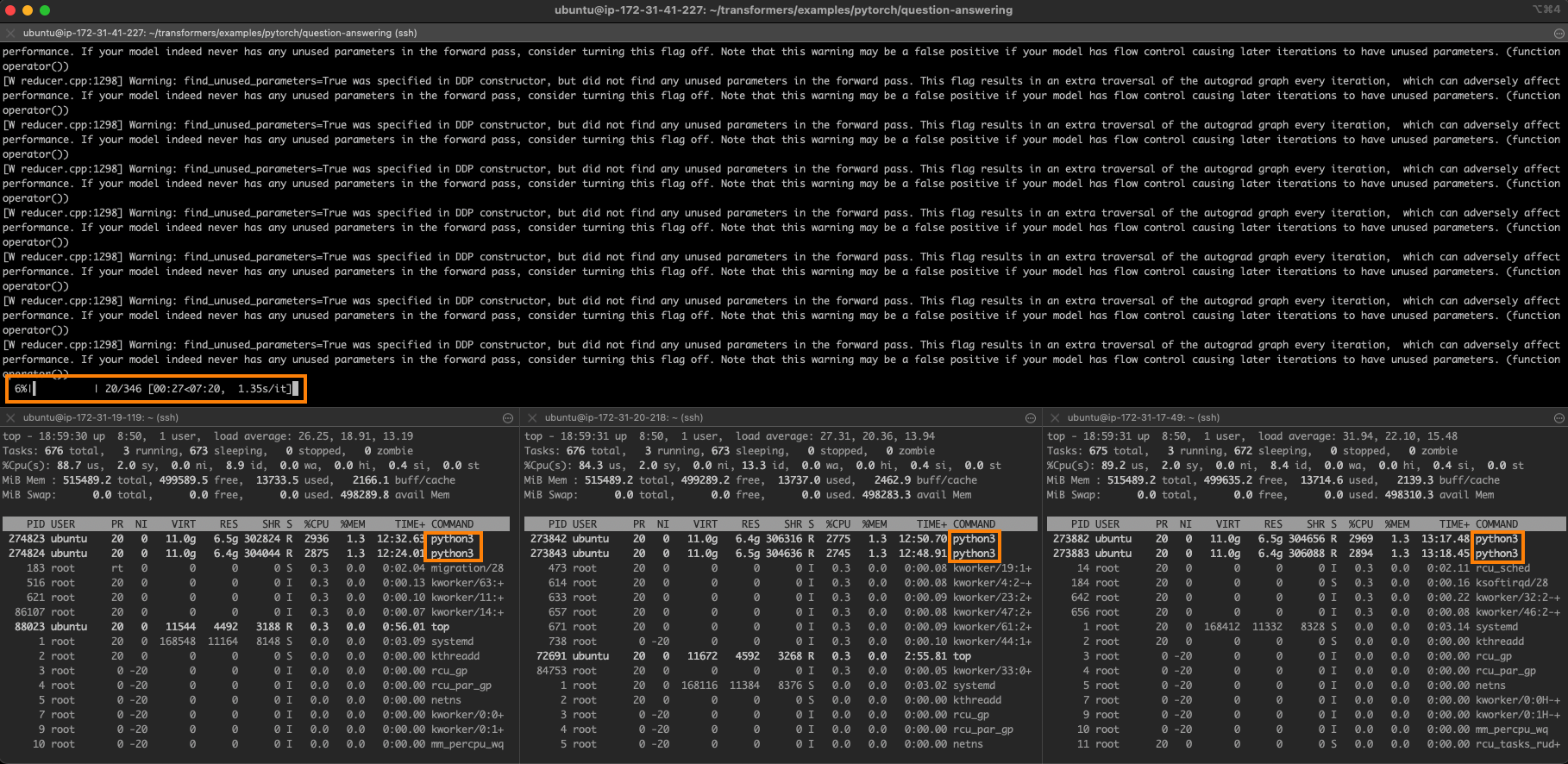
Distributed Training Abstraction

Hugging Face offers multiple levels of abstraction for distributed training, from native PyTorch DDP to the flexible 🤗 Accelerate library and the high-level 🤗 Trainer API. This post details how to leverage these tools for efficient distributed training, including single-GPU, multi-GPU, and multi-node setups, and introduces the concept of distributed training and its importance for scaling model training. This post specifically details how to train a language model using Megatron-LM, a framework for distributed training, and introduces techniques for optimizing inference speed. The focus is on achieving high throughput and enabling the execution of very large models by offloading parameters to the CPU.

4 posts · 2022–2026

Timeline

20222026
Feature trailActive

Long Context Window Models

Hugging Face now supports models with extremely long context windows, enabling agents to process and utilize significantly larger amounts of text. This includes advancements in model architecture and efficiency to handle million-token contexts, making them practical for complex tasks. GLM-5.2 introduces a 753B parameter model specifically built for long-horizon tasks, demonstrating significant improvements in handling extended contexts for generation and reasoning. The Mellum2-12B model from JetBrains and Qwen/Qwen3-4B are also highlighted for their long context capabilities. This post introduces Ulysses Sequence Parallelism, a novel technique that enables training of models with million-token contexts by efficiently managing memory and computation through sequence parallelism and optimized communication strategies.

9 posts · 2024–2026

Timeline

20242026
Feature trailActive

WebGPU Kernels for Browser Inference

Hugging Face is building a foundational layer for fast and user-friendly browser inference by releasing `@huggingface/kernels`, a library for loading and running optimized WebGPU kernels from the Hugging Face Hub. This initial release includes 207 kernels covering a wide range of machine learning operations, each published as a versioned package with explicit contracts, correctness tests, and benchmark cases. A browser-based benchmarking suite, Fleet, is also launched to crowdsource performance.

3 posts · 2026

Timeline

Feature trailActive

Bloom Inference Optimization

Hugging Face now supports BLOOM model inference optimization, leveraging DeepSpeed and Accelerate for incredibly fast inference. This builds upon existing efforts in large language model development and optimization, enabling efficient training and deployment of very large models. This post specifically details how to train a language model using Megatron-LM, a framework for distributed training, and introduces techniques for optimizing inference speed. The focus is on achieving high throughput and efficient resource utilization for BLOOM.

6 posts · 2023–2026

Timeline

20232026
Feature trailActive

Hardware Acceleration for ML Training

Hugging Face continues to explore hardware acceleration for ML training and inference, with a focus on optimizing diffusion models. This post details the integration of Nunchaku 4-bit diffusion inference with the Diffusers library, enabling faster and more memory-efficient image generation on consumer hardware. This builds upon existing efforts in hardware acceleration and diffusion model optimization.

1 post · 2022–2026

Timeline

20222026
Feature trailActive

DeepSpeed Large Model Training Acceleration

Hugging Face offers multiple levels of abstraction for distributed training, from native PyTorch DDP to the flexible 🤗 Accelerate library and the high-level 🤗 Trainer API. This post introduces Delta Weight Sync for TRL, a technique that leverages weight update sparsity to significantly reduce communication overhead in distributed reinforcement learning, enabling the efficient training of trillion-parameter models by only synchronizing sparse weight deltas instead of full model weights.

5 posts · 2022–2026

Timeline

20222026
Feature trailActive

Multilingual OCR

Hugging Face now supports PP-OCRv6, a highly accurate and efficient Optical Character Recognition (OCR) system capable of processing 50 languages. This system offers a range of model sizes, from 1.5 million to 34.5 million parameters, allowing for flexible deployment based on performance and resource constraints. The integration includes support for ONNX Runtime CPU backend for efficient inference. This post introduces the Dharma-AI/Dharma-OCR-LITE model, a 4B parameter image-text-to-text model, and demonstrates the integration of PaddleOCR 3.5 with the Transformers backend for OCR and document parsing tasks.

4 posts · 2026

Timeline

Feature trailActive

8-bit Matrix Multiplication for Large Models

Hugging Face integrates 8-bit matrix multiplication (LLM.int8()) into its Transformers library, significantly reducing memory usage for large language models with minimal performance degradation. This enables running larger models on less hardware, making them more accessible for inference and fine-tuning. The integration leverages the bitsandbytes library and is supported by the Accelerate library for seamless usage across different hardware configurations. This post introduces Quantization-Aware Healing, a compressed, 4-bit model that outperforms its full-precision original, demonstrating further advancements in model compression and performance.

2 posts · 2022–2026

Timeline

20222026
Feature trailActive

Robot Manipulation Data Recording System

Hugging Face now supports Grabette, an open system for recording robot-manipulation data, enabling the conversion of Grabette recordings into LeRobot datasets. This facilitates the development and analysis of robot manipulation tasks. The system has been extended to allow users to use Strands Agents and LeRobot to deploy models from the Hugging Face Hub to robot hardware, enabling real-time control and interaction. The new v0.6.0 release of LeRobot introduces Robometer-4B, a 4B parameter model for on-device inference, and SmolVLM-Base, a 2B parameter image-text-to-text model, enabling efficient AI on embedded platforms. This post details the integration of these models and optimizations for on-device performance.

5 posts · 2024–2026

Timeline

20242026
Feature trailActive

Interactive World Generation for AI

Hugging Face now supports interactive world generation for AI, enabling the creation of higher-fidelity interactive worlds for everyday GPUs. This capability leverages advanced models to generate complex and responsive environments, enhancing the possibilities for AI-driven simulations and applications. The Gradio Workflow feature has been extended to allow users to build complex, multi-model pipelines as single workflow canvases, integrating various media pipelines like text-to-image, image-to-image, and text-to-audio. The Waypoint-1.5-1B model represents a significant step forward in achieving higher fidelity and interactivity in generated worlds.

1 post · 2026

Timeline

Feature trailActive

Diffusers Library Updates

Hugging Face supports diffusion models for image generation. This post details the implementation of Modular Diffusers, allowing users to create custom diffusion workflows by combining different components like schedulers, UNets, and VAEs. The introduction of 'Overworld/Waypoint-1-Small' as a 2.3B parameter model further expands the available options for users, enabling real-time interactive video diffusion with low latency on consumer hardware via the WorldEngine inference library. This post also details how to fine-tune Stable Diffusion models using Dreambooth with the Diffusers library, enabling users to train custom models on their own data for personalized image generation.

13 posts · 2023–2026

Timeline

20232026
Feature trailActive

vLLM Inference Engine Migration and Correctness

This post details the migration from vLLM V0 to V1, focusing on ensuring backend correctness for RL training. Key fixes include aligning logprob semantics, managing runtime defaults, handling inflight weight updates, and ensuring fp32 precision for the LM head. This work establishes a stable foundation for RL objectives by eliminating train-inference mismatches.

1 post · 2026

Timeline

Feature trailActive

Hugging Face to SageMaker Studio Integration

Hugging Face now offers a seamless integration with Amazon SageMaker Studio, enabling users to transition directly from model discovery on Hugging Face to hands-on experimentation within SageMaker Studio. This integration streamlines the process by pre-configuring environments, permissions, and model context, reducing friction for fine-tuning and deployment workflows. The feature includes deep links from Hugging Face model pages to SageMaker Studio's customization and deployment pages, pre-configured IAM permissions for SageMaker capabilities, and direct visibility of GPU quota availability within the Studio UI.

1 post · 2026

Timeline

Feature trailActive

Hugging Face Models on Foundry Managed Compute

Hugging Face models are now integrated into Microsoft Foundry's Managed Compute platform, offering a curated catalog of open-weight models deployable with enterprise-grade security, governance, and observability. This integration streamlines the process of discovering, deploying, and operating open-source AI models within the Foundry ecosystem, leveraging managed GPU infrastructure and a variety of optimized inference runtimes like vLLM, SGLang, TensorRT-LLM, NIM, TEI, and llama.cpp. The platform provides a unified endpoint, SDKs, authentication, observability, and billing for all models, including open-source ones, enabling seamless integration with Foundry Agents. Managed Compute offers global and data zone deployments, with quota aligned to accelerator families for future hardware generations. The curation pipeline ensures models are security-screened, use SafeTensors format, and are deployed with appropriate runtimes. Weights are pre-staged in Azure storage, and runtime images are managed by Microsoft, allowing for deployments within private networks without outbound access to Hugging Face Hub.

1 post · 2026

Timeline

Feature trailActive

PyTorch Profiling and Optimization

This post continues the exploration of PyTorch profiling, delving into the optimization of ML model components like nn.Linear and MLPs. It provides technical details on how to analyze and improve the performance of these fundamental building blocks within PyTorch, contributing to more efficient deep learning model development and deployment. This part specifically focuses on profiling attention mechanisms.

2 posts · 2026

Timeline

Feature trailActive

Custom Kernel Distribution and Security

Hugging Face has significantly enhanced its 🤗 Kernels project, introducing a new 'kernel' repository type on the Hub for better discoverability and management of custom compute kernels. Security has been bolstered with trusted kernel publishers, kernel signing using Sigstore cosign, and reproducible builds via Nix. The CLIs for `kernels` and `kernel-builder` have been revamped for better separation of concerns and agent optimization. Support for frameworks like Torch Stable ABI and Apache TVM F. This post details how Claude was used to generate CUDA kernels for diffusion models, demonstrating an AI-assisted approach to kernel development and distribution, and how these kernels can be used to teach open models.

1 post · 2026

Timeline

Feature trailActive

Density and Score Estimation with Transformers

Hugging Face now supports DiScoFormer, a novel transformer-based model capable of estimating both the density and score of a distribution in a single forward pass. This approach generalizes kernel density estimation (KDE) and offers significant improvements in accuracy for high-dimensional data, removing the need for retraining per distribution. DiScoFormer leverages cross-attention and a shared backbone with two output heads for density and score, utilizing a label-free consistency loss for out-of-distribution adaptation. It analytically shows that attention generalizes KDE and includes it as a special case, improving on it by learning multiple scales and adapting them to data. Trained on Gaussian Mixture Models for universal density approximation and closed-form targets, DiScoFormer outperforms KDE significantly in high dimensions and on non-Gaussian shapes, with KDE retaining an advantage in speed for small datasets. This reusable, plug-in estimator has broad applications in generative modeling, Bayesian inference, and scientific computing.

1 post · 2026

Timeline

Feature trailActive

CI/CD Orchestration with Hugging Face Jobs

Hugging Face Jobs provides a robust platform for orchestrating CI/CD workflows, enabling seamless migration from existing CI systems like GitHub Actions. This includes features for dispatching jobs, managing execution environments, and integrating with code repositories. The platform now supports running vLLM servers with a single command, enabling users to spin up private, OpenAI-compatible LLM endpoints on Hugging Face infrastructure without provisioning servers or Kubernetes. This includes fe

2 posts · 2026

Timeline

Feature trailActive

LLM Guardrails and Adversarial Robustness

Hugging Face now supports AprielGuard, a guardrail system for LLM safety and adversarial robustness. This system aims to protect modern LLM applications from harmful outputs and adversarial attacks by implementing robust safety mechanisms and improving adversarial resilience. The integration of AprielGuard enhances the security and reliability of LLM deployments. This post introduces Nemotron 3.5 Content Safety, a multimodal safety model that can be customized for enterprise AI, offering advanced capabilities for content moderation and safety.

1 post · 2026

Timeline

Feature trailActive

Local AI Inference Stack

Hugging Face is integrating GGML and llama.cpp to enhance the local AI inference stack. This initiative aims to streamline the process of shipping models from the Transformers library to llama.cpp for local execution, improve packaging and user experience for GGML-based software, and make local inference more accessible and ubiquitous for casual users. The long-term vision is to provide the community with building blocks for open-source superintelligence accessible globally. The llama.cpp server now supports GGUF quants, enabling Transformers to run these quantized models directly.

3 posts · 2025–2026

Timeline

20252026
Feature trailActive

Graph Machine Learning

Hugging Face now supports graph machine learning, providing foundational knowledge and techniques for working with graph-structured data. This includes understanding graph representations, pre-neural approaches like feature engineering and centrality measures, and an introduction to Graph Neural Networks (GNNs) with concepts like aggregation and message passing, as well as the over-smoothing problem. The capability also touches upon Graph Transformers and provides resources for further learning.

2 posts · 2025–2026

Timeline

20252026
Feature trailActive

Continuous Batching Asynchronicity

Hugging Face Inference Endpoints now support asynchronous batching, disentangling CPU batch preparation from GPU computation to maximize GPU utilization and reduce inference latency. This builds upon continuous batching by introducing CUDA streams and events to enable concurrent execution of CPU and GPU workloads, significantly improving throughput and reducing idle time.

1 post · 2026

Timeline

Feature trailActive

Foundation Model Training and Inference on AWS

This post is the first in a series analyzing the building blocks for foundation model training and inference on AWS. It details the layered architecture of open-source software stacks, emphasizing the integration points between AWS infrastructure components (compute, network, storage) and OSS tools like Slurm, Kubernetes, PyTorch, JAX, Prometheus, and Grafana. It highlights the evolution of scaling laws and the convergent infrastructure requirements for pre-training, post-training, and inference.

1 post · 2026

Timeline

Feature trailActive

Safetensors Serialization Format

Safetensors has joined the PyTorch Foundation, becoming a foundation-hosted project under the Linux Foundation. This move ensures vendor-neutral governance and community ownership. Future developments include device-aware loading/saving (direct to CUDA, ROCm), first-class APIs for Tensor Parallel and Pipeline Parallel loading, and formal support for FP8, block-quantized formats (GPTQ, AWQ), and sub-byte integer types.

1 post · 2026

Timeline

Feature trailActive

GPU Management and Optimization

Hugging Face is developing capabilities to optimize GPU utilization, moving beyond simple idle detection to more sophisticated management strategies. This includes exploring concepts like 'grounded aircraft' to represent underutilized resources and developing systems to ensure GPUs are actively contributing to workloads, potentially through intelligent scheduling, resource pooling, or dynamic allocation based on demand. The goal is to maximize the value derived from expensive GPU hardware. This post introduces the analogy of 'grounded aircraft' to describe idle GPUs and discusses the challenges and potential solutions for optimizing their utilization, including the need for intelligent scheduling and dynamic allocation.

1 post · 2026

Timeline

Feature trailActive

Protein Language Models

Hugging Face now supports protein language models, enabling users to analyze protein sequences using deep learning. This includes models like ProtBERT for understanding protein sequences analogous to NLP models, opening new avenues for research in bioinformatics and computational biology. The platform also supports training and fine-tuning of transformer variants for codon-level language modeling, with CodonRoBERTa-large-v2 showing strong performance in perplexity and correlation metrics. This post details the development of an end-to-end pipeline for protein engineering, including structure prediction (ESMFold), sequence design (ProteinMPNN), and mRNA optimization (CodonRoBERTa-large-v2). The team scaled their codon optimization models to 25 species, trained 4 production models in 55 GPU-hours, and built a species-conditioned system.

2 posts · 2023–2026

Timeline

20232026
Feature trailActive

Deep Reinforcement Learning Class

Hugging Face now supports RL Environments on the Hub, providing a dedicated space for Reinforcement Learning environments. This initiative aims to standardize the discovery, versioning, and serving of RL environments, moving away from fragmented registries. The Hub now hosts datasets tagged as RL environments, with framework-specific tags (e.g., 'harbor', 'verifiers', 'openenv', 'nemo-gym') that generate loading commands. This allows frameworks to focus on runtime and verifier code while the Hub handles data hosting and discovery. Integrations with Harbor, Verifiers, OpenEnv, and NeMo Gym are highlighted, demonstrating how to run environments and inspect rewards.

2 posts · 2022–2026

Timeline

20222026
Feature trailActive

Storage Buckets

Hugging Face introduces Storage Buckets, a new S3-like object storage service integrated with the Hugging Face Hub. Buckets are designed for mutable, non-versioned storage of intermediate ML artifacts such as checkpoints, optimizer states, and logs. They are built on Xet, enabling content deduplication and efficient storage for related files. The service supports pre-warming data to specific cloud regions for improved compute proximity, and can be accessed via the `hf` CLI, Python (`huggingface_hub`), and JavaScript (`@huggingface/hub`). Filesystem integration via `fsspec` allows seamless use with libraries like pandas, Polars, and Dask. Buckets are intended for fast, iterative workflows where version control is not required, complementing the existing versioned repositories for final artifacts.

1 post · 2026

Timeline

Feature trailActive

Zero-Egress Storage for AI Workloads

Hugging Face now supports zero-egress storage for AI workloads using SkyPilot, enabling users to run AI tasks on any cloud and store data on Hugging Face without incurring egress charges. This capability simplifies cloud-based AI development and deployment by abstracting away complex storage and networking configurations.

1 post · 2026

Timeline

Feature trailActive

Reinforcement Learning Value-Based Methods

Hugging Face offers a comprehensive Deep Reinforcement Learning Class, covering foundational algorithms like REINFORCE and Actor-Critic methods, with practical applications in robotics simulations. This post details the journey to unlock agentic RL training for GPT-OSS, addressing challenges in MoE log-probability mismatch and attention sink support, and introduces memory-efficient training techniques like mitigating FSDP memory blow-ups and sequence parallel with Flash Attention V3. The work establishes a stable foundation for RL objectives by eliminating train-inference mismatches. This post introduces Decision Transformers, abstracting RL as a conditional-sequence modeling problem using Transformers, and details how to train an offline Decision Transformer from scratch for tasks like making a half-cheetah run, using a custom data collator and the 🤗 Trainer.

9 posts · 2022–2026

Timeline

20222026
Feature trailCooling

Tokenization Abstraction

Hugging Face has introduced a new, more modular, and simplified tokenization system within the Transformers library. This update aims to improve the developer experience by making tokenization more intuitive and easier to integrate into various ML workflows. The new architecture allows for greater flexibility and maintainability of tokenization components. The v5 release further refines this by introducing a clearer API, improved modularity, and enhanced support for custom tokenizers, making it easier to manage and extend tokenization logic.

1 post · 2025

Timeline

20252026
Feature trailCooling

Cross-Origin Storage API for Transformers.js

This post introduces the experimental integration and usage of the Cross-Origin Storage API within Transformers.js. It details how this API enables secure and persistent storage of models and data directly in the browser, overcoming previous limitations of client-side storage for large ML models. The capability now includes practical examples and considerations for leveraging this API to enhance the offline and client-side capabilities of Transformers.js.

1 post · 2025

Timeline

20252026
Feature trailQuiet since 2023

Language Model Bias Evaluation

Hugging Face now supports systematic evaluation and quantification of biases within language models using the 🤗 Evaluate library. This capability aims to provide developers and researchers with tools to identify, understand, and mitigate bias in AI systems, contributing to the development of more equitable and responsible AI. This post details how to perform sentiment analysis on Twitter data using a pre-trained model, demonstrating a practical application of NLP for understanding public opinion.

2 posts · 2023

Timeline

20232026
Feature trailQuiet since 2023

Instruction Following for Dialog Agents

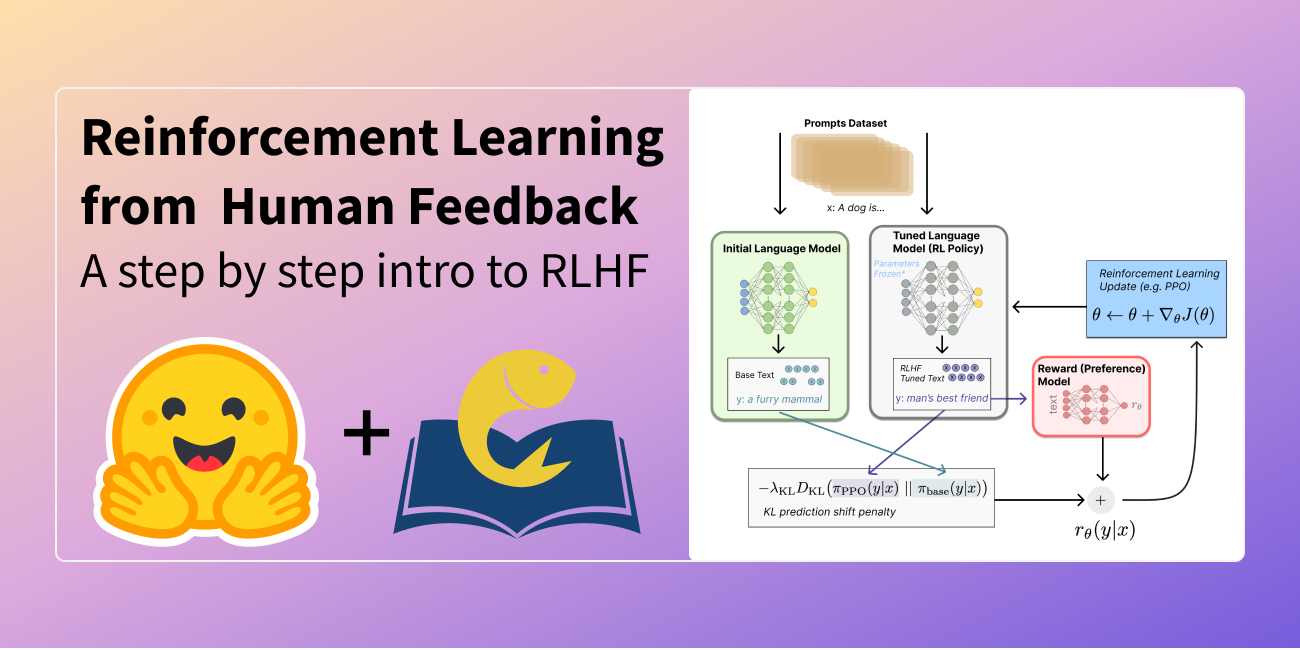
This post details Reinforcement Learning from Human Feedback (RLHF) as a method to align dialog agent behavior with human preferences. It builds upon previous discussions of Instruction Fine-Tuning (IFT) and Supervised Fine-Tuning (SFT) by detailing the practical application and understanding of RLHF, including the use of preference datasets and reward modeling to guide agent responses towards helpfulness and safety. The post likely provides concrete examples or code snippets demonstrating how to implement RLHF for dialog agents.

2 posts · 2023

Timeline

20232026
Feature trailQuiet since 2023

IPU-Ready Transformers Optimization

Hugging Face Optimum integrates with Intel IPUs, offering optimized performance for a range of Transformer models across computer vision, NLP, and speech. This partnership expands the hardware acceleration options for users, enabling efficient training and inference on Graphcore's specialized hardware. The latest update includes support for new models and leverages Graphcore's Bow IPU and Poplar SDK for enhanced performance and power efficiency without code changes.

8 posts · 2022–2023

Timeline

20222026
Feature trailQuiet since 2023

ONNX Runtime Training Integration

Hugging Face Optimum integrates with ONNX Runtime for training and inference, offering significant speedups and optimizations for popular Hugging Face models. This includes leveraging ONNX Runtime's memory and compute optimizations, fused optimizers, mixed-precision training, and integration with DeepSpeed ZeRO Stage 1. The ORTTrainer API provides a seamless transition for users familiar with the Transformers Trainer API. This post details the conversion of Transformers models to ONNX format using `torch.onnx`, `transformers.onnx`, and the high-level Optimum library, enabling accelerated inference and further optimization steps like quantization and TensorRT conversion.

1 post · 2022–2023

Timeline

20222026
Feature trailQuiet since 2023

CPU-based PyTorch Training Acceleration

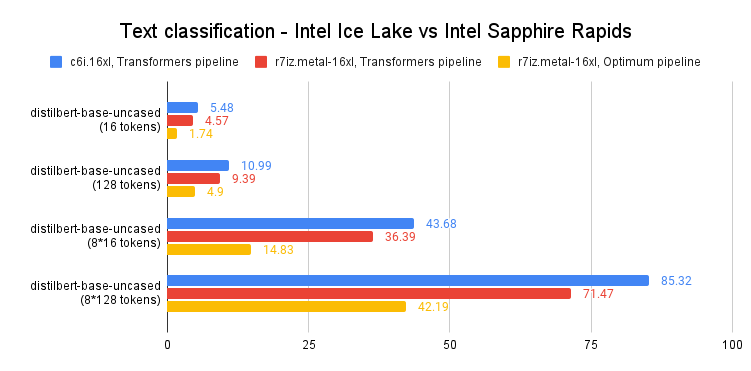
Hugging Face now supports accelerating PyTorch training jobs on clusters of Intel Sapphire Rapids CPUs using Intel oneAPI Collective Communications Library (CCL) and Intel Extension for PyTorch (IPEX). This enables significant speedups for distributed training by leveraging new CPU instructions like AMX, making CPU-based training a more cost-effective and scalable option, especially for smaller datasets and cloud spot instances.

1 post · 2023

Timeline

20232026
Feature trailQuiet since 2022

Zero-Shot Image Segmentation with CLIPSeg

Hugging Face now supports zero-shot image segmentation using CLIPSeg, enabling users to segment images based on natural language prompts without requiring task-specific training data. This capability leverages the CLIP model for image-text understanding and a segmentation decoder to generate masks. The integration allows for flexible and intuitive image segmentation applications.

1 post · 2022

Timeline

20222026
Feature trailQuiet since 2022

Elixir ML Integration

Hugging Face models are now accessible in the Elixir community through the Bumblebee library, which is a pure Elixir implementation of Hugging Face Transformers. This integration leverages the Nx (Numerical Elixir) project, which provides multi-dimensional tensors and numerical definitions compilable to CPU/GPU via bindings to Google XLA (EXLA) and Libtorch (Torchx). Other related projects include Axon for functional composable Neural Networks and Explorer for dataframes. Bumblebee and Tokenizer are the most recent releases. Future plans include training and transfer learning of Neural Networks in Elixir.

1 post · 2022

Timeline

20222026
Feature trailQuiet since 2022

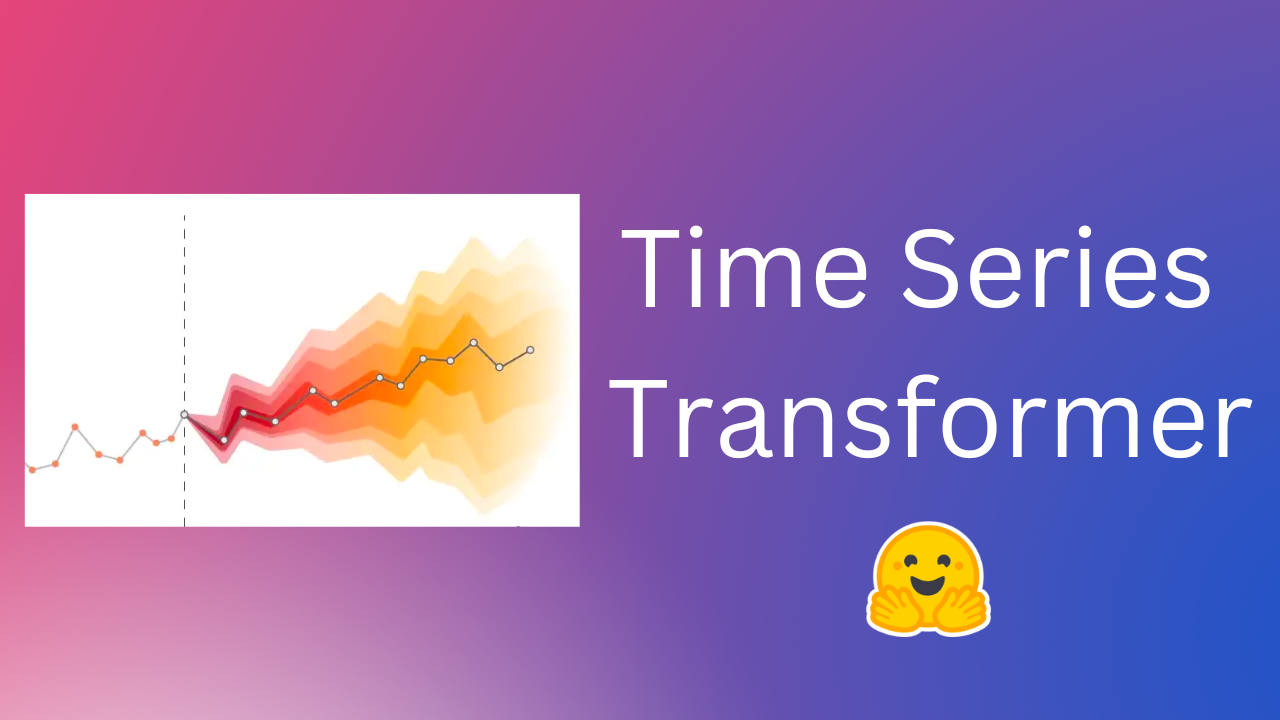
Probabilistic Time Series Forecasting with Transformers

Hugging Face Transformers now supports probabilistic time series forecasting using the Time Series Transformer model. This enables global probabilistic modeling, allowing for the prediction of future values along with their uncertainties. The implementation leverages the Encoder-Decoder Transformer architecture, handling sequential data, missing values, and offering ancestral sampling for forecasting. The post details the setup, data loading, model definition, training, and inference processes using the `monash_tsf` dataset and GluonTS for data transformation and batching.

2 posts · 2022

Timeline

20222026
Feature trailQuiet since 2022

Serialization and Versioning for ML Models

Skops is a new library for saving and loading scikit-learn models, ensuring version compatibility and providing a standardized way to share models. It addresses the challenges of model serialization by offering a robust and flexible solution that can be extended to other ML frameworks.

1 post · 2022

Timeline

20222026
Feature trailQuiet since 2022

Homomorphic Encryption for Sentiment Analysis

Hugging Face now supports sentiment analysis on encrypted data using fully homomorphic encryption (FHE), enabling privacy-preserving machine learning applications. This capability allows for secure analysis of sensitive data without decryption. The integration with Zama's FHE library enables sentiment analysis on encrypted tweets, demonstrating the practical application of FHE for privacy-preserving NLP.

1 post · 2022

Timeline

20222026
Feature trailQuiet since 2022

Contrastive Search for Text Generation

Introduced Contrastive Search, a novel decoding method for neural text generation that jointly optimizes for model confidence and a degeneration penalty. This method aims to produce human-level text by avoiding issues like repetition and semantic incoherence found in traditional greedy, beam, top-k, and nucleus sampling methods. It is integrated into the 🤗 Transformers library and demonstrated with examples and a live demo.

1 post · 2022

Timeline

20222026
Feature trailQuiet since 2022

Digital Object Identifiers for Models and Datasets

Hugging Face now allows users to generate Digital Object Identifiers (DOIs) for their models and datasets directly from the Hub. This feature, implemented in partnership with DataCite, provides persistent, citable links to ML assets, enhancing reproducibility and discoverability. Users can generate DOIs from repository settings, and these DOIs can be updated for new versions of models or datasets.

2 posts · 2022

Timeline

20222026
Feature trailQuiet since 2022

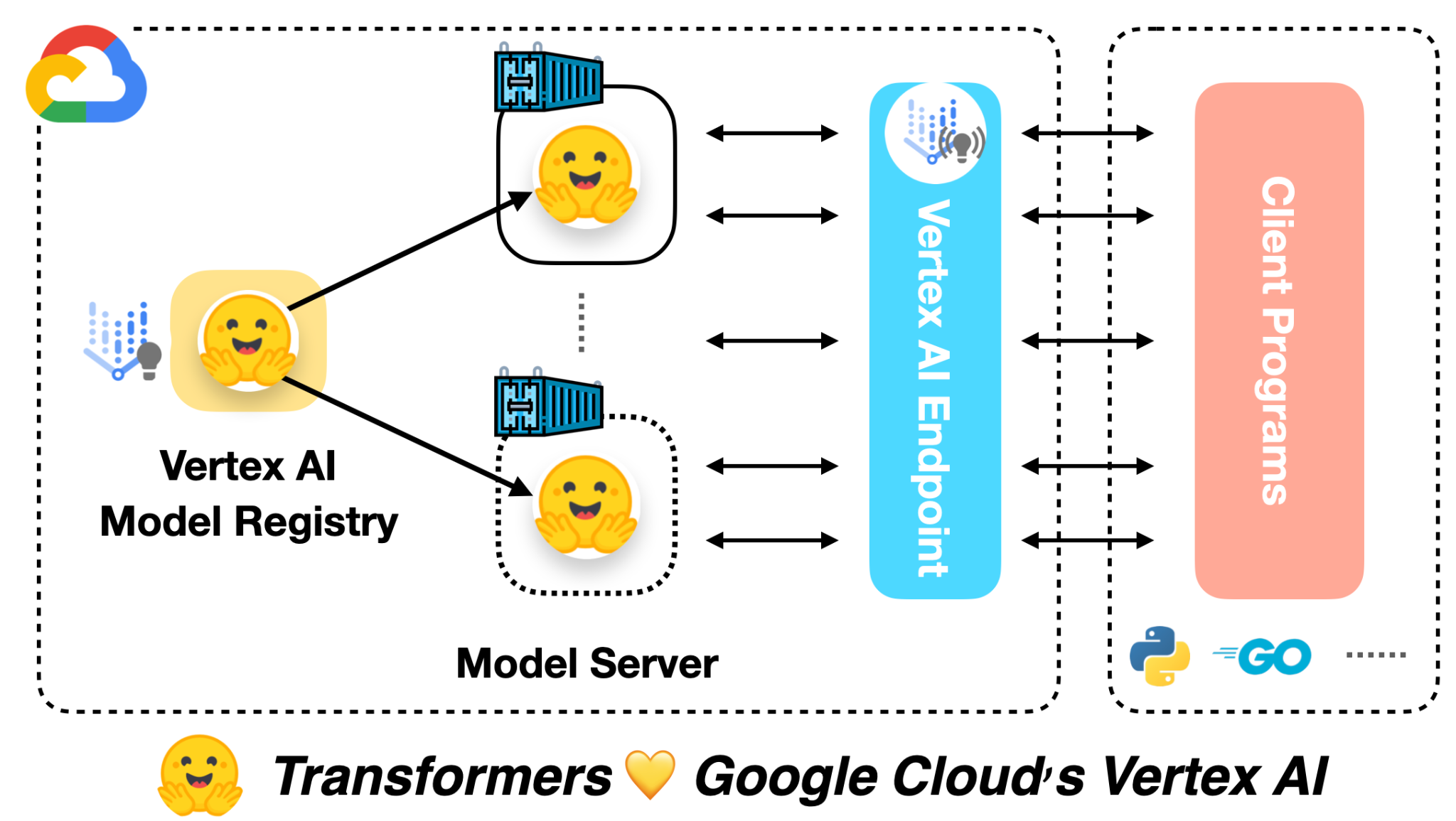
Kubernetes Deployment of Vision Transformers with TF Serving

Hugging Face now supports deploying Vision Transformer (ViT) models on Google Cloud's Vertex AI platform, offering a scalable and managed solution for ML model serving. This builds upon previous posts detailing local deployment and Kubernetes deployment, providing a streamlined workflow with less code. Vertex AI offers features like autoscaling, model versioning, traffic splitting, rate limiting, and monitoring. The integration leverages pre-built TensorFlow serving containers and the `google-cl`, and also supports local deployment of TensorFlow Vision Models using TensorFlow Serving, exposing them as REST or gRPC endpoints with features like model warmup and server-side batching.

3 posts · 2022

Timeline

20222026
Feature trailQuiet since 2022

Vision Transformer (ViT) Optimization on IPUs

Hugging Face Optimum provides integration for running and fine-tuning Vision Transformer (ViT) models on Graphcore Intelligence Processing Units (IPUs). This enables efficient training and inference of ViT models for computer vision tasks, leveraging IPU's parallel processing capabilities and pre-optimized model checkpoints from the Hugging Face Hub. The integration simplifies the development lifecycle for AI models on specialized hardware.

1 post · 2022

Timeline

20222026
Feature trailQuiet since 2022

TensorFlow Integration and Philosophy

This post outlines Hugging Face's philosophy for integrating TensorFlow models, emphasizing the use of Keras Model and Layer objects, default loss functions, flexible labels, simplified data pipelines, XLA optimization, and the importance of deployment. It details how `transformers` leverages Keras's `fit()`, `compile()`, and `predict()` methods, and provides examples of creating hybrid models and handling transfer learning with tokenizers. The post also touches upon XLA for performance gains and the importance of community contributions.

1 post · 2022

Timeline

20222026
Feature trailQuiet since 2022

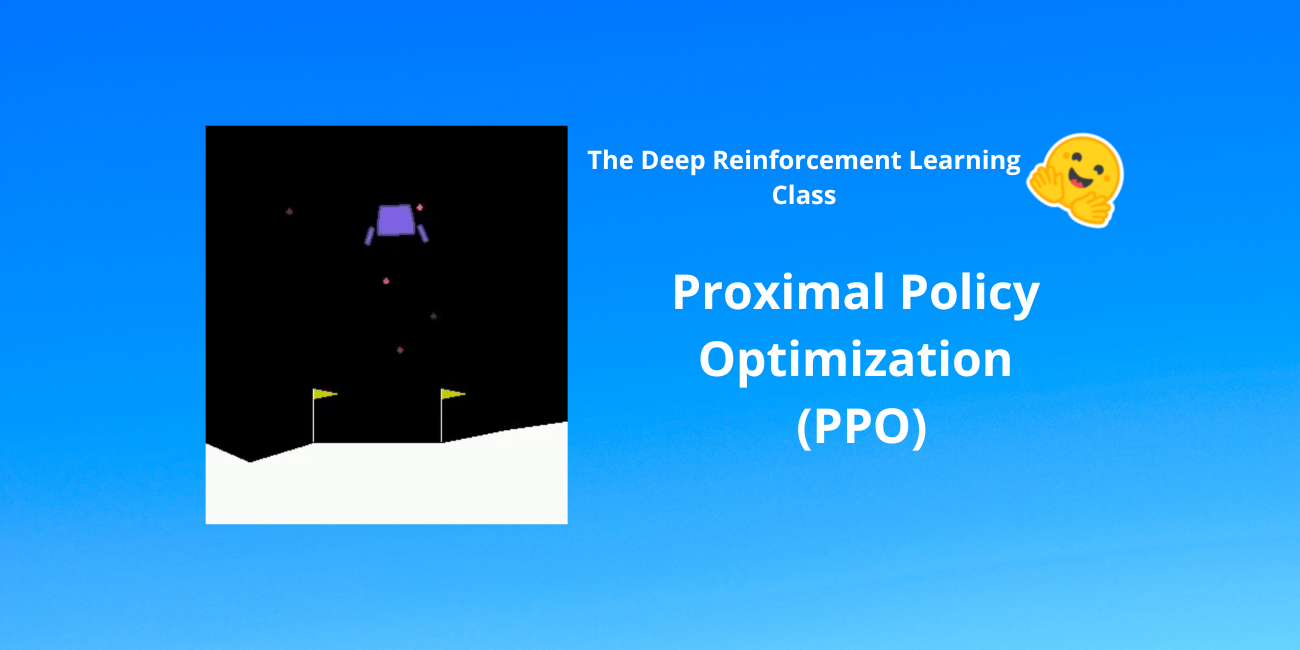
Proximal Policy Optimization (PPO)

Hugging Face now supports Proximal Policy Optimization (PPO), an algorithm that improves training stability in deep reinforcement learning by limiting the magnitude of policy updates. This is achieved through a clipped surrogate objective function that prevents overly large steps, ensuring more reliable convergence and avoiding catastrophic policy degradation. The implementation includes detailed explanations of the clipped surrogate objective, ratio calculations, and practical coding examples u

2 posts · 2017–2022

Timeline

20172026
Feature trailQuiet since 2022

TensorFlow XLA Text Generation Optimization

This post introduces optimizations for faster text generation using TensorFlow and XLA. It details how XLA (Accelerated Linear Algebra) can be used to compile TensorFlow models for improved performance, specifically focusing on text generation tasks. The post likely covers the process of enabling XLA compilation and its impact on inference speed and resource utilization for models like those used in text generation.

1 post · 2022

Timeline

20222026
Feature trailQuiet since 2022

Dynamic Model Training with Adversarial Data

This post introduces a method for dynamically training models using adversarial data. It details how to generate adversarial examples and incorporate them into the training loop to improve model robustness and performance. The approach aims to make models more resilient to subtle perturbations in input data, a crucial aspect for real-world applications where data can be noisy or manipulated.

1 post · 2022

Timeline

20222026
Feature trailQuiet since 2022

NLP Pipeline for Inbound Message Classification

Sempre Health implemented an NLP pipeline to automatically classify and respond to inbound patient messages, leveraging Hugging Face's language models. This system has successfully handled over 20% of incoming messages, significantly improving business scalability and operational workflow by reducing the load on their patient operations team. The implementation involved refining labeling strategies, selecting appropriate models and architectures, and accelerating the development process.

2 posts · 2022

Timeline

20222026
Feature trailQuiet since 2022

Table Pre-training with Synthetic Data

Hugging Face introduces TAPEX, a novel approach to table pre-training that leverages synthetic data generated from SQL queries and their execution results. This method significantly improves efficiency and performance on downstream table-related tasks like question answering and fact verification by learning a neural SQL executor. TAPEX achieves state-of-the-art results with a fraction of the pre-training data compared to previous methods.

1 post · 2022

Timeline

20222026
Feature trailQuiet since 2022

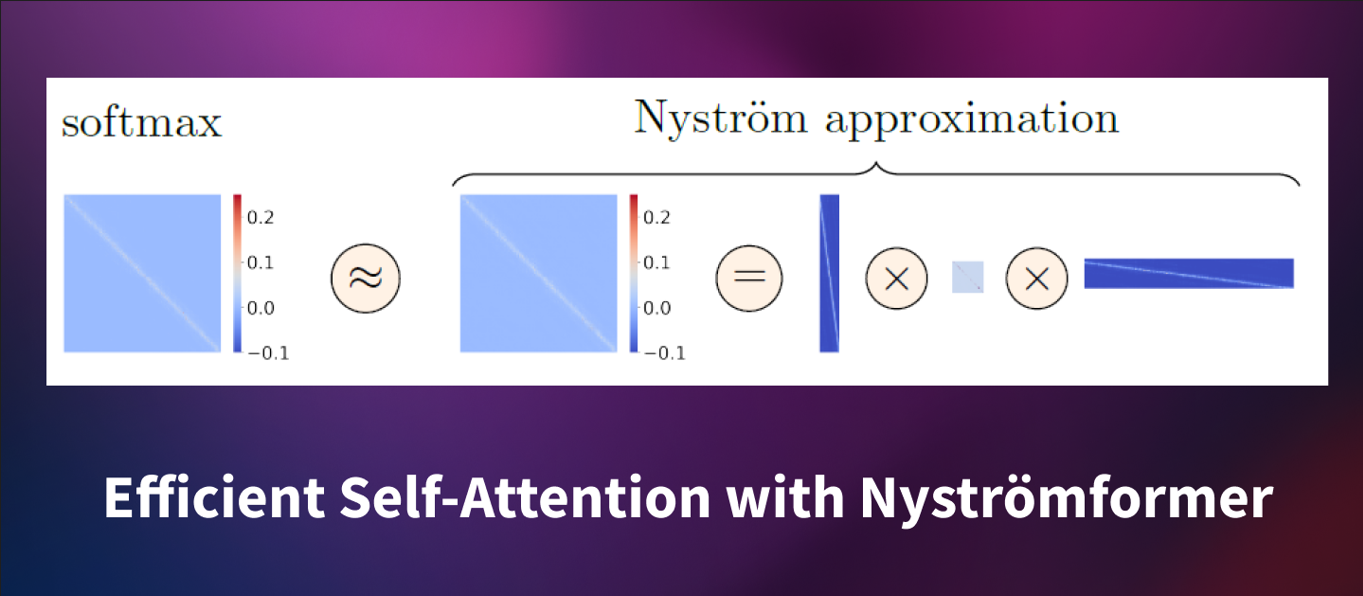
Nyströmformer for Efficient Self-Attention

Introduced Nyströmformer, a method to approximate self-attention in linear time and memory using the Nyström method, enabling more efficient processing of long sequences in transformer models.

1 post · 2022

Timeline

20222026