Blogs
Qdrant logo

Qdrant

Engineering blog · qdrant.tech/blog

150posts2this week0watchers

Feature trails

25
Feature trailActive

Agentic Retrieval Systems

Qdrant continues to be a core component for agentic retrieval systems and RAG evaluation, enhancing its capabilities for advanced retrieval, performance optimization, enterprise scaling, and deployment flexibility. This post highlights the use of Jev, a decision model, for various classification tasks within retrieval systems, including reranking, reducing repetitive answers via Maximal Marginal Relevance (MMR) guided by Jev scores, and query understanding through taxonomy routing. Experiments show Jev's effectiveness in improving relevance and diversity, often outperforming traditional methods and cross-encoders, while offering a more constrained and cost-effective alternative to generative LLMs for classification tasks.

17 posts · 2024–2026

Timeline

20242026
Feature trailActive

Embedding Model Evolution

Qdrant continues to enhance its support for advanced embedding models, now integrating with Google's Gemini Embedding 2. This enables native multimodal search by allowing text, images, video, audio, and PDF documents to be mapped into a single vector space within Qdrant. The integration leverages Gemini Embedding 2's flexible output dimensions (via Matryoshka Representation Learning) and Qdrant's features like named vectors and multi-stage retrieval for efficient, high-precision multimodal search. This post specifically explores the memory optimization techniques for EmbeddingGemma 2, demonstrating how quantization and vector dimension reduction can significantly reduce RAM usage while maintaining high retrieval quality.

6 posts · 2023–2026

Timeline

20232026
Feature trailActive

Cross-encoder Inference Optimization

Qdrant is developing and optimizing cross-encoder inference capabilities, focusing on performance improvements through Rust implementation and efficient use of ONNX Runtime. This includes benchmarking against Python libraries to demonstrate performance gains in latency and model load times, particularly for larger models.

1 post · 2026

Timeline

Feature trailActive

Production Benchmarking Framework

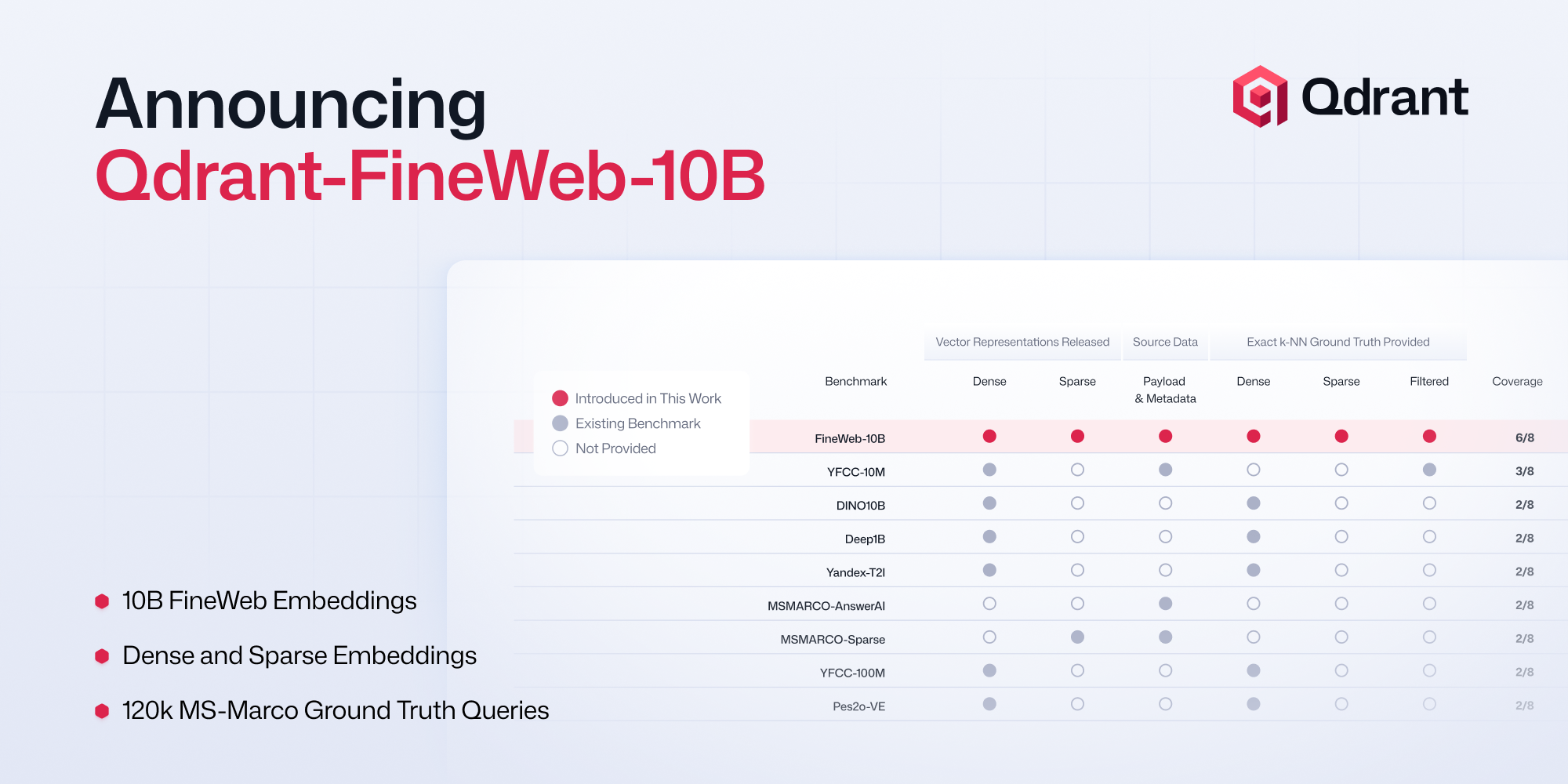
Qdrant is developing tools and datasets for production-grade research and benchmarking. This includes the release of large-scale datasets like Qdrant-FineWeb-10B and open-source benchmarking engines like Supernova, enabling reproducible and cost-effective evaluation of vector search systems at internet scale. The focus is on providing real data and ground truth for rigorous performance analysis.

1 post · 2026

Timeline

Feature trailActive

Vector Database Tradeoffs and Comparisons

Qdrant continues to be a core component for AI applications, with a focus on reliability, performance, and cost-efficiency. This post analyzes the trade-offs of using pgvector for vector search, highlighting that while it's suitable for small datasets and simple use cases, most applications will outgrow its capabilities due to limitations in metadata filtering, hybrid search, and scalability beyond ~1M vectors. Dedicated vector stores like Qdrant offer advantages in these areas, and synchronizat. Lyzr's adoption of Qdrant demonstrates significant improvements in AI agent performance, reducing query latency by over 90%, doubling indexing speed, and cutting infrastructure costs by 30%. This case study highlights Qdrant's ability to handle high concurrency (over 1,000 QPM) and large datasets, outperforming previous solutions like Weaviate and Pinecone in scalability, query throughput, and resource efficiency. Specific use cases with NTT Data and NPD further illustrate Qdrant's impact on retrieval accuracy and low-latency performance for customer-facing agents.

2 posts · 2023–2026

Timeline

20232026
Feature trailActive

Vector Search Tuning and Optimization

Qdrant continues to focus on providing users with the tools and knowledge to optimize vector search performance and relevance. This includes detailed guidance on tuning various collection settings, understanding the trade-offs between retrieval and ranking, and making informed decisions about hybrid search and reranker usage. The emphasis is on data-driven tuning based on measurable outcomes, moving away from guesswork. This post adds insights into hybrid retrieval, filtering strategies, embedding model integration (binary quantization), and cost-efficiency for large-scale AI applications in regulated industries.

4 posts · 2024–2026

Timeline

20242026
Feature trailActive

Composable Vector Search Infrastructure

Qdrant is being developed as fundamental infrastructure for AI, emphasizing composable vector search primitives that can be combined at query time. This approach aims to address architectural limitations encountered in production AI workloads, such as RAG and agents, by providing flexible and performant retrieval across diverse environments from edge devices to supercomputers. The focus is on building a robust, long-lasting engine that controls the stack down to assembly, written in Rust for performance and reliability. The company has secured Series B funding to further this mission.

2 posts · 2026

Timeline

Feature trailActive

Data Ingestion and Integration

Qdrant Hybrid Cloud offers flexible deployment across any environment (cloud, on-premise, edge), integrating with various infrastructure providers and AI frameworks like Airbyte and LangChain. This enables building AI applications such as RAG systems, chatbots, and recommendation engines, emphasizing data sovereignty and control. The platform supports scalable search engines for enterprises, handling millions of messages and evolving data models, including omnimodal data. The integration with Airbyte and LangChain simplifies data ingestion and application development.

46 posts · 2024–2026

Timeline

20242026
Feature trailActive

Data Deduplication and Quality Management

Qdrant enhances data quality management by detailing strategies to combat data duplication and staleness. The post emphasizes how repeated ingestion and evolving data models can degrade search recall and answer correctness. It highlights the use of Qdrant's idempotent point loading and payload filtering to maintain data integrity and improve retrieval quality. The importance of lifecycle management fields like `status`, `version`, `is_current`, and `updated_at` is stressed, along with the necessity of payload indexing for efficient filtering. This post details how these mechanisms prevent duplicate and stale data from negatively impacting retrieval performance and answer correctness, especially as collection size grows.

1 post · 2026

Timeline

Feature trailActive

Data Structure Optimization

Qdrant continues to enhance its core data structures and indexing capabilities to improve memory usage, storage efficiency, and query performance, particularly for multitenant workloads and large datasets. New features include defragmentation of tenant storage, on-disk support for payload indexes, and a more memory-efficient UUID datatype for payload indexes. The Query API has been expanded with a Groups endpoint for grouping results by payload fields, random sampling, and distribution-based score fusion.

1 post · 2024–2026

Timeline

20242026
Feature trailActive

Hackathon Project Showcase

Qdrant continues to be a versatile tool showcased in hackathons, demonstrating its application beyond traditional chatbot use cases. Projects span robotics, 3D e-commerce, spatial-temporal NPC behavior, route-aware event discovery, personality-driven social platforms, AI choreography, and multi-modal classroom assistants, highlighting its integration with various AI frameworks and technologies. This year's hackathon focused on innovative uses of Qdrant beyond RAG and simple chatbots, with submissions judged on Innovation, Creativity, and Technical Depth.

3 posts · 2025–2026

Timeline

20252026
Feature trailActive

GPU Accelerated Indexing

Qdrant continues to optimize performance for vector search, demonstrating significant speed improvements for disk-based retrieval. This post details benchmarks showing Qdrant achieving 2x higher throughput and 50% lower latency than Elastic's DiskBBQ at the same recall target, using significantly less CPU and RAM per node. This is achieved through advanced quantization (TurboQuant 4-bit), async disk scoring, and a two-stage retrieval process. The results highlight Qdrant's efficiency and perform. GPU indexing is now available, delivering up to 4x faster HNSW index builds on dedicated GPUs, beneficial for high-write workloads. Multi-AZ replication is introduced for enhanced availability with a 99.95% SLA. Audit logging is now available, capturing API operations for compliance and security.

4 posts · 2025–2026

Timeline

20252026
Feature trailActive

Relevance Score Boosting and Decay Functions

Qdrant enhances its relevance scoring capabilities by detailing the implementation and usage of decay functions (Linear, Exponential, Gaussian) within its score boosting functionality. These functions allow numeric payload fields or similarity scores to influence search relevance by transforming values into a 0.0-1.0 scale based on a target value and decay parameters (scale, midpoint). The post provides examples for use cases like time-based relevance, distance-based relevance, and price sensitivity. The Qdrant 1.14 release introduces a Score-Boosting Reranker that allows blending vector similarity with custom rules and context, enabling users to influence ranking using metadata like timestamps, location info, and numeric attributes. This allows for prioritizing content, recency, or geographical proximity in search results.

2 posts · 2025–2026

Timeline

20252026
Feature trailActive

Vector Data Migration

Qdrant continues to be a core component for AI applications, with a focus on reliability, performance, and cost-efficiency. This post details the launch of the beta Qdrant Vector Data Migration Tool, designed to simplify moving data between different instances, whether migrating between Qdrant deployments or switching from other vector database providers. The tool streams all vectors from a source collection to a target Qdrant instance in live batches, supporting migrations from open source to Qdrant Hybrid Cloud. Dust's experience highlights the challenges of scaling with per-collection architectures and the benefits of consolidating into multi-tenant collections with Qdrant, leveraging features like scalar quantization for significant performance and cost improvements. They also emphasize the importance of pairing vector search with structured query capabilities and plan for future enhancements like multi-region sharding and support for new embedding models.

2 posts · 2025–2026

Timeline

20252026
Feature trailActive

Real-time Computer Vision at Scale

Qdrant enables real-time multimodal similarity search for fraud and abuse detection at Flipkart, processing high-dimensional embeddings from images and other data sources to reduce detection time from hours to minutes. This capability is being expanded for company-wide RAG systems, standardized Kubernetes deployments, and agentic AI workflows. VISUA leverages Qdrant for quality control and anomaly detection in computer vision data, achieving 40x faster query processing and a 10x scalability boost.

1 post · 2024–2026

Timeline

20242026
Feature trailCooling

AI Framework Orchestration

Qdrant continues to explore and integrate with AI frameworks to enhance LLM application development. This post discusses the challenges and strategies for using LLMs as judges for evaluating chatbot responses, focusing on cost-effectiveness and real-time assessment. It highlights the use of smaller models for evaluation, the importance of tailored metrics, and techniques for mitigating issues like hallucinations and jailbreaking. The discussion touches upon integrating evaluation into the development lifecycle. The official Qdrant node for n8n is now available, allowing seamless integration of Qdrant's full capabilities, including hybrid search, reranking, and advanced filtering, directly into n8n workflows. This eliminates the need for HTTP nodes and simplifies the development of RAG systems, agentic pipelines, and data analysis tools.

4 posts · 2024–2025

Timeline

20242026
Feature trailCooling

Role-Based Access Control

Qdrant continues to enhance its security and management capabilities with granular access control via JSON Web Tokens (JWT) for Role-Based Access Control (RBAC), Single Sign-On (SSO), and granular Database API Keys. This allows for fine-grained permissions for users and external applications, restricting access to sensitive endpoints and data. The release also includes optimized shard transfers using the WAL delta method, reducing transfer times significantly, and native support for uint8 embeddings, offering memory savings and speed-ups. Minor improvements include enhanced snapshotting performance and improved sparse vector search.

2 posts · 2024–2025

Timeline

20242026
Feature trailQuiet since 2024

Vendor Lock-in Mitigation

Qdrant Hybrid Cloud offers deployment flexibility across cloud, on-premises, and edge environments, integrating with various infrastructure providers and AI frameworks. This approach aims to mitigate vendor lock-in by enabling users to run Qdrant on Kubernetes clusters in any setting, providing a unified, enterprise-grade managed service. The focus is on data sovereignty, continuous integration, and allowing businesses to switch cloud providers more easily. This post details the integration with Kubernetes and its benefits for hybrid deployments.

4 posts · 2024

Timeline

20242026
Feature trailQuiet since 2024

Security Vulnerability Response

Qdrant continues to enhance its security posture by addressing vulnerabilities. Following CVE-2024-2221, the company has now patched CVE-2024-3829, an arbitrary file upload vulnerability affecting versions prior to v1.9.0. The fix restricts file uploads to a dedicated folder, and Qdrant cloud deployments were not materially affected due to read-only filesystems and default authentication. Users are advised to upgrade to v1.9.0 or above.

2 posts · 2024

Timeline

20242026
Feature trailQuiet since 2022

ARM Architecture Support

Qdrant now supports the ARM architecture, providing Docker images compiled specifically for ARM users. Performance benchmarks show that ARM64 is approximately 10% slower on average and 20% slower on the median for vector search compared to x86, but offers more consistent performance and cost savings on cloud providers like AWS.

1 post · 2022

Timeline

20222026
Feature trailQuiet since 2022

ARM Architecture Support

Qdrant now officially supports the ARM architecture, providing compiled Docker images for ARM users. Performance benchmarks indicate that ARM64 is approximately 10% slower on average and 20% slower on the median for vector search compared to x86, but offers more consistent performance and cost savings on cloud providers like AWS.

1 post · 2022

Timeline

20222026