Blogs›SingleStore Feature Trails
See how major capabilities shipped, upgraded, and evolved across SingleStore's engineering blog.
Publishing pulse
2026–2026 · peak 2026
29 posts mapped

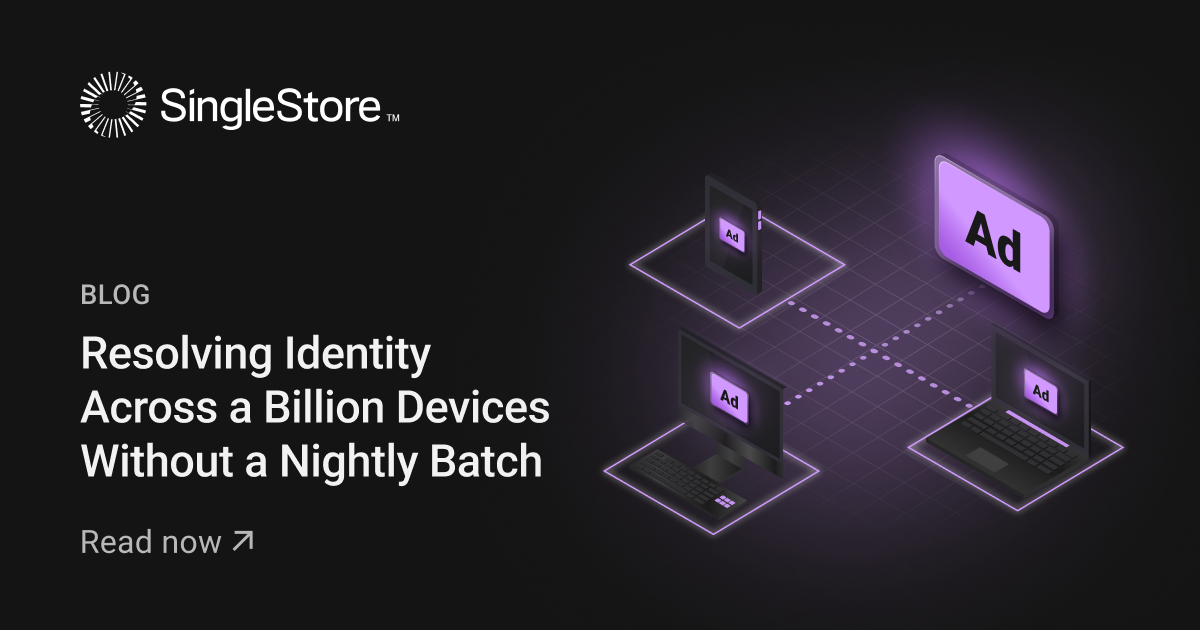
SingleStore Helios and its third-generation cluster architecture provide robust disaster recovery capabilities. This includes multi-AZ deployments for node and AZ failures, with automatic failover. For regional outages, Smart Disaster Recovery (Smart DR) offers continuous asynchronous replication of data, workspace topology, user accounts, permissions, pipelines, firewall settings, and configuration metadata to a secondary region. Failover is automated, with an RPO as low as approximately 10 minutes. This post extends this by demonstrating how continuous resolution of identity graphs, enabled by SingleStore's ability to handle transactional updates and analytical joins, eliminates the latency of nightly batch processing, allowing for real-time attribution, targeting, and frequency capping in AdTech platforms.
Timeline

SingleStore Helios and Helios BYOC have achieved PCI DSS v4.0.1 compliance, demonstrating robust security controls for handling payment card data. This includes identity and access management with MFA and SSO, encryption at rest and in transit (TLS 1.2+, AES-256), continuous monitoring of logs, regular vulnerability management, and secure cloud infrastructure on AWS with network segmentation. The compliance covers the managed platform, with shared responsibility for application-level security. This post further clarifies the scope and implications of PCI DSS compliance, detailing the shared responsibility model between SingleStore and the customer, and emphasizing that compliance is an ongoing process involving regular audits, risk assessments, and vulnerability management.
Timeline

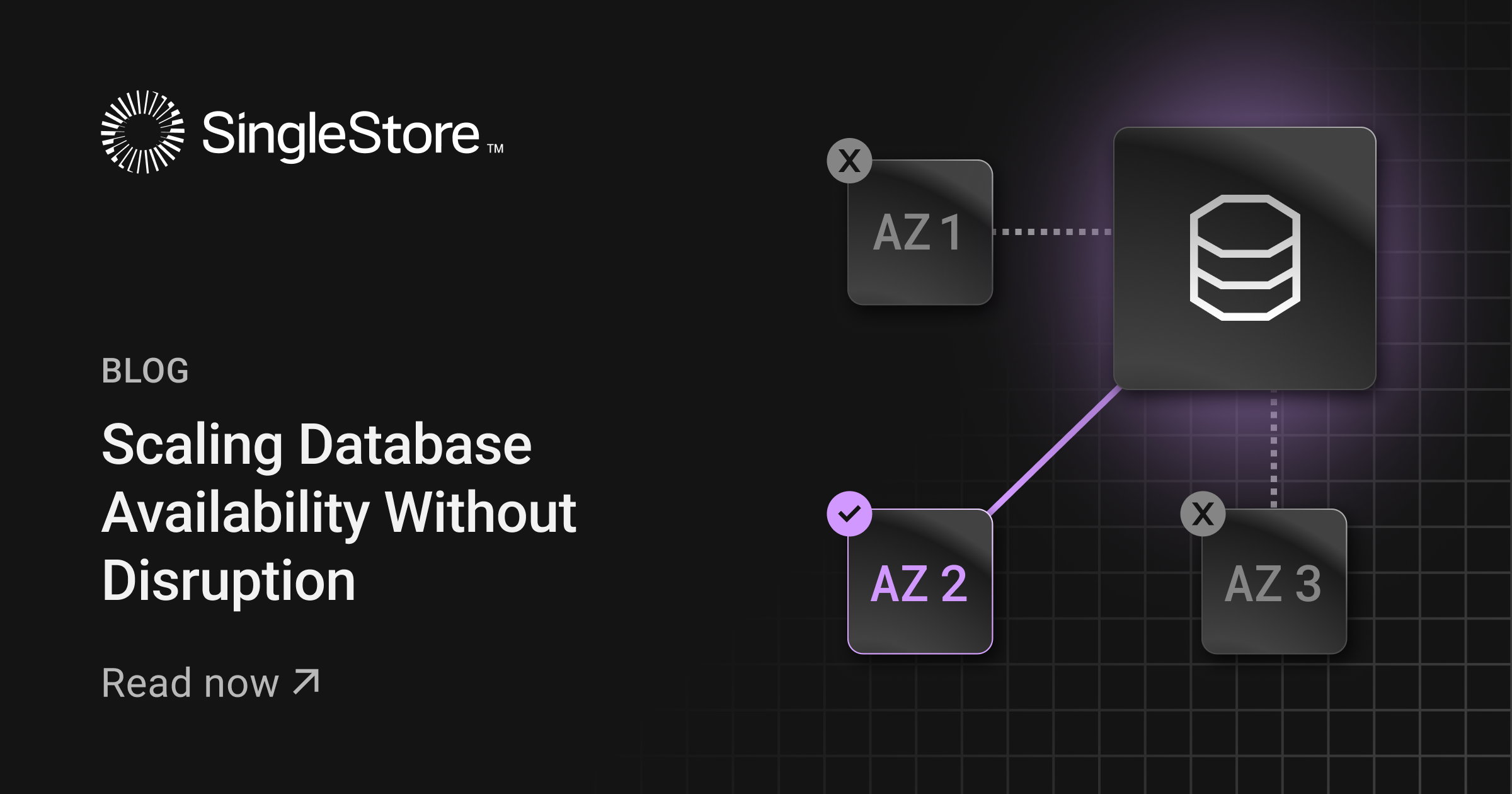
SingleStore's third generation cluster architecture introduces a zero-copy data fabric that allows compute clusters to attach to any database without data duplication. This enables direct support for Apache Iceberg, facilitating agentic applications by allowing read, write, and reasoning operations on open data formats. Features like Smart Read Replicas, Database Branching, and Smart DR leverage this fabric for independent scaling, rapid environment creation, and efficient disaster recovery, all while enabling Online AZ Migration, allowing customers to reconfigure a running deployment between single-AZ and multi-AZ operation without taking applications offline or migrating databases. This capability is possible because the database is built around independently managed partitions rather than a single machine that owns the entire dataset. If a leaf node becomes unavailable, the distributed query engine simply redirects work to healthy replicas for the affected partitions. The remainder of the query plan continues executing normally across the rest of the cluster. SingleStore refers to this capability as leaf fanout failover. Recovery occurs at partition granularity instead of server granularity, allowing failures to be isolated to a much smaller portion of the system.
Timeline

This post introduces the concept of a dedicated execution engine as a critical component for realizing the full potential of data lakehouses. It argues that while object storage and open table formats provide a foundation for data centralization and accessibility, the performance, concurrency, and transactional capabilities required for operational workloads and real-time analytics are determined by the execution layer. The post highlights the limitations of storage-first models in handling frequent updates and complex queries. SingleStore and HPE Alletra Storage MP X10000 enable enterprises to scale AI and analytics applications outside traditional cloud-only environments by providing a high-performance, S3-compatible object storage platform that serves as the storage layer for SingleStore's disaggregated compute and storage architecture. This allows for running modern HTAP workloads while keeping data in self-managed environments, offering scalable storage for growing datasets, predictable infrastructure costs, and greater control over data location. Performance testing showed SingleStore on HPE Alletra Storage MP X10000 performing comparably to public cloud deployments for OLTP workloads and outperforming them by over 30% for analytical workloads on a 10 TB dataset.
Timeline

SingleStore's AI Database Assistant integration is evolving beyond basic natural language querying and schema exploration. The focus is shifting towards embedding intelligence directly within the operational core of enterprise systems, enabling platforms to actively participate in contextual understanding. This involves moving AI from external environments and disconnected systems to become a foundational enterprise capability that interprets operational complexity in real-time, directly within workflows, reducing friction for human decision-making and accelerating understanding.
Timeline

This post details the operational considerations for running SingleStore on Kubernetes in production, covering architecture, storage, node sizing, upgrades, failure handling, scaling, observability, and backup/recovery. It contrasts self-managed Kubernetes deployments with the managed SingleStore Helios offering.
Timeline