Blogs
SingleStore logo

SingleStore

Engineering blog · singlestore.com/blog

42posts0this week0watchers

Feature trails

15
Feature trailActive

AI Query Tuning Agent

SingleStore's Query Tuning Agent leverages AI to analyze slow SQL queries and debug profiles, providing prioritized, evidence-backed tuning recommendations. It automates the process of identifying bottlenecks related to distributed execution, data skew, shard key choices, sort keys, cardinality estimation, and more. The agent integrates into existing workflows like Visual Explain and the SQL Editor, offering a safer and more scalable way to optimize complex workloads by providing expert-level in-database optimization. Feedback Reoptimization (FR) is SingleStore's answer to automatic query optimization. Instead of relying solely on statistics collected before execution, FR watches what actually happens when a query runs — how many rows really flowed through each operator, how much memory was actually consumed — and uses that observed reality to generate a better plan. It corrects the map by watching where queries actually end up. FR has four stages: observe, identify, replan, and validate. The validation stage compares candidate plans against the original, adopting only those that show clear improvement. FR's impact tracks data skew, with more significant improvements on datasets with extreme skew.

2 posts · 2026

Timeline

Feature trailActive

AI Database Assistant Integration

SingleStore's AI Database Assistant integration is evolving beyond basic natural language querying and schema exploration. The focus is shifting towards embedding intelligence directly within the operational core of enterprise systems, enabling platforms to actively participate in contextual understanding. This involves moving AI from external environments and disconnected systems to become a foundational enterprise capability that interprets operational complexity in real-time, directly within the database. The latest iteration introduces an Observability Agent that diagnoses system health issues by analyzing monitoring data and tracing symptoms to their root causes, significantly reducing investigation time from hours to minutes. This agent acts as an intelligent assistant for debugging and performance analysis, providing evidence-backed recommendations without taking direct action.

6 posts · 2026

Timeline

Feature trailActive

Real-time Data Ingestion and Querying

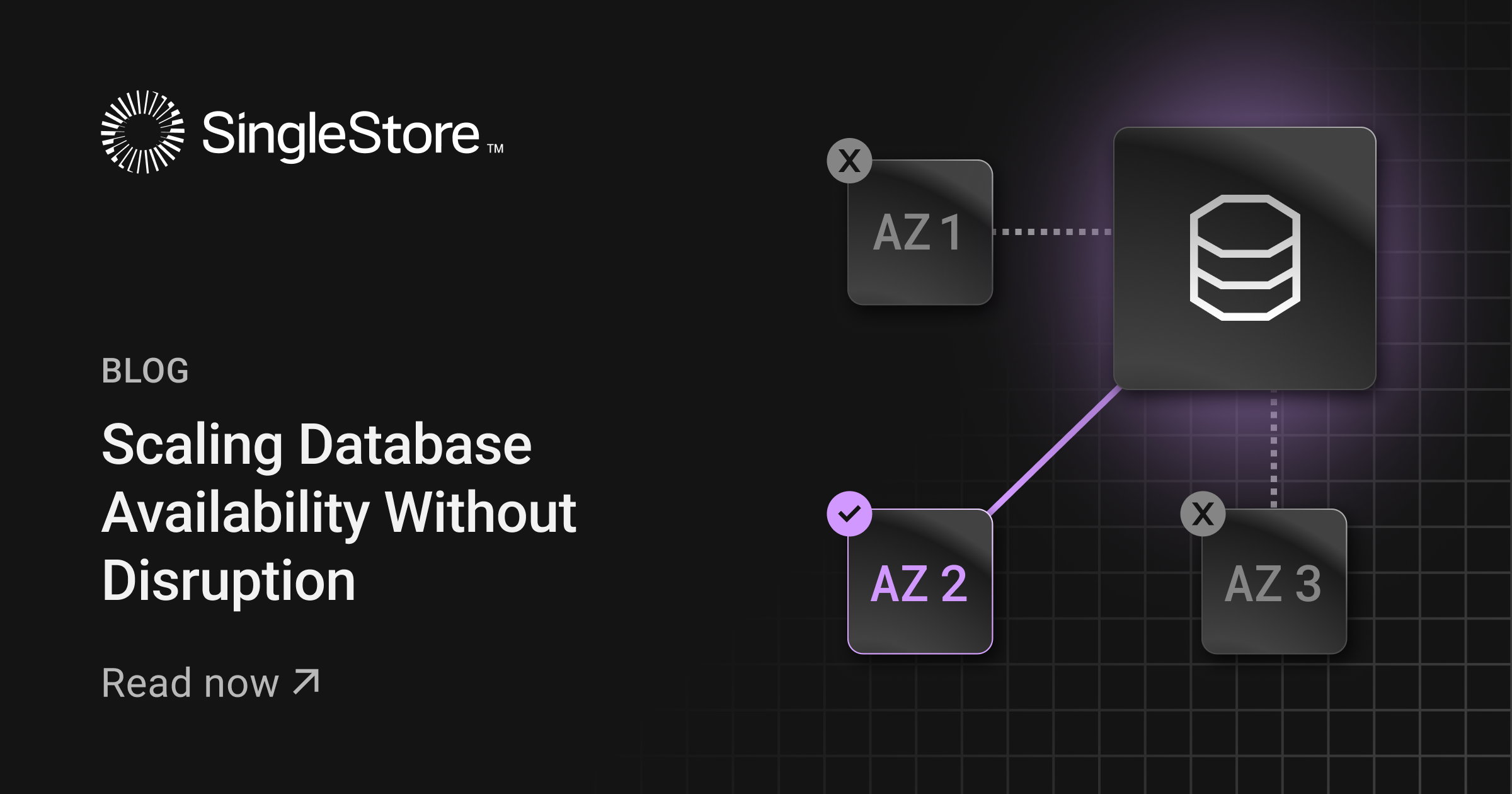
SingleStore Helios and its third-generation cluster architecture provide robust disaster recovery capabilities. This includes multi-AZ deployments for node and AZ failures, with automatic failover. For regional outages, Smart Disaster Recovery (Smart DR) offers continuous asynchronous replication of data, workspace topology, user accounts, permissions, pipelines, firewall settings, and configuration metadata to a secondary region. Failover is automated, with an RPO as low as approximately 10 min. This post extends this by detailing how a unified engine, processing transactional and analytical workloads against a single shared data copy, eliminates batch windows and sync pipelines, enabling AI agents and copilots to evaluate the live state of a facility directly. It positions SingleStore as a real-time front layer complementing existing warehouses/lakehouses for high-volume transactions, operational updates, concurrent analytics, and low-latency joins.

19 posts · 2026

Timeline

Feature trailActive

Python UDFs for Custom Logic

SingleStore's Python UDFs allow users to embed custom Python logic directly within the database, enabling efficient execution of complex transformations and computations on large datasets without moving data externally. This capability addresses the need for integrating specialized algorithms, such as phonetic matching, directly into the data platform, improving performance, reducing operational complexity, and enhancing compliance by keeping processing on-platform. It supports a repeatable pattern for incorporating custom logic that doesn't fit neatly into SQL.

1 post · 2026

Timeline

Feature trailActive

Data Lakehouse Execution Engine

SingleStore's Universal Storage architecture unifies rowstore and columnstore, enabling independent scaling of compute clusters. This post clarifies that while lakehouses provide flexible and cost-effective data storage in open formats, a robust execution engine is crucial for interactive workloads, real-time analytics, and AI systems. The engine, not just the storage, defines the system's performance, concurrency, and latency characteristics. SingleStore's engine is designed to handle ingestion, queries, and updates with low and predictable latency, supporting transactional and analytical workloads within the same system, moving beyond a simple data repository to support applications, real-time analytics, and AI systems.

4 posts · 2026

Timeline

Feature trailActive

HTAP Database for Fintech Scale

SingleStore's HTAP architecture, combining rowstore and columnstore in Universal Storage, addresses the scaling challenges faced by fast-growing fintechs beyond $100M ARR. It enables distributed writes, transactional and analytical processing on the same data without synchronization layers, native vector and full-text search, compliance readiness, elastic multi-tenancy, and predictable operational overhead. This positions SingleStore as a unified data layer for regulated SaaS platforms, supporti. This post details the specific technical constraints of PostgreSQL at scale (single-writer bottleneck) and contrasts the 'bolt-on' trap of specialized tools with the architectural benefits of a unified HTAP system for regulated SaaS and fintech, emphasizing distributed writes, transactions and analytics on the same data, native AI features, and compliance readiness. It outlines a service-by-service, incremental migration strategy using managed ingestion tools like SingleStore Pipelines and Flow.

1 post · 2026

Timeline

Feature trailActive

Composable AI Network Architecture

SingleStore's architecture is evolving to support a network of specialized AI models and agents, moving away from monolithic AI systems. This involves leveraging its distributed SQL capabilities for high concurrency and low-latency access to fresh enterprise data, enabling independent scaling and evolution of AI components. The focus is on data freedom through open formats like Apache Iceberg and integrating AI intelligence directly within the operational core. This post emphasizes the architect's role in building a real-time converged data architecture for agentic AI, highlighting the five building blocks: continuous ingestion, multi-pattern query support on one engine, machine-scale concurrency, multimodal data without cross-system joins, and compute close to data. SingleStore's HTAP engine, Universal Storage, hybrid search, and Aura GPU-aware compute are positioned as key components of this convergence layer, distinct from traditional data warehouses.

1 post · 2026

Timeline

Feature trailActive

Identity Resolution with Distributed SQL

SingleStore's distributed SQL engine is presented as a superior alternative to traditional graph databases and lakehouse batch processing for identity resolution workloads. It enables continuous, real-time merging of device signals, logins, and household identifiers, overcoming the limitations of nightly batch updates. This leads to more accurate attribution, frequency capping, and consent management, while also addressing the growing engineering bottleneck of recomputing large identity graphs. This post details how incoming signals resolve incrementally against a live graph, ensuring new edges are ready for attribution, targeting, and frequency capping within seconds, and how opt-out requests are processed in seconds, providing a defensible audit trail.

1 post · 2026

Timeline

Feature trailActive

Online AZ Migration

SingleStore's third generation cluster architecture introduces a zero-copy data fabric that allows compute clusters to attach to any database without data duplication. This enables direct support for Apache Iceberg, facilitating agentic applications by allowing read, write, and reasoning operations on open data formats. Features like Smart Read Replicas, Database Branching, and Smart DR leverage this fabric for independent scaling, rapid environment creation, and efficient disaster recovery, all

1 post · 2026

Timeline

Feature trailActive

PCI DSS Compliance

SingleStore Helios and Helios BYOC have achieved PCI DSS v4.0.1 compliance, demonstrating robust security controls for handling payment card data. This includes identity and access management with MFA and SSO, encryption at rest and in transit (TLS 1.2+, AES-256), continuous monitoring of logs, regular vulnerability management, and secure cloud infrastructure on AWS with network segmentation. The compliance covers the managed platform, with shared responsibility for application-level security. This post details the implementation of Zero Trust principles across four pillars: identity verification, access control, network restriction, and data protection, providing concrete controls and technical details for each.

9 posts · 2026

Timeline

Feature trailActive

Secure SDLC Practices

SingleStore is evolving its approach to enterprise cloud security by embedding security into its Software Development Lifecycle (SDLC). This involves a shift from point-in-time compliance audits to continuous security practices, including domain-specific security training, mandatory threat modeling for all new features, defining and embedding security requirements early in the design phase, active architecture vetting with security experts, secure code reviews by security-trained engineers, and automated security testing integrated into the CI/CD pipeline. This comprehensive approach aims to ensure security is a continuous property of the development process, not just a checkpoint.

1 post · 2026

Timeline

Feature trailActive

Cloud Database Encryption Keys

SingleStore Helios offers a spectrum of encryption control for data at rest, ranging from platform-managed encryption using cloud provider KMS keys to Customer-Managed Encryption Keys (CMEK) for enhanced data sovereignty and control. CMEK allows customers to supply their own encryption keys via AWS KMS, Azure Key Vault, or GCP KMS, enabling cryptographic erasure and meeting stringent regulatory requirements. The system utilizes envelope encryption where customer-managed keys (KEKs) encrypt data encryption keys (DEKs). This post details the technical architecture, access control, revocation mechanisms, and critical data loss risks associated with CMEK, guiding users on choosing the appropriate encryption model based on their security and compliance needs.

1 post · 2026

Timeline

Feature trailActive

AI Application Infrastructure Scaling

SingleStore's architecture, particularly its Unlimited Storage and separation of compute from storage, enables enterprises to scale AI and analytics applications. This includes supporting HTAP workloads, offering flexibility in deployment (cloud, hybrid, on-premises), and providing performance comparable to or exceeding cloud-only solutions, especially for analytical workloads. The integration with platforms like HPE Alletra Storage MP X10000 provides an S3-compatible object storage layer for se

1 post · 2026

Timeline

Feature trailActive

Enterprise Identity and Access Management Integration

SingleStore Helios is evolving its enterprise identity integration beyond basic SSO to encompass a comprehensive lifecycle management solution. This includes deep integration with SAML 2.0 and OIDC for federated authentication, leveraging customer-defined MFA and conditional access policies. Furthermore, SCIM 2.0 is implemented for automated user provisioning and deprovisioning, synchronizing user and group status in real-time with identity providers. The platform also supports machine identity through cloud IAM integration (AWS IAM, Azure AD, GCP IAM) and direct JWT validation, eliminating static credentials for automation. This provides a mature, multi-stage approach to identity management, moving from local accounts to fully automated, password-less machine identities, ensuring robust security and operational efficiency for enterprise customers.

1 post · 2026

Timeline

Feature trailActive

SingleStore on Kubernetes Operations

SingleStore's third generation cluster architecture introduces a zero-copy data fabric that allows compute clusters to attach to any database without data duplication. This enables direct support for Apache Iceberg, facilitating agentic applications by allowing read, write, and reasoning operations on open data formats. Features like Smart Read Replicas, Database Branching, and Smart DR leverage this fabric for independent scaling, rapid environment creation, and efficient disaster recovery, all while detailing the operational considerations for running SingleStore on Kubernetes in production, covering architecture, storage, node sizing, upgrades, failure handling, scaling, observability, and backup/recovery. It contrasts self-managed Kubernetes deployments with the managed SingleStore Helios offering and emphasizes the importance of disciplined validation and testing for production readiness.

1 post · 2026

Timeline