BlogsUber Feature Trails

Uber logo

Uber Feature Trails

See how major capabilities shipped, upgraded, and evolved across Uber's engineering blog.

Feature trails

27

Git as a Service for Large-Scale Monorepos

Active

Uber has developed GitFarm, a 'Git as a Service' platform to address the significant performance bottlenecks and infrastructure overhead associated with traditional Git workflows in large-scale monorepos. GitFarm acts as a centralized Git client, executing Git commands via a high-performance gRPC API within secure, ephemeral sandboxes backed by pre-warmed repository and container pools. This approach eliminates local clones, provides rapid access to repository checkouts (under 500ms), and drastically reduces client-side resource utilization by over 80% while preserving the flexibility of native Git semantics. The system supports multi-command workflows and employs specialized back-end clusters for workload isolation, improving overall efficiency and scalability for Git operations.

1 post

Timeline

Zone-Failure-Resilient OpenSearch

Active

Uber has achieved Zone Failure Resilience (ZFR) for its OpenSearch deployments by integrating OpenSearch's native shard allocation awareness with its in-house isolation-group infrastructure. This approach ensures that OpenSearch clusters can withstand the complete loss of a zone without impacting core functions like querying and data ingestion. Key components include using isolation groups for balanced node distribution across failure domains and employing forced shard allocation awareness to prevent disruptive rebalancing during zone outages. For cluster manager nodes, running 5 nodes with auto-shrink voting configuration further enhances resilience against multi-node failures.

1 post

Timeline

Digital Identity Verification with Mobile Wallets

Active

Uber has integrated Apple's Verify with Wallet API into its Identity Verification Platform to enable users to verify their identity using digital IDs stored in Apple Wallet. This platform-agnostic solution handles the orchestration of data elements, cryptographic validations according to ISO/IEC 18013-5, and the management of trust anchors for government-issued credentials. It supports multiple use cases across Uber's apps by centralizing request management and ensuring compliance with approved data scopes. The system uses HPKE for secure data transfer and performs rigorous validation of the Mobile Security Object, device binding, and issuer certificates. Future work includes supporting new digital document types and cross-platform integrations.

1 post

Timeline

AI-Powered Cart Generation and Management

Active

Uber is developing advanced AI capabilities to transform user interactions with its commerce platforms, starting with Uber Eats. This initiative focuses on moving beyond traditional search-based interactions to more intuitive, intent-driven experiences. Key developments include the Cart Assistant, which uses multi-prompt state graphs and LLMs to interpret natural language and image inputs, generate draft grocery carts, and manage complex constraints like pricing and quantity. This evolution aims to improve the user experience by enabling agentic grocery shopping, where the system plans and constructs a cart based on user intent, rather than requiring manual item-by-item search. The architecture involves a multi-prompt state graph with distinct stages for planning, retrieval, relevance judging, quantity selection, and guardrails, all driven by LLMs and deterministic systems. Evaluation-driven development is a core part of the process to ensure reliable measurement and improvement of the system's behavior.

1 post

Timeline

Data Abstraction Layer for Unified Data Access

Active

Uber has developed a Data Abstraction Layer (DAL) to simplify data integration and product development. The DAL acts as an RPC service between data consumers and producers, abstracting away the complexity of underlying data models and storage. It enables consumers to request data using a consistent interface, while empowering data producers to evolve their data models independently. The DAL orchestrates queries across various data sources, including OLAP, Hive, and MySQL, and handles table resolution and query generation to assemble a coherent response, significantly reducing the time to build new reports and enabling independent evolution of data models.

1 post

Timeline

Data Warehouse Decentralization and Federation

Active

Uber is undertaking a significant initiative to decentralize its monolithic data warehouse, addressing challenges of shared-fate outages, resource contention, operational bottlenecks, governance blind spots, and open ACLs. This evolution involves migrating large datasets into smaller, domain-specific units, leveraging a 'pointer manipulation' technique for zero-downtime migrations without data duplication. The system comprises a layered access model for security, with foundational primitives managed by a Bootstrap Migrator, Realtime Synchronizer, Batch Synchronizer, and Recovery Orchestrator. The Bootstrap Migrator handles one-time data copying and pointer updates, ensuring data integrity through distributed copying, checksum verification, and rigorous data quality checks. The pointer manipulation strategy updates the Hive Metastore to point to new HDFS locations, enabling seamless transitions and significant cost savings by avoiding data duplication.

3 posts

Timeline

20242026

AI-Powered File Semantic Analysis for Data Security

Active

Uber has developed an AI-powered File Semantic Analyzer (FSA) to enhance data security by semantically classifying files and identifying sensitive content. This system moves beyond traditional DLP methods by using Generative AI to understand the meaning and context of file contents, enabling more accurate identification of business-critical, personal, or neutral data. The FSA extracts summaries, entities, and infers intent, feeding into a policy enforcement layer. It incorporates human-in-the-loop validation and continuous learning to refine its accuracy and reduce alert fatigue. The system has significantly reduced incident response times for data exfiltration cases by providing immediate, high-level understanding of file content.

1 post

Timeline

Artifact Storage and Distribution

Active

Uber has evolved its artifact storage and distribution system from a legacy on-premise solution to a modern, cloud-native approach. The system was modernized by migrating to a managed SaaS offering for artifact storage and implementing an internal proxy layer for validation and cost optimization. This proxy layer reduces egress costs by over 99% by using conditional requests to avoid re-downloading unchanged artifacts, while maintaining comparable latency and reliability. The new architecture provides improved observability and ensures sustainable cost growth.

1 post

Timeline

AI Agent Identity and Provenance

Active

Uber is building a robust identity and access management system for AI agents to ensure accountability, auditability, and security as agentic autonomy increases. This involves establishing verifiable cryptographic identities for agents, propagating execution context across agent hops, and integrating with existing security infrastructure. The goal is to provide clear attribution for agent actions, enabling fine-grained access control and comprehensive auditing, ultimately fostering trust in AI-driven workflows.

3 posts

Timeline

20252026

Real-time Traffic Forecasting

Active

Uber has significantly enhanced its real-time traffic forecasting system, initially built over a decade ago. The latest iteration, DeepETT (Deep Estimated Travel Time), leverages deep learning, specifically a graph-aware transformer model, to improve arrival time accuracy, especially for longer trips. This multi-year effort focused on addressing challenges in rapidly changing traffic conditions, sparse road networks, and the compounding effects of segment-level inaccuracies on trip-level ETAs. The system now serves upwards of 2 million real-time forecasts per second, improving long-trip arrival time accuracy by 6% and boosting forecast variance explained by 19%. Key engineering decisions included decoupling training from the routing loop and using fixed-size inputs from pre-aggregated observations to maintain predictable inference and scale. The system defines contracts for segment-level and trip-level forecasts, decomposing metrics into resolution and calibration to manage the paradox of segment MSE improvements not always directly translating to trip MAE improvements. The model design utilizes local receptive fields with spatiotemporal views and context features to forecast segment-level ETTs.

1 post

Timeline

Incentive Optimization and Budget Management

Active

Uber has developed a sophisticated platform called Tarot (Targeting Orchestrator) to address the complex challenge of optimizing incentive allocation at scale. This system tackles the Multiple Knapsack Problem (MKP) by integrating uplift models with budget constraints, moving beyond heuristic-based approaches. Tarot enables dynamic ROI calculation by considering multi-objective optimization and strategic weighting, and employs a Budget Pacer to manage spend velocity and ensure quarterly budget adherence. The system has evolved to use a multi-lever optimizer with Google OR-Tools CP-SAT solver and incorporates a two-layer ROI calculation (prediction and valuation) to handle cross-vertical cannibalization and strategic weighting. The Budget Pacer acts as a control loop to reconcile configured budgets with observed and predicted spend, adjusting future allocations to maximize utilization and adhere to quarterly limits.

1 post

Timeline

AI-Powered Product Requirement Document (PRD) Evaluation

Active

Uber is enhancing its AI capabilities and product development lifecycle with advanced tools. Initially, the focus was on an AI system (PRD Evaluator) to act as a first-pass reviewer for Product Requirement Documents (PRDs), improving their quality by assembling context and identifying gaps. This has evolved to encompass AI-powered prototyping, accelerating concept exploration and team alignment. Furthermore, Uber is developing sophisticated in-house LLM training infrastructure (Michelangelo platform).

4 posts

Timeline

Go Runtime Stack Optimization

Active

Uber is actively optimizing the performance of its Go services, which constitute a significant portion of its infrastructure. This effort focuses on reducing CPU overhead by fine-tuning the Go runtime's stack allocation mechanisms and improving CPU resource allocation for containerized workloads. Initial work involved understanding and mitigating the costs associated with goroutine stack expansion, leading to the development of techniques to statically pre-allocate stack sizes and disable adaptive stack growth. This has resulted in significant CPU savings for specific services, with a plan to replicate these optimizations across more of Uber's Go services.

2 posts

Timeline

Cloud Commitment and Infrastructure Optimization

Active

Uber is developing a comprehensive approach to cloud commitments and infrastructure optimization, focusing on a layered engineering discipline. This involves deep analysis of regional and availability zone topology, power architecture, fit-for-purpose compute ecosystems, and silicon-level awareness for SKU selection. The goal is to ensure cost-effectiveness, performance, and operational autonomy in large-scale cloud deployments, moving beyond default provider offerings to tailor infrastructure t

1 post

Timeline

Corporate Network Automation with Ansible

Active

Uber has established a comprehensive automation strategy for its global corporate network (Corpnet) using Ansible. This initiative addresses the challenges of managing a large, diverse, and geographically distributed on-premises network infrastructure. By leveraging Ansible, Uber standardizes configuration management across thousands of devices, including switches, gateways, and firewalls, from multiple vendors. The system employs a 'Daily Nightly Enforcement' process that includes backing up existing configurations, generating desired configurations using Jinja templates based on inventory variables, and pushing these golden configurations to devices. This process ensures stability, provides a versioned record of network state, and overwrites any untracked manual adjustments, thereby reducing technical debt and guaranteeing operational readiness.

1 post

Timeline

Automated Bounding Box Annotation Validation

Active

Uber is developing advanced AI and ML-based systems to improve the quality and efficiency of data annotation processes. This includes a focus on validating bounding box annotations in videos to detect and correct errors such as ID swaps and position jumps, which are critical for building object trackers. The system uses a multi-stage pipeline involving feature extraction, ML classification (XGBoost), and post-processing to cluster errors for human review. This initiative aims to reduce annotatio

1 post

Timeline

Hybrid CPU Allocation for Stateful Containers

Active

Uber's Odin platform has evolved its CPU allocation strategy for stateful containers by introducing a hybrid model that combines dedicated and shared cores. This addresses the limitations of previous models that relied on one-minute averages and dedicated cores, which were insufficient for bursty CPU usage. The new model allows for over-allocation of shared cores pooled per host, with Linux's cpu.shares dynamically distributing CPU time during contention. The system also incorporates NUMA considerations for efficient memory access and in-place vertical scaling without relocating workloads. The decision-making for CPU allocation is currently host-level but is planned to move to a higher-level workload scheduler. Efforts are underway to bridge Kubernetes gaps for hybrid core allocation by factoring out cgroups management code into a standalone library and wrapping it into a Kubernetes CRI plugin. The goal is to reduce overprovisioning, increase fleet-wide CPU utilization, and maintain service-level performance guarantees.

1 post

Timeline

Delivery Search Platform Evolution

Active

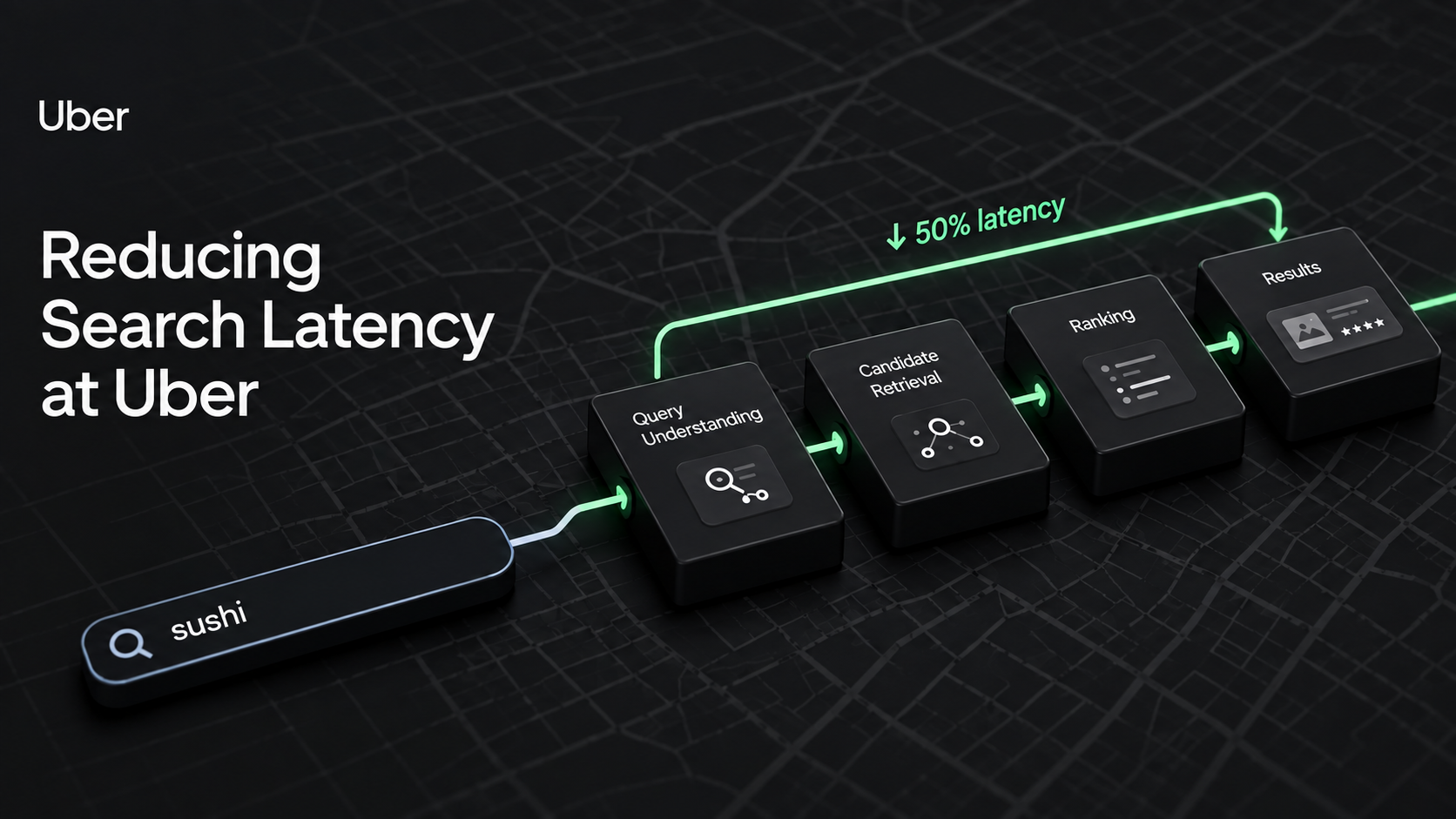
Uber has significantly evolved its Delivery Search Platform, moving from traditional lexical matching to a sophisticated semantic search system. This evolution addresses challenges in understanding complex user queries, including synonyms, typos, language mixes, and context. The platform now leverages deep learning models (Qwen backbone) with a two-tower architecture for real-time query embedding and batch document embedding. Key advancements include optimizing retrieval accuracy against infrastructure and compute costs through careful tuning of ANN parameters, quantization, and embedding dimensions, and ensuring safe, automated, and rollback-capable index deployments with strong validation, versioning, and real-time consistency checks in production.

1 post

Timeline

Design System Observability

Active

Uber is establishing a comprehensive Design System Observability framework to ensure consistent and high-quality user experiences across its global applications. This initiative addresses the challenge of maintaining design integrity at scale by providing tools and processes to measure and enforce adherence to the Base design system. Key components include the 'Deterministic Counter' (the 'eye') for visual identification and measurement of Base component adoption, and automated analysis pipeline. This has evolved to include an agentic system (uSpec) that leverages AI agents and Figma Console MCP to automate the generation of up-to-date component specifications, including anatomy, API, properties, color annotation, structure, and screen reader accessibility details, directly within Figma files. This significantly reduces the time and effort required for spec creation and maintenance, ensuring accuracy and consistency across multiple implementation stacks.

1 post

Timeline

Ads Personalization with Sequential Modeling and Hetero-MMoE

Active

Uber has enhanced its ads personalization system by incorporating sequential user behavior modeling with a target-aware transformer encoder and a novel Hetero-MMoE architecture. This evolution moves beyond static, aggregate features to capture temporal dynamics and evolving user intent using multi-head latent attention for efficient sequence summarization. The Hetero-MMoE framework blends MLP, DCN, and CIN experts to capture low- to high-order feature interactions more effectively, enabling more precise, context-aware ad predictions across diverse objectives like CTR and CTO. This architecture serves as a general foundation for multi-objective, multi-task modeling across the platform, leading to improved ad relevance, user engagement, and advertiser outcomes.

1 post

Timeline

Privileged Command Execution Gateway

Active

Uber has introduced the Superuser Gateway, a system designed to provide a safe, auditable, and reviewed path for executing dangerous privileged commands. This system replaces direct superuser access with a workflow involving peer review, automated validation, and controlled remote execution, significantly reducing the risk of accidental data corruption or system outages. Initially targeting data storage systems, the gateway aims to expand to other privileged systems across Uber. The evolution has involved migrating from direct engineer-held credentials to a centralized gateway service, incorporating a Git-backed PR workflow for review and automated validation jobs for syntax, permissions, and impact estimation. The system now handles hundreds of commands and has successfully migrated all admin engineers to this flow.

2 posts

Timeline

20252026

Mobile Analytics Standardization

Active

Uber has standardized its mobile analytics pipeline to address inconsistencies in event definitions, instrumentation, and metadata. This initiative involved defining core event types (Tap, Impression, Scroll) with standardized emission rules, incorporating common metadata at app and event levels, and implementing sampled event coverage for unmapped/disabled events. The goal is to improve data quality, reduce engineering effort, and enable more reliable cross-platform insights for product teams. The post details the implementation of standardized event types (Tap, Impression, Scroll) with specific emission rules, the introduction of common metadata at app and event levels, and the implementation of sampled event coverage for unmapped/disabled events. It also covers the pilot process, broad adoption strategies including centralized and distributed migrations, and the benefits realized by data consumers such as clear semantics, cross-platform parity, accurate impression counts, high reliability, and lower data volume via sampling.

1 post

Timeline

20252026

IAM Policy Simulation and Safety

Active

Uber has developed a Policy Simulator to enhance the safety and determinism of IAM policy changes. This system allows policy authors to preview the impact of proposed changes in real-time by replaying access logs against both the current and proposed policy sets. This helps prevent accidental outages caused by misconfigurations, particularly with grant removals or unintended privilege escalations. The simulator fetches access logs from various Policy Enforcement Points (PEPs), optimizes their ingestion into Apache Pinot for low-latency access, and then replays them on local authorization engines to compare outcomes. This ensures that policy changes are thoroughly validated before deployment, significantly reducing the risk of production incidents.

1 post

Timeline

20252026

Secrets Management Platform

Cooling

Uber has developed a comprehensive Secrets Management Platform to address widespread secrets sprawl, insecure sharing, and the challenges of managing over 150,000 secrets across thousands of microservices, databases, and third-party integrations. This initiative involves implementing preventive measures like pre-commit hooks to stop secrets from entering codebases, and remediation strategies including real-time and scheduled scanning of code, Slack conversations, logs, and container images. The platform has been extended to support automated periodic rotation of Kerberos keytabs, addressing the scale and complexity of managing over 100,000 keytabs across thousands of applications and nodes. This rotation process is designed to be failure-domain-aware, orchestrating keytab updates without human intervention and minimizing the risk of service disruption by carefully managing the Kerberos key version (kvno) during AS_REQ and AP_REQ phases. For AS_REQ, the system ensures sufficient TGT validity before rotation and minimizes the fetch time for new keytabs. For AP_REQ, servers are configured to maintain both previous and current key versions during the transition to prevent decryption failures. To further enhance safety, containerized applications have been migrated to use node-specific principals/keytabs to minimize blast radius.

2 posts

Timeline

20252026

Unified Checkout and Payment Ecosystem Streamlining

Cooling

Uber has developed a Unified Checkout platform to streamline its payment ecosystem across various Lines of Business (LOBs). This initiative addresses the historical challenge of implementing payment logic independently for each LOB, leading to inconsistencies, increased costs, and reduced velocity. Unified Checkout acts as a central layer, orchestrating payment methods, risk assessments, and user authentication flows. It offers modular and hosted solutions, abstracting payment complexity away from LOBs. The architecture includes a microservices-based backend that handles payment profile preparation, risk system invocation, and the execution of generic Checkout Actions. Checkout Actions are a stateless framework for guiding users through necessary steps like 2FA, clearing arrears, or authorizing payments, with pre-checkout and post-checkout phases. The system aims to enable unified payment method support and operations across all Uber LOBs.

2 posts

Timeline

20242026

Delegate Booking for Corporate Travel

Cooling

Uber has developed a Delegate Booking tool to streamline executive travel, empowering executive assistants (EAs) to manage bookings on behalf of their executives. This involves evolving the platform's participant model to support multiple user roles (executive and EA) interacting with a single trip, expanding the notification system for dual updates, and integrating the billing engine for accurate financial transactions. The architecture was overhauled across numerous services and platforms to accommodate this new model, enabling EAs to assign delegates, manage trip details, and receive real-time updates.

1 post

Timeline

20242026

Live Activity Integration for Rider App

Quiet since 2024

Uber has successfully integrated Apple's Live Activities feature into its Rider app, enabling users to receive real-time trip updates directly on their iOS devices without needing to open the application. This involved significant engineering efforts to overcome challenges related to limited UI space, lack of direct networking and state in Live Activities, dynamic asset handling, and ensuring reliable updates through a combination of background app execution, push notifications, and a new backend service for server-driven content.

1 post

Timeline

20242026