Blogs
Uber logo

Uber

Engineering blog · eng.uber.com

48posts1this week0watchers

Feature trails

34
Feature trailActive

AI Agent Identity and Provenance

Uber is building a robust identity and access management system for AI agents to ensure accountability, auditability, and security as agentic autonomy increases. This involves establishing verifiable cryptographic identities for agents, propagating execution context across agent hops, and integrating with existing security infrastructure. The goal is to provide clear attribution for agent actions, enabling fine-grained access control and comprehensive auditing, ultimately fostering trust in AI-d. Uber has developed the first generation of its Legal Redlining Agent (LRA), an AI-powered assistant integrated into Microsoft Word. LRA reviews contract edits, detects intent, recommends policy-aligned responses, generates structured comments, and flags risks. It has achieved over 20% reduction in contract review time and 91% accuracy in AI-generated decisions. The agent has evolved through multiple iterations, starting with RAG, then incorporating a robust feedback loop for continuous learning and adapting to lawyer preferences. A key refinement involved a dedicated LLM call for tone modulation, guided by legal team input on prompt anatomy to ensure appropriate communication style. The system leverages Uber's GenAI Gateway and has demonstrated significant improvements in efficiency and accuracy.

6 posts · 2025–2026

Timeline

20252026
Feature trailActive

AI-Powered Cart Generation and Management

Uber is developing advanced AI capabilities to transform user interactions with its commerce platforms, starting with Uber Eats. This initiative focuses on moving beyond traditional search-based interactions to more intuitive, intent-driven experiences. Key developments include the Cart Assistant, which uses multi-prompt state graphs and LLMs to interpret natural language and image inputs, generate draft grocery carts, and manage complex constraints like pricing and quantity. This evolution aims to improve model effectiveness by ensuring training and inference feature consistency through a feature logging framework, addressing bandwidth, volume, feature name length, and selective logging challenges. The system logs features at inference time, uses a feature allow list, feature name aliasing via enums, and impression filtering with Flink for efficient data processing and storage.

2 posts · 2026

Timeline

Feature trailActive

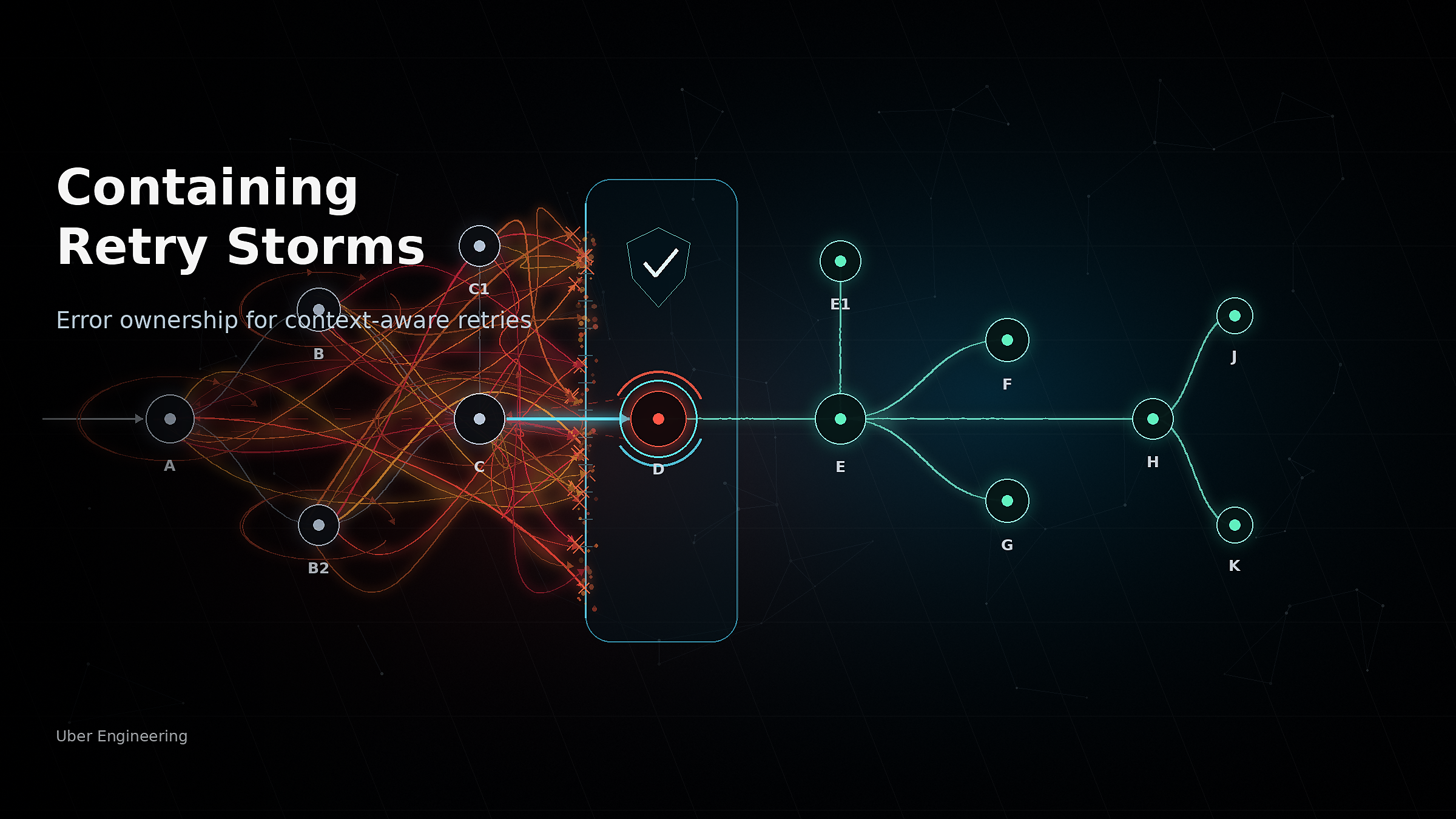
Retry Storm Mitigation

Uber has developed a context-aware mechanism in shared infrastructure to protect against retry storms. This system establishes error ownership by correlating inbound failures with outbound failures, allowing retries only when the error originates from the service itself. This prevents cascading failures caused by deep dependency chains and fan-out patterns, improving system reliability and user experience. This post details the large-scale automated dependency analysis across Uber's service mesh and introduces an intelligent load manager that detects overload from multiple signals to keep databases stable and fair under pressure, utilizing CoDel queues for controlled delay, a Scorecard engine for per-tenant fairness, and plug-in regulators for specific overload conditions like write bytes, partition keys, memory, and goroutines.

3 posts · 2026

Timeline

Feature trailActive

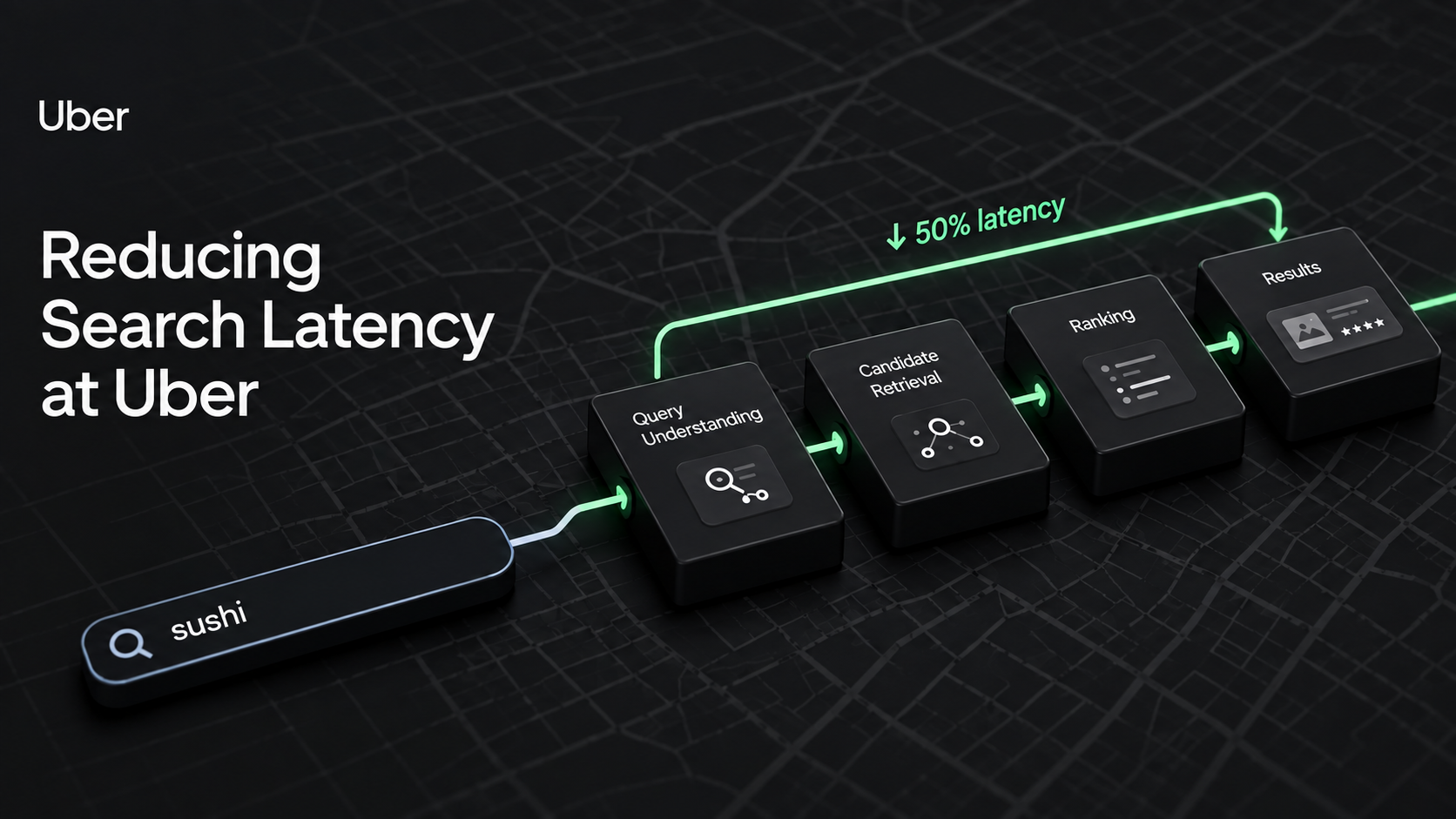
Delivery Search Platform Evolution

Uber has significantly evolved its Delivery Search Platform, moving from traditional lexical matching to a sophisticated semantic search system leveraging deep learning models (Qwen backbone) with a two-tower architecture for real-time query embedding and batch document embedding. Key advancements include optimizing retrieval accuracy against infrastructure and compute costs through careful tuning of ANN parameters, quantization, and embedding dimensions, and ensuring safe, automated, and rollba. This post details the development and application of Two-Tower Embeddings (TTE) for recommendation systems, focusing on Uber Eats. It describes the architecture, challenges, and scalability benefits of TTE compared to previous models like Deep Matrix Factorization (DeepMF). The post highlights how TTE enables efficient candidate retrieval by generating embeddings for users and items, facilitating faster and more personalized recommendations. Future use cases for TTE in item feed ranking and generating transferable features for other domains are also discussed.

3 posts · 2026

Timeline

Feature trailActive

Multi-Controller Compute Orchestration

Uber evolved its compute platform to support multiple scaling controllers for stateless workloads. This transition from a single orchestrator model to a system with multiple controllers, including a new ServiceScale Controller, addresses the need to safely manage scaling decisions from different sources like normal operations and failover events. The architecture introduces new CRDs and controllers to handle these multi-writer scenarios, along with mechanisms to ensure consistency and reliability in Kubernetes environments.

1 post · 2026

Timeline

Feature trailActive

M3DB Subclustered Placement Algorithm

Uber has evolved its M3DB database architecture by introducing a subclustered placement algorithm. This addresses operational reliability and maintenance overhead issues encountered with traditional sharded placement in large clusters. The subclustered approach partitions nodes into self-contained groups, each owning a distinct shard space, thereby reducing the blast radius of failures and enabling greater parallelism in cluster operations. A greedy shard donation strategy is employed during scale-up to minimize intra-subcluster skew and avoid costly rebalancing operations. This enhancement improves the scalability and maintainability of M3DB deployments.

1 post · 2026

Timeline

Feature trailActive

Data Warehouse Decentralization and Federation

Uber has developed a chunked aggregation buffer strategy to overcome JVM memory limitations when computing exact distinct counts for high-cardinality non-rollup metrics in distributed data pipelines. This strategy partitions the bitmap aggregation buffer across a map, keyed on the top 16 bits of each hashed identifier, effectively eliminating the 2 GB JVM constraint and enabling concurrent execution of backfill jobs. This has reduced two-year backfill time by 65% on average and eliminated out-of-memory failures. The solution is generalizable beyond Uber's stack and addresses challenges in computing metrics like monthly active users at scale.

5 posts · 2024–2026

Timeline

20242026
Feature trailActive

Unified Checkout and Payment Ecosystem Streamlining

Uber has developed a Unified Checkout platform to streamline its payment ecosystem across various Lines of Business (LOBs). This initiative addresses the historical challenge of implementing payment logic independently for each LOB, leading to inconsistencies, increased costs, and reduced velocity. Unified Checkout acts as a central layer, orchestrating payment methods, risk assessments, and user authentication flows. It offers modular and hosted solutions, abstracting payment complexity away from individual LOBs. This post details the evolution of Uber's Payments Platform (Gulfstream) over a decade, highlighting core principles like immutable money orders, zero-sum accounting, and strongly consistent ledger balances. It describes the migration from DynamoDB to a custom LedgerStore, the introduction of Entity Fares to enforce zero-sum at computation, and the specialized batch-write mechanism to solve the hot entity problem for B2B growth. The platform's evolution into a multi-tenant Ledger-as-a-Service model is also discussed, enabling various Uber services like Uber Cash, Uber Money, and Uber for Business. The platform's LOB-agnostic and payment-instrument-agnostic design principles have allowed it to scale to numerous product lines and payment methods with minimal core platform changes.

3 posts · 2024–2026

Timeline

20242026
Feature trailActive

Git as a Service for Large-Scale Monorepos

Uber has developed GitFarm, a 'Git as a Service' platform to address the significant performance bottlenecks and infrastructure overhead associated with traditional Git workflows in large-scale monorepos. GitFarm acts as a centralized Git client, executing Git commands via a high-performance gRPC API within secure, ephemeral sandboxes backed by pre-warmed repository and container pools. This approach eliminates local clones, provides rapid access to repository checkouts (under 500ms), and drastically reduces client-side resource utilization by over 80% while preserving the flexibility of native Git semantics. The system enforces identity-scoped authorization, supports multi-command workflows, and leverages specialized back-end clusters for workload isolation.

1 post · 2026

Timeline

Feature trailActive

Zone-Failure-Resilient OpenSearch

Uber has achieved Zone Failure Resilience (ZFR) for its OpenSearch deployments by integrating OpenSearch's native shard-allocation awareness features with its in-house isolation-group infrastructure. This approach ensures that OpenSearch clusters can withstand the complete loss of a zone without impacting core functions like querying and data ingestion. Key components include using isolation groups for balanced node distribution across failure domains and employing forced shard allocation awareness to prevent aggressive rebalancing during failures. The system can tolerate a full zone outage plus an additional node failure while still retaining quorum and preventing data loss, by running at least 3 shard copies and 5 cluster manager nodes with auto-shrink voting configuration.

1 post · 2026

Timeline

Feature trailActive

Digital Identity Verification with Mobile Wallets

Uber has integrated Apple's Verify with Wallet API into its Identity Verification Platform to enable users to verify their identity using digital IDs stored in Apple Wallet. This platform-agnostic solution handles the orchestration of data elements, cryptographic validations according to ISO/IEC 18013-5, and the management of trust anchors for government-issued credentials. It supports multiple use cases across Uber's apps by centralizing request management and ensuring compliance with approved data elements. The system has been scaled to handle multiple use cases and data elements, with a focus on platform agnosticism, cryptographic validation, and robust trust anchor management for evolving government issuing authorities.

1 post · 2026

Timeline

Feature trailActive

Data Abstraction Layer for Unified Data Access

Uber has developed a Data Abstraction Layer (DAL) to simplify data integration and product development. The DAL acts as an RPC service between data consumers and producers, abstracting away the complexity of underlying data models and storage. It enables consumers to request data using a consistent interface, while empowering data producers to evolve their data models independently. The DAL orchestrates queries across various data sources, including OLAP, Hive, and MySQL, and handles table resolution and query generation to satisfy consumer requests, significantly reducing the time to build new reports and enabling dynamic metric rollups.

1 post · 2026

Timeline

Feature trailActive

AI-Powered File Semantic Analysis for Data Security

Uber has developed an AI-powered File Semantic Analyzer (FSA) to enhance data security by semantically classifying files and identifying sensitive content. This system moves beyond traditional DLP methods by using Generative AI to understand the meaning and context of file contents, enabling more accurate identification of business-critical, personal, or neutral data. The FSA extracts summaries, entities, and infers intent, feeding into a policy enforcement layer. It incorporates human-in-the-loop validation and continuous learning to refine its accuracy and relevance.

1 post · 2026

Timeline

Feature trailActive

Artifact Storage and Distribution

Uber has evolved its artifact storage and distribution system from a legacy on-premise solution to a modern, cloud-native approach. The system was modernized by migrating to a managed SaaS offering for artifact storage and implementing an internal proxy layer for validation and cost optimization. This proxy layer reduces egress costs by over 99% by using conditional requests to avoid re-downloading unchanged artifacts, while maintaining comparable latency and reliability. The new architecture provides high-performance gRPC endpoints for OpenSearch, enabling faster ingestion and search by replacing REST/JSON APIs with efficient binary serialization and streaming. This work contributes back to the OpenSearch open-source ecosystem.

2 posts · 2026

Timeline

Feature trailActive

Real-time Traffic Forecasting

Uber has significantly enhanced its real-time traffic forecasting system, initially built over a decade ago. The latest iteration, DeepETT (Deep Estimated Travel Time), leverages deep learning, specifically a graph-aware transformer model, to improve arrival time accuracy, especially for longer trips. This multi-year effort focused on addressing challenges in rapidly changing traffic conditions, sparse road networks, and the compounding effects of segment-level inaccuracies on trip-level ETAs. The system now serves upwards of 2 million real-time forecasts per second, driving an estimated $100 million in incremental annual revenue.

1 post · 2026

Timeline

Feature trailActive

Incentive Optimization and Budget Management

Uber has developed a sophisticated platform called Tarot (Targeting Orchestrator) to address the complex challenge of optimizing incentive allocation at scale. This system tackles the Multiple Knapsack Problem (MKP) by integrating uplift models with budget constraints, moving beyond heuristic-based approaches. Tarot enables dynamic ROI calculation by considering multi-objective optimization and strategic weighting, and employs a Budget Pacer to manage spend velocity and ensure quarterly budget adherence. The system has evolved to incorporate a multi-lever optimizer using Google OR-Tools CP-SAT solver and a two-layer ROI calculation that accounts for cross-vertical cannibalization and strategic weighting.

1 post · 2026

Timeline

Feature trailActive

AI-Powered Product Requirement Document (PRD) Evaluation

Uber has enhanced its AI capabilities and product development lifecycle with advanced tools. Initially, the focus was on an AI system (PRD Evaluator) to act as a first-pass reviewer for Product Requirement Documents (PRDs), improving their quality by assembling context and identifying gaps. This has evolved to encompass AI-powered prototyping, accelerating concept exploration and team alignment. Furthermore, Uber is developing sophisticated in-house LLM training infrastructure (Michelangelo platform) and has launched a company-wide Responsible AI program. This program builds governance directly into the AI development lifecycle through a centralized Model Catalog, automated tooling, feature-importance explainability, early compliance checks, and broad employee education, creating a scalable foundation for responsible AI innovation. The Model Catalog serves as a single source of truth for model metadata, integrated into the ML development process. Explainability is achieved through global (PFI) and local (SHAP, Integrated Gradients) attributions, linked to Model Cards. Governance is embedded into workflows via PRD/ERD reviews and pre-deployment Model Card completion. Education is provided through training courses and an AI Resource Hub. Adoption focuses on operationalizing governance across existing AI/ML assets with life-cycle-aware, adaptive, technology-agnostic controls that balance automation with context and operate at the system level.

5 posts · 2026

Timeline

Feature trailActive

Go Runtime Stack Optimization

Uber has optimized the performance of its Go services by fine-tuning the Go runtime's stack allocation mechanisms. This effort focuses on reducing CPU overhead by disabling adaptive stack expansion and shrinking, and instead pre-allocating stack sizes. A profile-guided approach automates the tuning process by analyzing CPU profiles to determine optimal static stack sizes for different services, leading to significant CPU savings.

2 posts · 2026

Timeline

Feature trailActive

Cloud Commitment and Infrastructure Optimization

Uber is developing a comprehensive approach to cloud commitments and infrastructure optimization, focusing on a layered engineering discipline. This involves deep analysis of regional and availability zone topology, power architecture, fit-for-purpose compute ecosystems, and silicon-level awareness for SKU selection. The goal is to ensure cost-effectiveness, performance, and operational autonomy in large-scale cloud deployments, moving beyond default provider offerings to tailor infrastructure.

1 post · 2026

Timeline

Feature trailActive

Corporate Network Automation with Ansible

Uber has established a comprehensive automation strategy for its global corporate network (Corpnet) using Ansible. This initiative addresses the challenges of managing a large, diverse, and geographically distributed on-premises network infrastructure. By leveraging Ansible, Uber standardizes configuration management across thousands of devices, including switches, gateways, and firewalls, from multiple vendors. The system employs a 'Daily Nightly Enforcement' process that includes backing up existing configurations, generating desired configurations based on inventory and templates, and pushing these configurations to devices. This ensures a stable and versioned network state, overwriting any untracked manual changes.

1 post · 2026

Timeline

Feature trailActive

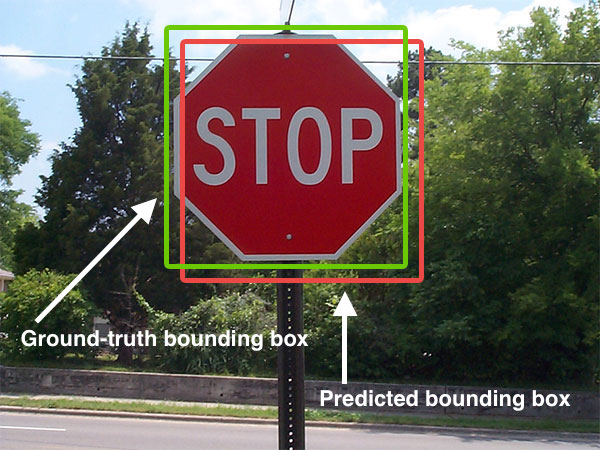
Automated Bounding Box Annotation Validation

Uber has developed advanced AI and ML-based systems to improve the quality and efficiency of data annotation processes. This includes a focus on validating bounding box annotations in videos to detect and correct errors such as ID swaps and position jumps, which are critical for building object trackers. The system uses a multi-stage pipeline involving feature extraction, ML classification (XGBoost), and post-processing to cluster errors for human review. This initiative aims to reduce annotation costs and time by providing automated outlier detection with confidence scoring, clustering detected errors into actionable groups for human review.

1 post · 2026

Timeline

Feature trailActive

Hybrid CPU Allocation for Stateful Containers

Uber's Odin platform has evolved its CPU allocation strategy for stateful containers by introducing a hybrid model that combines dedicated and shared cores. This addresses the limitations of previous models that relied on one-minute averages and dedicated cores, which were insufficient for bursty CPU usage. The new model allows for over-allocation of shared cores pooled per host, with Linux's cpu.shares dynamically distributing CPU time during contention. The system also incorporates NUMA considerations and in-place vertical scaling for stateful workloads.

1 post · 2026

Timeline

Feature trailActive

LLM Training Infrastructure and Optimization

Uber has developed a robust in-house LLM training infrastructure, Michelangelo, leveraging open-source tools like PyTorch, Ray, Hugging Face, and DeepSpeed. This platform supports both full-parameter fine-tuning and parameter-efficient methods like LoRA and QLoRA. The system has been optimized for throughput and Model Flops Utilization (MFU) through techniques such as DeepSpeed ZeRO-stage-3 CPU Optimizer Offload and flash attention, demonstrating scalability and efficiency on NVIDIA A100 and H10. This post details optimizations to Petastorm for high-throughput and reproducible GPU training, significantly improving GPU utilization to over 60%, reducing end-to-end training time by 86%, and slashing compute costs by nearly 80%. The optimizations include pushing data transformations to worker threads, implementing local disk caching with quota management, and ensuring deterministic data loading by caching row groups and adding a final shuffle step.

2 posts · 2026

Timeline

Feature trailActive

JUnit Migration at Scale

Uber has successfully migrated a significant portion of its Java monorepo from JUnit 4 to JUnit 5, enabling adoption of modern testing capabilities and ensuring future framework support. This involved developing a custom Bazel integration for the JUnit Platform and leveraging OpenRewrite for automated code transformations. The migration processed over 75,000 test classes, modifying 1.25 million lines of code within four months, demonstrating a scalable approach to large-scale framework transitions.

1 post · 2026

Timeline

Feature trailActive

AI-Assisted Design System Documentation

Uber has developed uSpec, an agentic system that leverages AI agents and the Figma Console MCP to automate the generation of design system component specifications. This system connects an AI agent in Cursor to Figma, allowing it to crawl component structures, compile data with provided context, and generate spec pages directly within Figma files. This significantly reduces the time and effort required for documentation, improving accuracy, consistency, and maintainability across multiple implementations. The entire pipeline runs locally, ensuring data security.

1 post · 2026

Timeline

Feature trailActive

Design System Observability

Uber is establishing a comprehensive Design System Observability framework to ensure consistent and high-quality user experiences across its global applications. This initiative addresses the challenge of maintaining design integrity at scale by providing tools and processes to measure and enforce adherence to the Base design system. Key components include the 'Deterministic Counter' (the 'eye') for visual identification and measurement of Base component adoption, and automated analysis pipeline. This has evolved to include an agentic system (uSpec) that leverages AI agents and Figma Console MCP to automate the generation of up-to-date component specifications, including anatomy, API, properties, color annotation, structure, and screen reader accessibility details, directly within Figma files. This significantly reduces the time and effort required for spec creation and maintenance, ensuring accuracy and consistency across multiple implementation stacks.

1 post · 2026

Timeline

Feature trailActive

Ads Personalization with Sequential Modeling and Hetero-MMoE

Uber has enhanced its ads personalization system by incorporating sequential user behavior modeling with a target-aware transformer encoder and a novel Hetero-MMoE architecture. This evolution moves beyond static, aggregate features to capture temporal dynamics and evolving user intent using multi-head latent attention for efficient sequence summarization. The Hetero-MMoE framework blends MLP, DCN, and CIN experts to capture low- to high-order feature interactions more effectively, enabling more precise, context-aware ad predictions across diverse objectives. The system achieved significant performance gains in online experiments, leading to measurable improvements in revenue impact, user engagement, and advertiser outcomes.

1 post · 2026

Timeline

Feature trailActive

Privileged Command Execution Gateway

Uber has introduced the Superuser Gateway, a system designed to provide a safe, auditable, and reviewed path for executing dangerous privileged commands. This system replaces direct superuser access with a workflow involving peer review, automated validation, and controlled remote execution, significantly reducing the risk of accidental data corruption or system outages. Initially targeting data storage systems, the gateway aims to expand to other privileged systems across Uber.

2 posts · 2025–2026

Timeline

20252026
Feature trailCooling

Mobile Analytics Standardization

Uber has standardized its mobile analytics pipeline to address inconsistencies in event definitions, instrumentation, and metadata. This initiative involved defining core event types (Tap, Impression, Scroll) with standardized emission rules, incorporating common metadata at app and event levels, and implementing sampled event coverage for unmapped/disabled events. The goal is to improve data quality, reduce engineering effort, and enable more reliable cross-platform insights for product teams.

1 post · 2025

Timeline

20252026
Feature trailCooling

IAM Policy Simulation and Safety

Uber has developed a Policy Simulator to enhance the safety and determinism of IAM policy changes. This system allows policy authors to preview the impact of proposed changes in real-time by replaying access logs against both current and proposed policy sets. This helps prevent accidental outages caused by misconfigurations, particularly with grant removals or unintended privilege escalations. The simulator fetches access logs from various Policy Enforcement Points (PEPs), optimizes their ingestion into Apache Pinot for low-latency access, and replays them on local authorization engines to compare outcomes. Optimizations include prioritizing key data (actor, action, resource), focusing on distinct occurrences, and excluding irrelevant data. For coarse-grained policies, M3 access logs are used, while fine-grained policies leverage logs from authfx via Hive and Pinot.

1 post · 2025

Timeline

20252026
Feature trailCooling

Automated Kerberos Keytab Rotation

Uber has developed a robust, failure-domain-aware automation system for orchestrating Kerberos keytab rotation without human intervention. This system integrates with the Secret Management Platform (SMP) and the Keytab Distribution Pipeline (KDP) to manage the lifecycle of over 100,000 keytabs across thousands of applications and nodes. Key innovations include minimizing authentication failures during rotation by carefully managing TGT validity and fetch intervals for clients, and ensuring servers can decrypt service tickets using previous key versions during transition phases. This enables safe, scalable keytab rotation.

1 post · 2025

Timeline

20252026
Feature trailCooling

Secrets Management Platform

Uber has developed a comprehensive Secrets Management Platform to address widespread secrets sprawl, insecure sharing, and the challenges of managing over 150,000 secrets across thousands of microservices, databases, and third-party integrations. This initiative involves implementing preventive measures like pre-commit hooks to stop secrets from entering codebases, and remediation strategies including real-time and scheduled scanning of code, Slack conversations, logs, and container images. The platform consolidates secret vaults, provides a metadata model for governance, supports CRUD operations across various secret managers, offers user interfaces (API, CLI, web UI), manages secret lifecycle workflows (rotation, deletion, revocation), enforces uniform access control, and integrates with third-party vendors and SaaS applications. It also enables automated secret rotation and deletion by integrating with multiple deployment platforms and handling various secret types, including those that don't support seamless rotation. The system tracks secret inventory and metadata, leveraging heuristics and crowdsourcing for missing information, and provides a Secrets Insights Dashboard for governance metrics.

2 posts · 2025

Timeline

20252026
Feature trailQuiet since 2024

Delegate Booking for Corporate Travel

Uber has developed a Delegate Booking tool to streamline executive travel, empowering executive assistants (EAs) to manage bookings on behalf of their executives. This involves evolving the platform's participant model to support multiple user roles (executive and EA) interacting with a single trip, expanding the notification system for dual updates, and integrating the billing engine for accurate financial transactions. The architecture was overhauled across numerous services and platforms to accommodate this new model.

1 post · 2024

Timeline

20242026
Feature trailQuiet since 2024

Live Activity Integration for Rider App

Uber has successfully integrated Apple's Live Activities feature into its Rider app, enabling users to receive real-time trip updates directly on their iOS devices without needing to open the application. This involved significant engineering efforts to overcome challenges related to limited UI space, lack of direct networking and state in Live Activities, dynamic asset handling, and ensuring reliable updates through a combination of background app execution, push notifications, and a new backend service. The system also includes a server-driven language for content consistency across iOS Live Activities and Android push notifications, and has demonstrated measurable improvements in reducing cancellations and pickup defects.

1 post · 2024

Timeline

20242026