Blogs
Decagon logo

Decagon

Engineering blog · decagon.ai/resources/blog

82posts0this week0watchers

Feature trails

16
Feature trailActive

AI Support Agent Platform

Decagon is evolving its AI Support Agent Platform by introducing Duet Apprentice. This capability allows AI agents to learn from enterprise onboarding materials (Notion, Confluence, SharePoint, Google Drive) and observe escalated conversations handled by tenured employees. It also enables continuous learning by integrating with team messaging platforms like Slack and Microsoft Teams, proactively capturing changes and ambiguities. This aims to provide agents with a deeper understanding of business context and operational nuances, improving their autonomy and effectiveness.

80 posts · 2025–2026

Timeline

20252026
Feature trailActive

Real-time Text-to-Speech Inference Scaling

Decagon has significantly scaled its real-time text-to-speech (TTS) inference by rebuilding the pipeline on the M* modular inference framework. This involved stage decomposition, packed inputs, cache and batch-state integration, causal decoder history management, CUDA Graphs, and validation. The new approach enables stage-aware scheduling and true tensor batching, leading to higher capacity and reduced latency. Key improvements include packed prefill for variable-length prompts, paged KV caching. Decagon has now developed Chord, a post-trained speech model specifically for customer conversations, which improves naturalness, engagement, and resolution rates. Chord utilizes a dedicated pipeline for conversational data, verbatim transcription, and a tokenizer-free diffusion model for enhanced steerability and detail preservation. Production deployment is handled via Modal.

8 posts · 2026

Timeline

Feature trailActive

Audio-native Speaker Change Detection

Decagon is developing advanced audio-native semantic speaker-change detection capabilities. This system aims to reliably identify when a new participant joins a conversation, distinguishing relevant changes that require agent intervention (e.g., for security or fraud prevention) from irrelevant audio events (e.g., background noise, announcements). The system leverages speaker embeddings and multimodal LLMs, with a focus on constructing robust benchmarks and employing supervised fine-tuning to optimize for conversation-level false-positive rate and recall. This capability enhances the security and operational efficiency of voice agents.

1 post · 2026

Timeline

Feature trailActive

Voice Activity Detection (VAD) and Turn Detection

Decagon is evolving its voice AI capabilities by focusing on conversational design and voice profiles that reflect brand identity, moving beyond just technical fundamentals like latency and accuracy. The company emphasizes principles of efficient task completion, natural and clear communication, robust error recovery, empathetic interaction, and deep user understanding. This includes aligning Text-to-Speech (TTS) voice characteristics (formal/casual, energetic/calm, mature/youthful, warm/profess). This post details improvements to Voice Activity Detection (VAD) and turn detection by introducing Bayesian methods for improved calibration and a hazard statistic for more robust turn-ending decisions, resulting in fewer broken turns and reduced transcription errors.

6 posts · 2026

Timeline

Feature trailActive

Voice Authentication System

Decagon is developing a robust voice authentication system that addresses the unique challenges of identifying callers in voice AI interactions. This system balances security with user experience by offering flexible authentication models, including pre-authenticated and mid-conversation approaches. It focuses on selecting reliable voice identifiers, optimizing information collection methods (SMS, DTMF, voice transcription), and implementing incremental agent authentication to adhere to least privilege principles. The system is being enhanced with fine-tuned STT models for improved accuracy in authentication-centric utterances.

1 post · 2025–2026

Timeline

20252026
Feature trailActive

Campaign Composer

Decagon is introducing Agent Modules, a system for building and running end-to-end customer journeys beyond traditional support. This capability integrates infrastructure, analytics, and campaign orchestration to manage multiple instances of agents across various business functions like lead qualification, onboarding, payment collection, and customer relationship growth. Modules provide a foundation shaped by production experience, allowing teams to define business logic with tools like Duet and test behavior with Simulations. Campaign Composer enables sequencing touchpoints across channels and time, with Memory carrying context across sessions and channels for a continuous customer experience. This extends the trust established in contact centers to the entire customer journey.

2 posts · 2026

Timeline

Feature trailActive

Browser Actions

Decagon is introducing Browser Actions, a new capability that allows AI agents to interact with and complete tasks within web-based systems that lack traditional API integrations. This feature enables agents to log in, navigate, and perform actions by directly interacting with the user interface of any accessible web system, mimicking manual user interaction. It aims to resolve tasks previously trapped in manual workflows or requiring complex integrations, thereby extending the agent's capabilities. The system runs in a secure, containerized, and fully audited sandbox, and provides detailed logging of every agent action for visibility and debugging.

2 posts · 2026

Timeline

Feature trailActive

PgBouncer Debugging and Migration

Decagon successfully migrated from GCP's managed connection pooler to self-managed PgBouncer. This migration uncovered a latent bug in PgBouncer related to TLS buffering and packet handling, which caused connection stalls and pool exhaustion. The issue was mitigated by shortening the application name parameter and an upstream fix was contributed to PgBouncer to address the event loop deadlock. The investigation traced the bug through SQLAlchemy, PgBouncer, OpenSSL, and the Linux kernel's epoll interface.

1 post · 2026

Timeline

Feature trailActive

Air-gapped AI Deployment

Decagon is evolving its AI deployment strategies to support increasingly stringent enterprise infrastructure requirements, including air-gapped environments. This involves building custom telephony layers, self-hosting model inference within customer perimeters, and developing deep integrations with customer-specific internal systems. The company offers a spectrum of deployment options from standard SaaS to customer VPC deployments, catering to varying risk tolerances and regulatory needs. This post details the engineering challenges and learnings from a customer VPC deployment for a financial services company, including building a self-hosted telephony layer and reconstructing model inference infrastructure within the customer's perimeter.

1 post · 2026

Timeline

Feature trailActive

Open Source LLM Productionization

Decagon is increasingly leveraging open-source Large Language Models (LLMs) for production workloads, particularly for customer service AI agents. This strategy is driven by the need for low-latency, highly specialized models that can be customized for specific tasks. The company's experience suggests a maturity curve for AI use cases, where early-stage applications benefit from general-purpose frontier models, while mature, high-volume use cases transition to fine-tuned open-source models for improved performance and cost-efficiency. This post details the benefits of fine-tuning smaller models for specific tasks within a modular agent architecture, contrasting them with off-the-shelf models and outlining the use of Supervised Fine-Tuning (SFT) and Reinforcement Learning (RL) for optimization. The approach emphasizes model independence and continuous refinement.

3 posts · 2025–2026

Timeline

20252026
Feature trailActive

AI Agent Testing and Simulation

Decagon is enhancing its AI agent testing and simulation capabilities with Diagnostic Tools, which provides prescriptive insights to guide teams to the most important optimization opportunities. This includes Escalation Drivers to quantify when conversations escalate to a human agent and AOP Flow Analysis to understand conversation progression through Agent Operating Procedures. These features aim to accelerate agent improvements by transforming hillclimbing from manual guesswork into a data-dri. QA Hub provides a dedicated workspace for human-in-the-loop quality review, enabling teams to organize QA batches, apply custom rubrics, and track follow-ups. It integrates with Watchtower for automated QA and leverages Duet for sampling conversations, scoring interactions, and synthesizing reviewer feedback to identify improvement areas. The External QA Page allows for sharing standalone QA pages for testing.

2 posts · 2026

Timeline

Feature trailActive

Prompt Engineering Optimization

Decagon is developing systematic approaches to prompt engineering optimization, moving beyond manual iteration. The GEPA (Reflective Prompt Evolution) framework, built on DSPy, uses LLM reflection to automatically improve prompts. Key findings from production deployment include identifying an optimal sample size range (20-100 examples), the critical need for frontier LLMs as reflection models, and the effectiveness of length constraints as regularization to prevent prompt bloat and improve generation. This post details the application of a GAN-like adversarial game to prompt optimization, where a generator and judge are pitted against each other, with GEPA optimizing their prompts based on failure analysis. The system achieved a 34% human fool rate, demonstrating improved realism without model fine-tuning, highlighting the value of adversarial optimization for discovering failure modes and improving prompts, with a methodological takeaway that realism must be validated outside the game.

4 posts · 2026

Timeline

Feature trailActive

Contact Center Analytics

Decagon is enhancing its Contact Center Analytics capabilities by providing a comprehensive, four-stage loop from data capture to operational activation. This includes real-time data streaming, advanced AI-driven analysis (sentiment, topic classification, pattern recognition), and direct integration into operational workflows for supervisors, managers, and product teams. The system supports both human and AI agents, offering specialized analytics for speech, text, interaction, predictive, and quantitative insights. The introduction of Generative Analytics allows users to create custom charts by asking natural language questions, fill data gaps with trigger-based Action Trackers, and empower smarter business decisions through deep dives into revenue and agent health.

2 posts · 2026

Timeline

Feature trailActive

User Memory for AI Agents

Decagon is introducing User Memory, a system designed to provide AI agents with persistent context across multi-turn conversations and sessions. This capability captures conversational history and personal user signals, storing them as structured metadata attached to a user's profile. It aims to enable deeper personalization, surface user-specific insights for proactive engagement, and provide enterprise-grade governance with data portability and expiration controls. This complements existing sy

1 post · 2026

Timeline

Feature trailActive

Experimentation A B Testing Suite

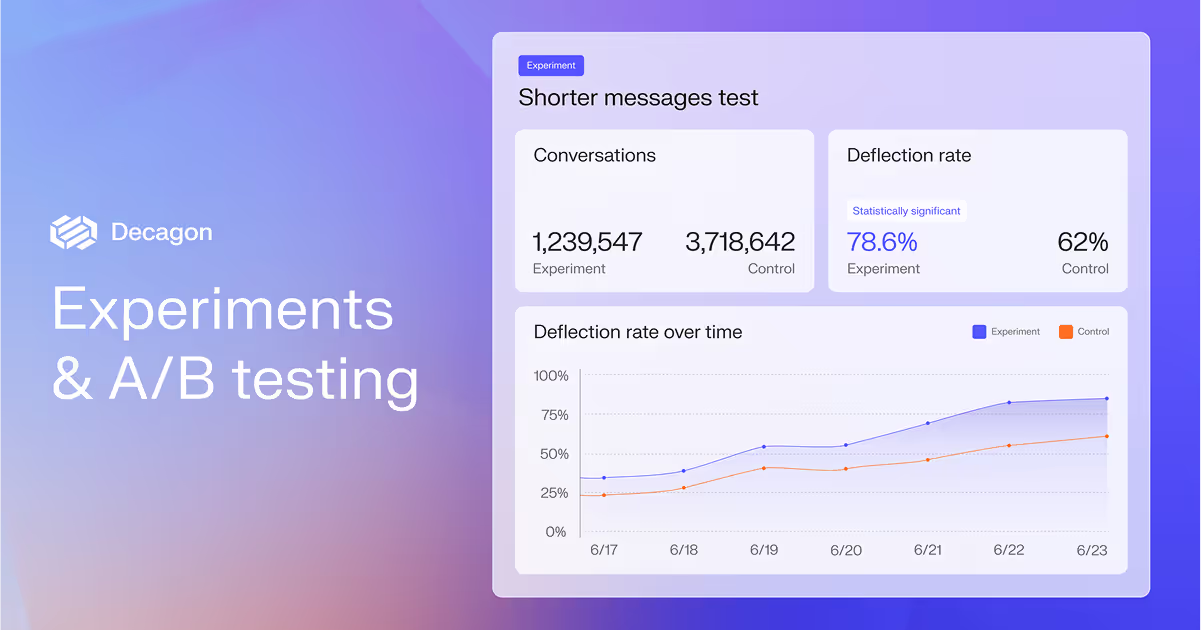
Decagon is evolving its AI agent platform by integrating a comprehensive experimentation and A/B testing suite. This suite allows teams to safely test changes to Agent Operating Procedures (AOPs), tone, knowledge, and tools against control groups, manage gradual rollouts, and track business-critical metrics like CSAT and deflection rate. The goal is to foster a culture of continuous iteration and data-driven decision-making for AI agents, treating them as products that require ongoing optimization.

1 post · 2026

Timeline

Feature trailActive

Holiday Season Reliability and Resilience

Decagon's AI agents are engineered for consistent performance, reliability, and resilience, especially during peak demand periods like the holiday season. The platform utilizes a scalable, multi-tenant architecture with elastic capacity that scales within seconds, isolation of real-time tasks, tiered storage for low latency, and per-tenant throttling for fairness and resilience. Disaster recovery is achieved through instant failover across multiple LLM and voice providers, defense in depth across the stack, and inherited SLAs from infrastructure partners. Operational discipline includes proactive capacity planning, a code freeze during peak season, and 24x7 monitoring.

1 post · 2026

Timeline