Blogs›Hex Feature Trails
See how major capabilities shipped, upgraded, and evolved across Hex's engineering blog.
Publishing pulse
2026–2026 · peak 2026
18 posts mapped

Hex has evolved its agent evaluation capabilities with the introduction of Kimi K2.7, an open-weight model that demonstrates comparable intelligence to frontier models like Opus 4.7 at a significantly lower cost. The post details the evaluation of Kimi K2.7 against Opus 4.7 across various analytical tasks, highlighting its strengths in semantically modeled and analytically hard questions, while noting areas for improvement in visualization and contextually hard tasks. This integration represents a strategic bet on open-weight models, enabling new tradeoffs between cost, speed, and intelligence for data analytics.
Timeline

Hex now supports a wide range of data integrations, including direct connections to data warehouses, local file uploads, metadata and semantic layer tools, data cataloging and observability platforms, code sync and versioning tools, machine learning frameworks, and orchestration/workflow tools. This allows users to bring their data and tools into Hex for seamless analytics and data operations. Hex now allows users to build governed semantic models for their data, defining trusted metrics and dimensions. This post details how customers like Ramp, Underdog, and Hover leverage Hex's integrations with tools like dbt and GitHub to manage and activate context for AI analytics, ensuring accuracy and consistency by syncing documentation, model descriptions, and endorsements. It highlights features like Context Studio for monitoring agent performance and suggestions, and the use of GitHub Actions and CLI for programmatic updates to context guides, demonstrating an evolution in how context is managed and integrated for AI-driven data analysis.
Timeline

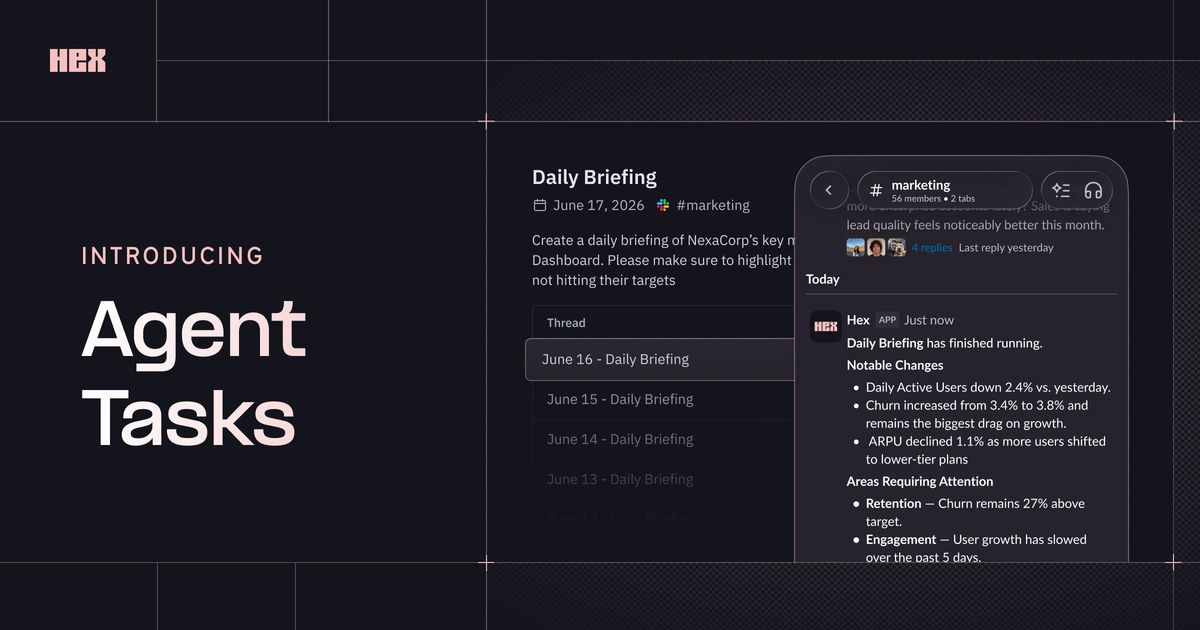
Hex has evolved its customer data presentation from a static dashboard (Account 360) to a more dynamic, conversational interface (Threads). This shift allows customer-facing teams to ask direct questions of their data, receive real-time answers, and gain deeper narrative insights into customer behavior and history. The underlying data sources (support tickets, product usage, revenue) remain, but the access and interaction model has been significantly improved for speed and depth of understanding. Agent Tasks further enhances this by enabling scheduled, automated execution of agent queries, delivering results directly to users via Slack or email, and allowing for follow-up questions and learning from previous runs to track changes over time.
Timeline

Introduced Embedded Analytics, a feature allowing product teams to seamlessly embed data experiences for their customers. This includes a flexible notebook for building visualizations, customization options for a white-labeled UI, and a developer-friendly Embed API for easy integration. The system supports seamless authentication with pass-through authentication and row-level security, interactive analytics with user inputs and export options, and real-time data through live queries. This post highlights the agentic capabilities within Hex, demonstrating how users can interact with their data through natural language prompts to generate insights, visualizations, and even entire data applications. The agent can access and interpret various data sources, perform complex analyses, and present findings in a structured and understandable format, showcasing the platform's ability to democratize data access and analysis.
Timeline

Hex has evolved its customer data presentation from a static dashboard (Account 360) to a more dynamic, conversational interface (Threads). This shift allows customer-facing teams to ask direct questions of their data, receive real-time answers, and gain deeper narrative insights into customer behavior and history. The underlying data sources (support tickets, product usage, revenue) remain, but the access and interaction model has been significantly improved for speed and depth of understanding. This post details the integration of conversational agents (Hex Agent) within Threads, enabling users to query data through natural language. It also highlights the creation of interactive Data Apps from these conversations, allowing for reusable and shareable data experiences. The system leverages semantic models and data context to provide accurate and auditable answers, with the ability to drill down into specific data points and visualize trends. The underlying notebook infrastructure allows for inspectable and auditable answers, bridging the gap between conversational queries and detailed data analysis.
Timeline

Hex now allows users to generate data apps using AI code generation, leveraging the platform's trusted data, context, and governance. This feature enables the creation of custom apps from prompts, with full control over UI elements, styles, and layouts. Apps are built on real Hex projects, inheriting security, permissioning, and governance from the platform, and can be maintained and updated directly within Hex.
Timeline