Blogs
Hex logo

Hex

Engineering blog · hex.tech/blog

239posts1this week0watchers

Publishing pulse

2020–2026 · peak 2026

239 posts mapped

20202026

Feature trails

61
Feature trailActive

Agent Evals

Hex has evolved its agent capabilities by introducing Evals, a testing workflow inspired by internal practices, now available to users. Evals allow for grading agent work beyond just answers, using an LLM-as-judge to assess tool usage, reasoning, and behavior. Test cases are defined in version-controlled files and run from the Hex CLI. Context changes can be tested safely via Context Previews before publishing. Evals enable measurement and improvement of agent quality and cost, helping to test c. This post details how Hex used evals to drive the development of its 'Quick Edits' feature, achieving a 7x reduction in the AI error rate through a hill-climbing approach. The focus was on minimizing wrong edits over incorrect handoffs, and improvements were largely driven by enhancements to the validation harness around the model rather than prompt engineering. Holdout cases were used to prevent overfitting, and the speed of the eval runs enabled rapid iteration on both the AI and the broader feature.

40 posts · 2023–2026

Timeline

20232026
Feature trailActive

Metrics Layer

Hex has evolved its data analytics capabilities by integrating with dbt's Semantic Layer and Databricks Unity Catalog Metric Views, enabling users to access trusted, governed metrics through a new Metrics Cell. This allows users to specify metrics, dimensions, and time grains via a UI, generating a data frame for analysis and visualization. Additionally, Hex now supports writing dbt-flavored SQL, including refs, macros, and sources, directly within Hex SQL cells, enhancing the integration with dbt. This post also details Hex's integration with Snowflake Semantic Views, allowing users to bring Snowflake-defined models, dimensions, measures, and relationships into Hex while keeping Snowflake as the source of truth. These definitions can then be used in Threads, semantic-model exploration, notebooks, and published apps. Hex's Context Studio provides a feedback loop for data teams to observe real-world usage, identify context gaps, and validate improvements. Per-user Snowflake OAuth preserves user-level permissions and row-access/masking policies.

6 posts · 2021–2026

Timeline

20212026
Feature trailActive

Generative Data Apps

Hex has evolved its generative data apps by introducing Generative Chart Controls, allowing users to make precise, point-and-click edits to visualizations within generated apps without needing to prompt an agent. This feature adds a 'Style' button to visualizations, enabling users to modify chart titles, series colors, axis labels, and legend placement directly. This breaks the tradeoff between the flexibility of code generation and the precision of traditional chart controls, enhancing the usability and accuracy of forecasting models by allowing them to continuously learn from recent trends and historical conversion curves. The app now ingests campaign data directly from CRMs, utilizes up-to-date conversion rates, models time-to-convert patterns specific to each pipeline generating activity, and provides a data-warehouse centric approach to forecasting, reducing organizational anxiety and enabling more confident, data-driven decisions.

14 posts · 2024–2026

Timeline
20242026
Feature trailActive

Agentic Analytics Benchmark

Hex has evolved its agent capabilities by introducing DataBench, a new frontier benchmark designed to evaluate the performance of AI agents on complex data work and analytical reasoning tasks. This benchmark aims to provide a more realistic assessment of agent capabilities compared to existing benchmarks, focusing on tasks that mirror actual customer usage in Hex. DataBench covers a range of analytical prompts, including question-answering and open-ended decision-making, and evaluates models across various performance metrics and cost-effectiveness.

2 posts · 2026

Timeline

Feature trailActive

Connected Apps for Agent Context

Hex has evolved its agent capabilities by introducing the Notebook Agent, an AI assistant embedded directly into the Hex Notebook experience. This agent can write SQL or Python, pull data from warehouses, and build charts based on natural language prompts. It aims to accelerate analysis by allowing users to perform complex tasks like pricing analysis, joining tables, and using window functions without extensive SQL knowledge or deep data model understanding. Users can follow the agent's work, edit its output, and iterate on analyses faster. This post details how the team uses AI to automate low-hanging fruit like drafting documentation and bootstrapping analyses, and how it enables new insights by analyzing unstructured data and surfacing patterns. It also discusses the limitations of AI in complex data modeling and bug identification, and the importance of human oversight and tying AI-driven insights to business outcomes. The Notebook Agent is continuously improving, with past frustrations in visualization and reporting becoming more manageable.

22 posts · 2024–2026

Timeline
20242026
Feature trailActive

Hex CLI

Hex has evolved its developer experience by introducing a Command Line Interface (CLI) and an MCP server. The CLI allows users to script Hex workflows, create and update projects and cells, move analyses into Hex programmatically, connect workflows with other tools via their CLIs, and make changes to multiple projects at scale. The MCP server handles structured, authenticated access for AI assistants to search the workspace and get data answers through Threads, drawing on semantic models and end-to-end project execution.

1 post · 2025–2026

Timeline

20252026
Feature trailActive

Agent Caching Optimization

Hex has evolved its agent capabilities by introducing a credit model for Hex Agents, including monthly credit grants per user seat type, and the ability to purchase pooled add-on credits with auto top-ups and spend limits. The consumption is effort-based, with different models offering varying cost-efficiency. Users gain visibility into their credit balance and prompt-level usage, while Admins have access to workspace-wide usage logs, spend limits, and granular control over add-on credit allocation. This post details tactics for credit efficiency, focusing on context management, user prompting, and admin controls to optimize AI usage and cost.

6 posts · 2025–2026

Timeline
20252026
Feature trailActive

Data Integrations

Hex has evolved its data integration and semantic capabilities by enhancing how users can bring their data and tools into Hex for seamless analytics and data operations. This includes direct connections to data warehouses, local file uploads, metadata and semantic layer tools, data cataloging and observability platforms, code sync and versioning tools, machine learning frameworks, and orchestration/workflow tools. Hex now allows users to build governed semantic models for their data, defining tr

40 posts · 2022–2026

Timeline
20222026
Feature trailActive

AI Gateway

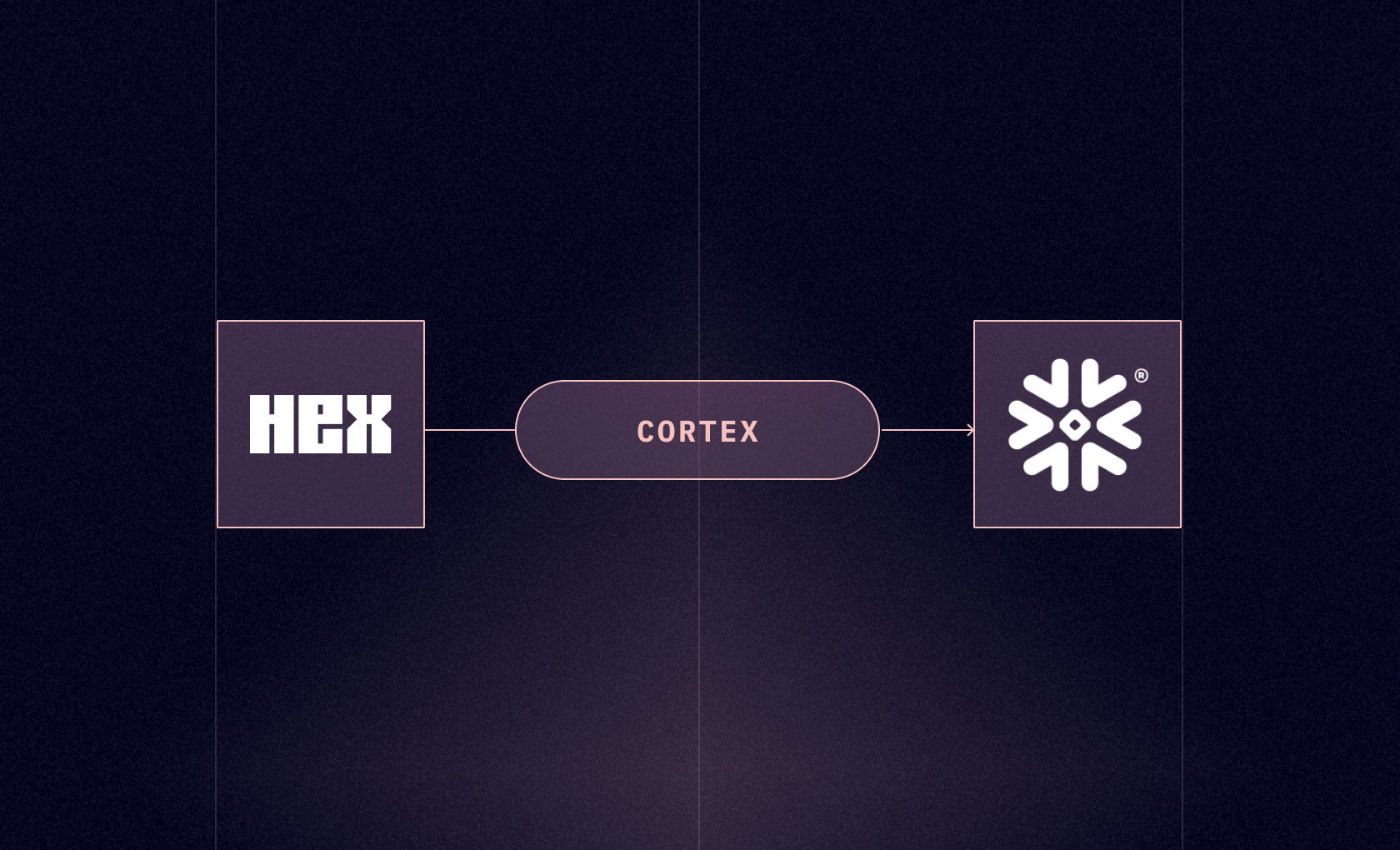
Hex has evolved its AI capabilities by integrating with Snowflake Cortex, allowing users to leverage Claude models directly within their Snowflake instances. This integration enhances control, governance, and observability for AI workloads, keeping data within the customer's Snowflake account. Users can already call Cortex functions in SQL and add Cortex APIs to Python cells in Hex, and soon will be able to back Hex's Magic tools with Claude 3.5 on Cortex. This post details the concept of an AI Gateway and the benefits of using Claude 3.5 on Cortex for Hex's Magic tools, emphasizing data residency and enhanced AI workload management.

6 posts · 2024–2026

Timeline

20242026
Feature trailActive

Embedded Analytics

Hex has evolved its data analytics capabilities by introducing and detailing embedded analytics. This feature allows users to embed Hex applications directly into their own client portals or applications, providing seamless and secure access to data insights within a trusted environment. Key advancements include pass-through authentication for a unified login experience, row-level security to ensure data privacy, and reduced operational burden for internal teams by enabling the reuse of dynamic

19 posts · 2025–2026

Timeline

20252026
Feature trailActive

Behavioral Segmentation

Hex has evolved its data analysis capabilities by detailing six patterns for behavioral segmentation, focusing on how data teams write SQL and Python to group users by their actions. This includes RFM analysis, cohort retention, engagement scoring, lifecycle stage segmentation, product-qualified lead scoring, and churn risk detection. The post emphasizes building trustworthy segments at scale and making them actionable beyond the data team, covering both batch processing and the importance of up

8 posts · 2022–2026

Timeline

20222026
Feature trailActive

Data Efficiency Measurement and Improvement

Hex has evolved its data efficiency capabilities by providing a comprehensive guide to measuring and improving data efficiency. This includes defining data efficiency, outlining key metrics such as storage utilization rate, query latency, cost-per-workload, total cost of ownership, data duplication rate, time-to-insight, and data freshness. It also introduces frameworks for evaluating data efficiency, including cost-model frameworks, data lifecycle frameworks, utilization efficiency models, team

2 posts · 2025–2026

Timeline

20252026
Feature trailActive

Data Federation

Hex has evolved its data integration capabilities by detailing the concept, mechanics, and trade-offs of data federation. This includes explaining how federation engines work with schema hierarchies, source-specific connectors, and query execution lifecycles, emphasizing pushdown optimization. The post contrasts federation with ETL, ELT, and replication, highlighting its use cases in cross-database analytics, regulated environments, multi-cloud setups, and exploratory work. It also details common failure points such as latency compounding, cross-source join limitations, schema drift, and security coordination challenges.

1 post · 2026

Timeline

Feature trailActive

Data Transformation Workflows

Hex has evolved its data transformation capabilities by providing a dedicated workspace for analytics engineers. This includes streamlining the development of data transformations through features like input parameters for automated common checks, a non-linear SQL notebook format for iterative development and debugging, and integrated chart cells for visualizing transformed data as work progresses. The platform aims to keep users in flow by consolidating queries, models, and visualizations in one place, and emphasizes making transformation work visible and collaborative through version control, code review, and documentation.

4 posts · 2021–2026

Timeline

20212026
Feature trailActive

Drill-down Analysis

Hex has evolved its data exploration capabilities by introducing and detailing drill-down analysis. This feature allows users to navigate from aggregate summary metrics to progressively more granular detail by descending through a predefined data hierarchy. The post explains how drill-down powers diagnostic analysis, its distinctions from filtering and drill-through, and the critical importance of upstream data modeling decisions (granularity, ragged hierarchies, slowly changing dimensions, non-conformed dimensions). It also highlights the limitations of predefined paths and the need for flexible exploration beyond them.

3 posts · 2023–2026

Timeline

20232026
Feature trailActive

Data Drift Detection and Mitigation

Hex has evolved its data trustworthiness capabilities by introducing comprehensive explanations and strategies for data drift. This includes detailing the causes of data drift (silent schema changes, SaaS platform modifications, third-party format changes, upstream pipeline rewrites, semantic drift), its impact on AI analytics (corrupting answers, passing quality checks while degrading), and methods for detection at the data-team level (statistical tests like KS, Wasserstein distance, PSI, chi-s. This post details data quality monitoring techniques, covering both structural and semantic dimensions, and how AI can be leveraged for automated anomaly detection and validation against learned patterns. It emphasizes integrating these checks into the analytics workflow for continuous assessment of data fitness.

4 posts · 2026

Timeline

Feature trailActive

Underfitting Diagnosis and Mitigation

Hex has evolved its machine learning capabilities by detailing the diagnosis and mitigation of underfitting and overfitting, including strategies for feature selection to prevent overfitting. This involves understanding the bias-variance tradeoff, systematic approaches to fixing issues, and careful feature selection to improve model generalization. This post details using autoencoders for feature selection, a technique that leverages neural networks to learn compressed representations of data, t

7 posts · 2023–2026

Timeline

20232026
Feature trailActive

Customer Data Hub Evolution

Hex has evolved its customer data presentation from a static dashboard (Account 360) to a more dynamic, conversational interface (Threads). This shift allows customer-facing teams to ask direct questions of their data, receive real-time answers, and gain deeper narrative insights into customer behavior and history. The underlying data sources (support tickets, product usage, revenue) remain, but the access and interaction model has been significantly improved for speed and depth of understanding. This post details how to build data apps for customer success questions, enabling guided exploration with guardrails (input parameters), layering in business context automatically, and making insights persistent and shareable through features like app subscriptions, comments, @mentions, version history, and saved filter combinations. It emphasizes choosing the right first use case, designing for exploration, involving customer success throughout the process, and measuring key metrics like time from question to answer and actions taken based on findings.

9 posts · 2024–2026

Timeline

20242026
Feature trailActive

Data Science Maturity and Governance

Hex has evolved its data science capabilities by introducing a framework for assessing and improving data science maturity through a governance lens. This includes defining stages of maturity, providing diagnostic tools to assess current standing across dimensions like prediction access controls, metric definition consistency, AI output inspectability, and decision coverage. It also outlines a stage-by-stage roadmap for implementing governance, starting with documentation and endorsement, progressing to automated policy enforcement and continuous monitoring.

15 posts · 2024–2026

Timeline

20242026
Feature trailActive

Ground Truth Management

Hex has evolved its machine learning capabilities by introducing comprehensive strategies and best practices for managing ground truth. This includes defining ground truth, exploring its types (human annotation, expert annotation, behavioral inference, synthetic ground truth), and detailing its role across the ML lifecycle (training, validation, testing, production monitoring). The post highlights the challenges of ground truth, such as label leakage, annotation drift, feedback loops, and distribution mismatch. It also addresses the specific challenges of ground truth for AI analytics, emphasizing the importance of context and governed semantic models. Best practices include treating ground truth as infrastructure, investing in data quality monitoring, and establishing clear processes for data collection, labeling, and validation.

1 post · 2026

Timeline

Feature trailActive

Visualization Subagent

Hex has evolved its generative data apps by introducing a dedicated visualization subagent. This specialized AI agent handles all visualization-related tasks, taking over from the main Hex agent. The subagent is designed to be iterative, focusing on structure first and then style, and is equipped with enhanced perception capabilities to accurately interpret its own output. It utilizes a structured handoff from the main agent, incorporating principles from visualization design to ensure the 'what' and 'why' are passed, not dictating the 'how'. Evaluation is performed using a rubric modeled after VisEval, with specific tests for bug fixes and proactive expansion of capabilities.

2 posts · 2024–2026

Timeline

20242026
Feature trailActive

AI-Assisted Data Validation

Hex has evolved its data validation capabilities by introducing an AI audit agent. This agent automates the process of validating data changes, incorporating principles of standardization, flexibility, and traceability. It can design and conduct end-to-end audits, suggest relevant models to audit, ensure fresh development schemas, apply noise reduction techniques (like truncating timestamps and rounding floats), and handle large model comparisons by filtering prod data to match dev schema date ranges. The agent acts as a partner, prompting for feedback and flagging discrepancies for review.

1 post · 2026

Timeline

Feature trailActive

ML Model Inference Cost Analysis

Hex has evolved its ML capabilities by providing in-depth analysis of ML model inference costs, contrasting them with training costs. The platform now offers insights into the recurring and scaling nature of inference expenses, which can surpass training budgets. It details optimization techniques such as quantization, pruning, knowledge distillation, and memory access optimization (e.g., FlashAttention) to reduce inference costs without retraining. The post also covers deployment strategies (batch vs. real-time) and the importance of continuous retraining and monitoring for cost management and model accuracy in production environments. Hex enables users to ingest inference logs for cost visualization and analysis, facilitating better infrastructure planning and budget forecasting.

1 post · 2026

Timeline

Feature trailActive

ML Failure Modes

Hex has evolved its machine learning capabilities by detailing common failure modes in production ML systems. This includes addressing data issues like leakage, drift, and label errors, as well as issues related to shortcut learning and system complexity. The post emphasizes that most ML failures are not due to the model itself but rather surrounding architecture, processes, and organizational gaps. It provides strategies for detecting and mitigating these failures, such as monitoring input data distributions, using worst-group-accuracy for testing, and reducing system complexity through careful dependency management.

1 post · 2026

Timeline

Feature trailActive

Exploratory Data Analysis (EDA) Tools

Hex has evolved its data analysis capabilities by providing a comprehensive guide to Exploratory Data Analysis (EDA). This includes detailing EDA techniques such as data profiling, statistical summaries, and visualization, and emphasizing their importance in understanding data before building models or dashboards. The post also highlights how collaborative tools and AI assistants are transforming EDA workflows, enabling faster iteration and insight generation. Best practices for conducting effec

8 posts · 2023–2026

Timeline

20232026
Feature trailActive

Pipeline Intelligence

Hex has evolved its data analysis and AI capabilities by introducing Pipeline Intelligence, a system that consolidates disparate lead signals into a unified, prioritized view. This system leverages AI to analyze combined data from product engagement, website visits, campaign interactions, social media, hiring trends, and opportunity data to provide actionable recommendations for sales teams. It aims to cut through market noise and improve lead-to-pipeline conversion by offering clear focus and a

4 posts · 2022–2025

Timeline

20222026
Feature trailActive

Notebook Alternatives

Hex has evolved its data analysis capabilities by providing a comprehensive guide to Exploratory Data Analysis (EDA). This includes detailing EDA techniques such as data profiling, statistical summaries, and visualization, and emphasizing their importance in understanding data before building models or dashboards. The post also highlights how collaborative tools and AI assistants are transforming EDA workflows, enabling faster iteration and insight generation. Best practices for conducting effective EDA are covered, positioning Hex as a modern alternative to traditional notebook environments by addressing collaboration, reproducibility, and publishing challenges inherent in tools like Jupyter.

4 posts · 2022–2025

Timeline

20222026
Feature trailActive

Cloud Analytics Architecture

Hex has evolved its data analytics capabilities by detailing the architecture and benefits of cloud analytics. This includes explaining the separation of storage and compute layers, elastic scaling of compute resources on demand, and the role of the services layer in coordinating operations. The post emphasizes how this architecture enables faster workflows, scalability without infrastructure overhead, and enterprise adoption. It also guides users on choosing an approach based on existing data i

7 posts · 2023–2025

Timeline

20232026
Feature trailActive

Self-serve Data Exploration for Engineering

Hex has evolved its data exploration capabilities by enabling engineering, product, and design teams to explore their own data using Hex. This initiative aims to empower non-data teams to answer their own questions, measure feature performance, investigate incidents, and find information without solely relying on the central data team. The adoption of Hex has led to increased productivity, creative use cases, and improved knowledge sharing, while maintaining data governance through AI agents that leverage well-modeled data, documentation, rules files, semantic layers, and reusable analyses as context.

2 posts · 2022–2025

Timeline

20222026
Feature trailCooling

Admin APIs

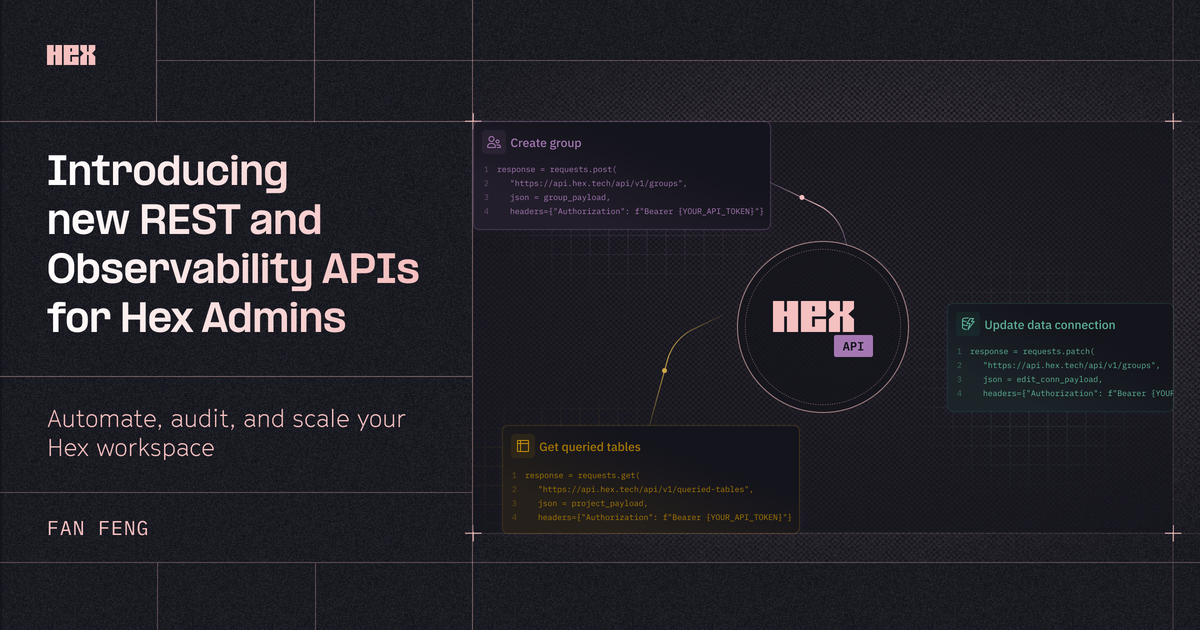
Hex has evolved its administrative capabilities by introducing a comprehensive set of REST and Observability APIs. These APIs allow for programmatic management of users, groups, projects, and data connection credentials, enabling automation, enhanced governance, and deeper integration with existing data platforms. The Observability API, specifically for Enterprise customers, provides insights into project data usage, such as queried tables, aiding in audits and lineage mapping. This evolution also explores the possibility of an MCP server for scaled orchestration.

2 posts · 2022–2025

Timeline

20222026
Feature trailCooling

Exploratory Analysis with SQL & Python

Hex has evolved its data analysis capabilities by enabling engineering, product, and design teams to explore their own data using Hex. This initiative aims to empower non-data teams to answer their own questions, measure feature performance, investigate incidents, and find information without solely relying on the central data team. The adoption of Hex has led to increased productivity, creative use cases, and improved knowledge sharing, while maintaining data governance through AI agents that can write SQL or Python. This post details how AllTrails leverages Hex for exploratory analysis, data validation, and building internal web apps, replacing a previous workflow involving CSVs, SQL files, Google Docs/Sheets, and Jupyter notebooks. Hex's integration with Google Cloud Platform (GCP) and Google Dataform allows for SQL and Python-based analysis directly from their data warehouse (BigQuery). Features like query caching, dynamic markdown, and auto-rerun simplify the analysis and sharing process. Published apps allow for tailored views for stakeholders.

1 post · 2022–2025

Timeline

20222026
Feature trailCooling

AI Team Reorganization

Hex has evolved its AI strategy by disbanding its dedicated AI product team ('Magic') and integrating AI feature development directly into persona-based product teams (Editors, Explorers, Curators). This aims to foster an AI-first mentality across the entire engineering organization, eliminate the 'bolt-on' perception of AI features, and increase the number of engineers working on AI. A core AI Platform team remains to manage research, infrastructure, and frameworks, supporting the persona teams.

1 post · 2025

Timeline

20252026
Feature trailCooling

Browser Virtualization

Hex has evolved its front-end performance by introducing a custom virtualization solution for its notebooks. This approach, dubbed 'VirtualizedElement,' allows individual cells to manage their own rendering based on viewport proximity, addressing limitations of list-based virtualization libraries like React Virtuoso. This has led to significant improvements in initial render time, interaction lag, page load, render lag, and memory usage, enabling a more performant and scalable user experience.

1 post · 2025

Timeline

20252026
Feature trailCooling

Advanced Compute Profiles

Hex has evolved its compute capabilities by introducing Advanced Compute Profiles, offering users significantly more processing power (up to 16 CPUs and 128GB RAM, or V100 GPUs) for demanding data science and ML workflows directly within the Hex notebook environment. This complements existing integrations with data warehouses and external ML platforms, allowing for end-to-end model development without data export or environment reconfiguration. New features include adjustable idle timeouts for kernels, pay-per-minute billing, and admin controls for spend limits and access.

3 posts · 2023–2024

Timeline

20232026
Feature trailCooling

No-Code Cells

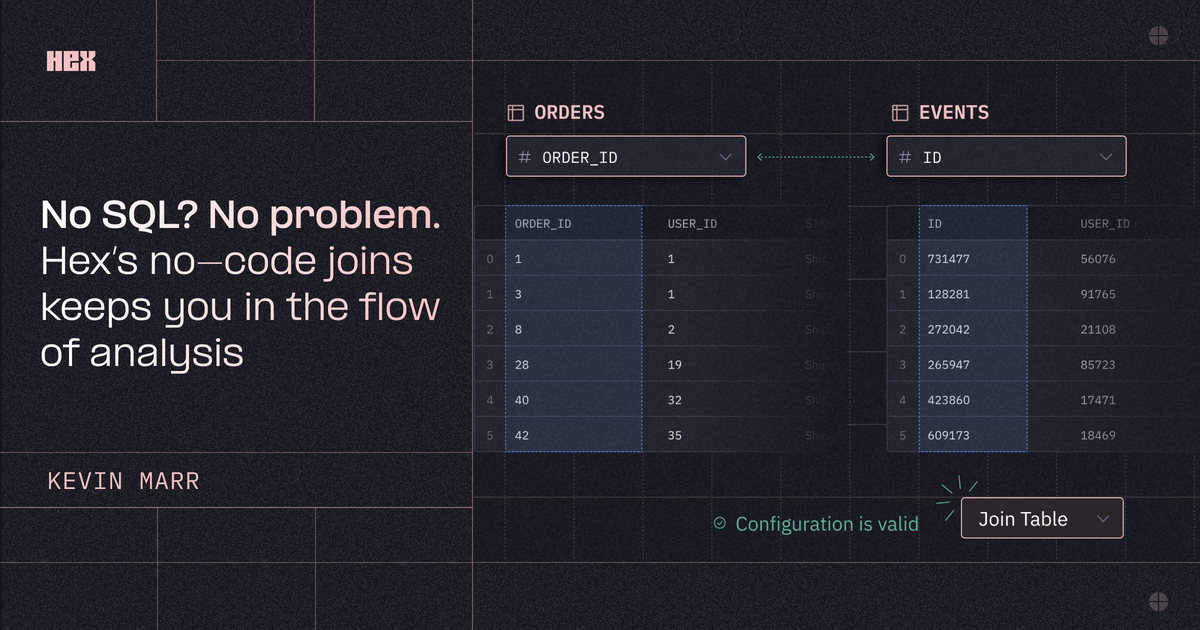
Hex has evolved its data analysis capabilities by introducing "no-code" UI-driven cells (Pivot, Filter, Writeback) that complement existing code-based workflows. These cells generate code behind the scenes, allowing users to switch between UI and code, learn new syntax, and perform common data manipulation tasks more easily. The Chart cell has also seen improvements in visualization types and customization. The Writeback cell enables sending dataframes back to the database programmatically. This evolution is part of a broader multi-modal strategy, allowing users to seamlessly integrate SQL, Python, and no-code workflows within a single notebook environment, accelerating data exploration and analysis.

1 post · 2022–2024

Timeline

20222026
Feature trailQuiet since 2024

Data Tool Security Practices

Hex has evolved its security posture by providing a comprehensive checklist for evaluating the security practices of data tools. This checklist covers critical areas such as storage and encryption, data handling, security policies and upkeep, access control, identity management, user training, compliance (HIPAA, GDPR), incident response, monitoring, and vendor trust. This aims to help organizations ensure their data tools meet first-class security standards, mitigating risks and building customer trust.

1 post · 2024

Timeline

20242026
Feature trailQuiet since 2024

Lazy Dataframe Compute Engine

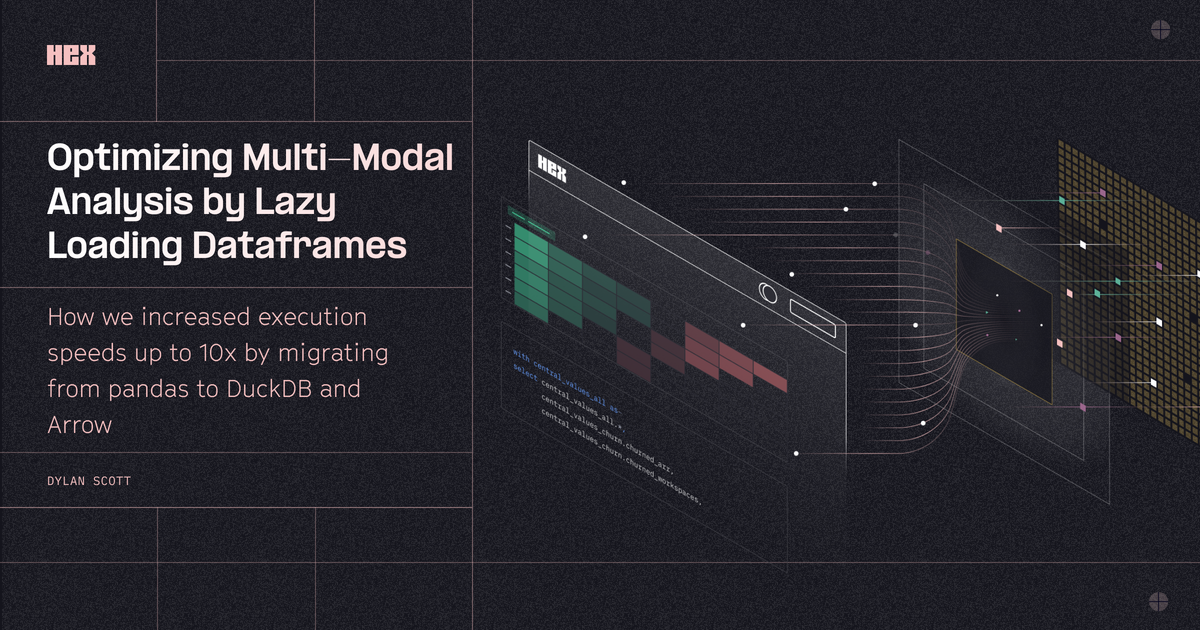
Hex has evolved its compute engine by introducing lazy loading of dataframes using DuckDB and Arrow, significantly improving performance for multi-modal analytics. This new architecture avoids materializing large datasets into local memory for every cell, instead processing data directly via DuckDB queries against Arrow data stored in S3. This results in 5-10x speedups for project runtimes, particularly for projects with heavy SQL and no-code cell usage. The system also lays the groundwork for future optimizations by translating operations into an internal DSL (HexQL) that can be executed by various SQL dialects or pushed down to customer warehouses.

2 posts · 2024

Timeline

20242026
Feature trailQuiet since 2024

Collaborative Analysis Platform

Hex has evolved its collaborative analysis platform by introducing a new grid-backed app layout engine. This engine combines the flexibility of a drag-and-drop builder with the automagic layout of Story mode, addressing user pain points in both previous modes. The new engine allows for more intuitive app building, easier insertion of elements, and better responsiveness, bridging the gap between narrative and dashboard use cases. This post details enhancements to table display cells, including column formatting (currency, percentage, URL), conditional formatting for highlighting cells, and other familiar spreadsheet features like quick column resizing and text wrapping, improving the interactivity and visual appeal of dataframe outputs.

17 posts · 2021–2024

Timeline

20212026
Feature trailQuiet since 2024

Calculations and Input Parameters

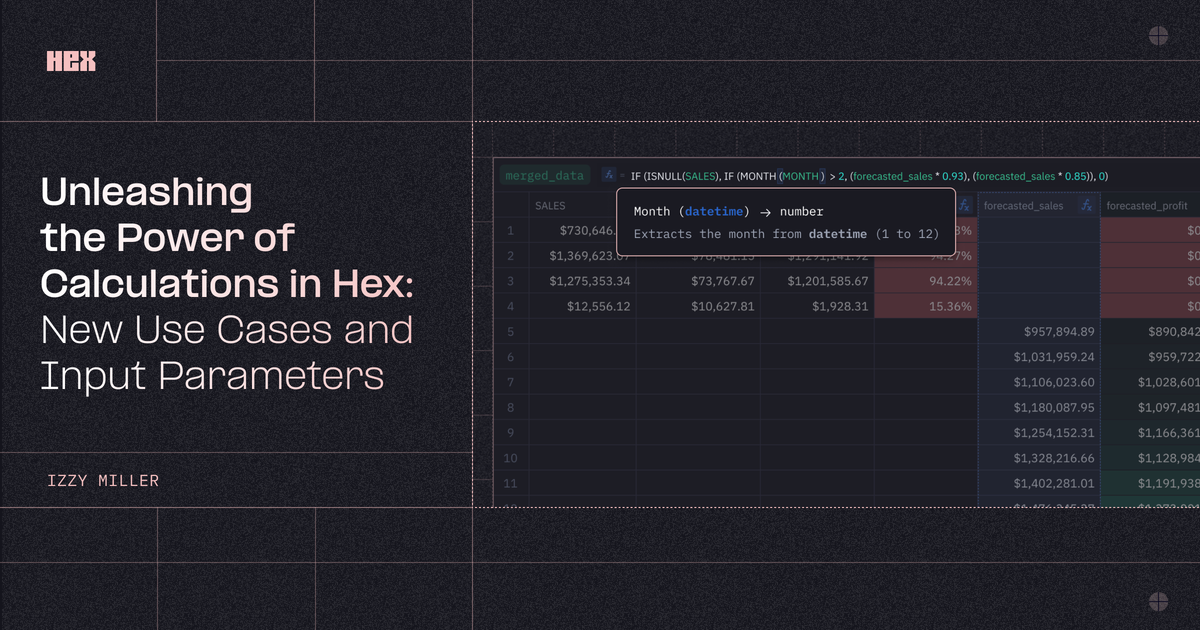
Hex has evolved its data analysis capabilities by introducing and enhancing Calculations and Input Parameters. Calculations allow business users to perform complex data manipulations and modeling using familiar spreadsheet-like functions, which are compiled to SQL for execution at data warehouse scale. This empowers users to create custom metrics, segments, and simplify complex filter logic without writing SQL or Python. The integration with Input Parameters allows these calculations to be parameterized, enabling the creation of dynamic and interactive data apps without writing SQL or Python code.

2 posts · 2024

Timeline

20242026
Feature trailQuiet since 2024

VegaFusion Server-Side Acceleration

Hex has evolved its visualization capabilities by donating VegaFusion to the Vega community. VegaFusion enables server-side acceleration for Vega charts, allowing them to handle large datasets by pushing aggregation to the backend. This integration was a key component in Hex's ability to render interactive visualizations over millions of rows of data. The project continues to be supported and maintained, with contributions including support for additional Vega transforms, faceted charts, and integration with Vega-Altair.

3 posts · 2022–2024

Timeline

20222026
Feature trailQuiet since 2024

Snowpark Integration

Hex has deepened its Snowpark integration, allowing users to seamlessly switch between SQL, Python, and R cells while leveraging Snowpark dataframes and container services. This enhances security through Snowflake OAuth and simplifies session creation, enabling applications like Hex to run entirely within Snowflake's managed infrastructure. It supports advanced use cases like data pipelines with CDC and ML workloads using Snowpark ML, including GPU compute for accelerated ML training. The integration now also supports Snowflake ML functions, enabling users to train and call ML models using only SQL within Hex, with support for partitioned model training.

6 posts · 2022–2024

Timeline

20222026
Feature trailQuiet since 2024

Code Reviews

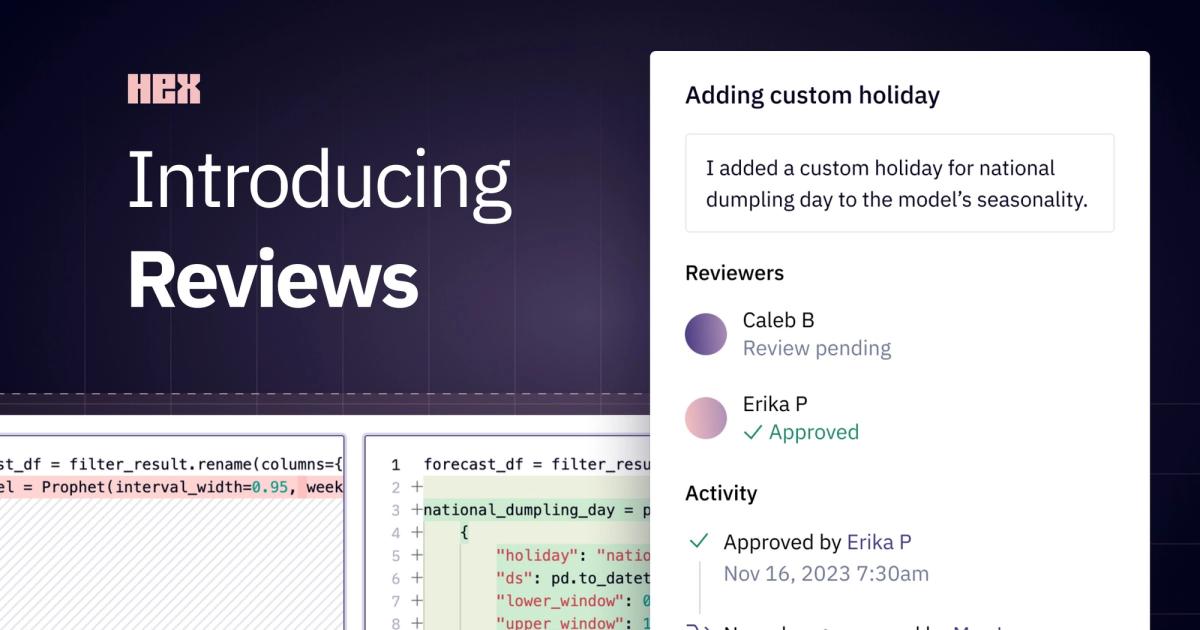
Hex has evolved its collaborative analysis platform by introducing a code review system for projects. This feature allows users to request and perform peer reviews on published projects, with options for required reviews to protect business-critical assets. The review interface provides a side-by-side diff of code and output, enabling reviewers to leave comments, request changes, or approve updates. Stakeholders with view permissions can also participate in the review cycle. The publishing flow now integrates with GitHub sync for a seamless pull request workflow.

2 posts · 2022–2024

Timeline

20222026
Feature trailQuiet since 2024

ML Model Deployment to Databases

Hex has evolved its ML capabilities by enabling seamless deployment of trained models to data warehouses like Snowflake. This allows for batch predictions directly within the database using simple SQL commands, eliminating the need for separate infrastructure or complex deployment pipelines. This integration leverages tools like Modelbit to bridge the gap between model training in Hex and production inference at scale. This post details using on-demand GPUs with Hex and Modelbit to build and deploy ML models, specifically demonstrating the process with a Grounding DINO model. It covers setting up the environment, building the model on remote GPU compute via Modelbit's job execution, and deploying the trained model as a REST API for inference, which is then called back into Hex.

2 posts · 2023–2024

Timeline

20232026
Feature trailQuiet since 2023

Time Series Seasonality Detection

Hex enables users to detect seasonality in time series data using autocorrelation, ACF, and PACF. This includes understanding autocorrelation basics, calculating and interpreting autocorrelation values, and applying these techniques to real-world datasets like air passenger data. The platform supports visual inspection via line plots and seasonal decomposition to identify trends, seasonal patterns, and residuals, aiding in business forecasting and decision-making.

3 posts · 2023

Timeline

20232026
Feature trailQuiet since 2023

Scaling Hierarchical Clustering

Hex has evolved its data science capabilities by detailing techniques and tools for scaling hierarchical clustering. This includes exploring the computational and memory challenges of traditional methods, and introducing solutions like sampling, approximation algorithms, and leveraging specialized libraries and distributed computing frameworks such as Fastcluster, Apache Spark, and GPU-accelerated approaches. The post aims to provide practical strategies for applying hierarchical clustering to large datasets.

2 posts · 2023

Timeline

20232026
Feature trailQuiet since 2023

K-Means Clustering

Hex has evolved its data analysis capabilities by providing a comprehensive guide to K-Means clustering. This includes detailing the algorithm's fundamentals, how it works through initialization, assignment, and iterative updates, and key parameters like the number of clusters (K). The post demonstrates practical application using the Iris dataset, covering data loading, cleaning, transformation (scaling and PCA), and methods for selecting an optimal K value such as the Elbow method and Silhouette Score. It aims to empower users to uncover patterns in unlabeled data and categorize datasets into actionable segments.

1 post · 2023

Timeline

20232026
Feature trailQuiet since 2023

Multicollinearity Detection and Remediation

Hex has evolved its data analysis capabilities by providing a comprehensive guide to detecting and remedying multicollinearity. This includes explaining the consequences of multicollinearity on model interpretability and predictive power, and detailing methods for its detection using Variance Inflation Factor (VIF), correlation matrices, heatmaps, clustermaps, and eigenvalues. The post also outlines strategies for fixing multicollinearity, such as removing correlated variables, using dimensionality reduction techniques, or employing regularization methods.

1 post · 2023

Timeline

20232026
Feature trailQuiet since 2023

Jupyter Kernel Internals

This post details the architecture and communication mechanisms of the Jupyter kernel, explaining its role as the computational engine for notebooks. It covers the decoupling of I/O from computation, the benefits of this model (multiple frontends/backends, isolation, performance), and the communication protocols (WebSockets, ZeroMQ) and sockets (shell, IOPub, stdin, control, heartbeat) used between the frontend and kernel. The post also provides a practical example of building a simple echo kernel to illustrate the underlying principles.

1 post · 2023

Timeline

20232026
Feature trailQuiet since 2023

Brand Inaccessibility Explorer

Hex has evolved its data exploration capabilities by enabling users to discover and visualize 'Poles of Brand Inaccessibility' across the United States. This feature allows users to identify locations farthest from specific brands, combine multiple brand inaccessibility poles, and explore the resulting geographical distributions. The underlying analysis involves processing large datasets of brand locations, calculating great-circle distances, and optimizing these calculations for interactive web-based exploration. This capability enhances data-driven discovery and provides a novel way to interact with geographical and brand data.

1 post · 2023

Timeline

20232026
Feature trailQuiet since 2023

Dimensionality Reduction Techniques

Hex has evolved its data analysis capabilities by introducing and detailing dimensionality reduction techniques. This post provides an introduction to the concept, explaining what dimensions are, the challenges posed by the curse of dimensionality, and the distinction between linear and non-linear reduction methods. It serves as a foundational piece for understanding how to simplify complex datasets while preserving essential information, with a companion post offering practical implementation details.

1 post · 2023

Timeline

20232026
Feature trailQuiet since 2023

Python SQL Server Integration

Hex has evolved its data integration capabilities by enabling users to connect to and query SQL Server databases using Python and the pyodbc library. This allows for seamless data loading, manipulation, and analysis directly within the Hex environment, leveraging the robustness of SQL Server for data storage and Python for advanced analytics. The integration supports creating tables, inserting data in bulk via CSV, and running complex SQL queries for filtering and sorting.

2 posts · 2023

Timeline

20232026
Feature trailQuiet since 2023

Natural Language Processing Tools

Hex has introduced capabilities for Natural Language Processing (NLP) in Python, enabling users to programmatically understand and interpret human language. This includes basic text processing using libraries like NLTK for tasks such as tokenization and frequency distribution, sentiment analysis using VADER, and an introduction to topic modeling with Gensim. The platform facilitates the application of these NLP techniques within the Hex environment for data analysis and insight generation.

2 posts · 2022–2023

Timeline

20222026
Feature trailQuiet since 2023

Reusable Components

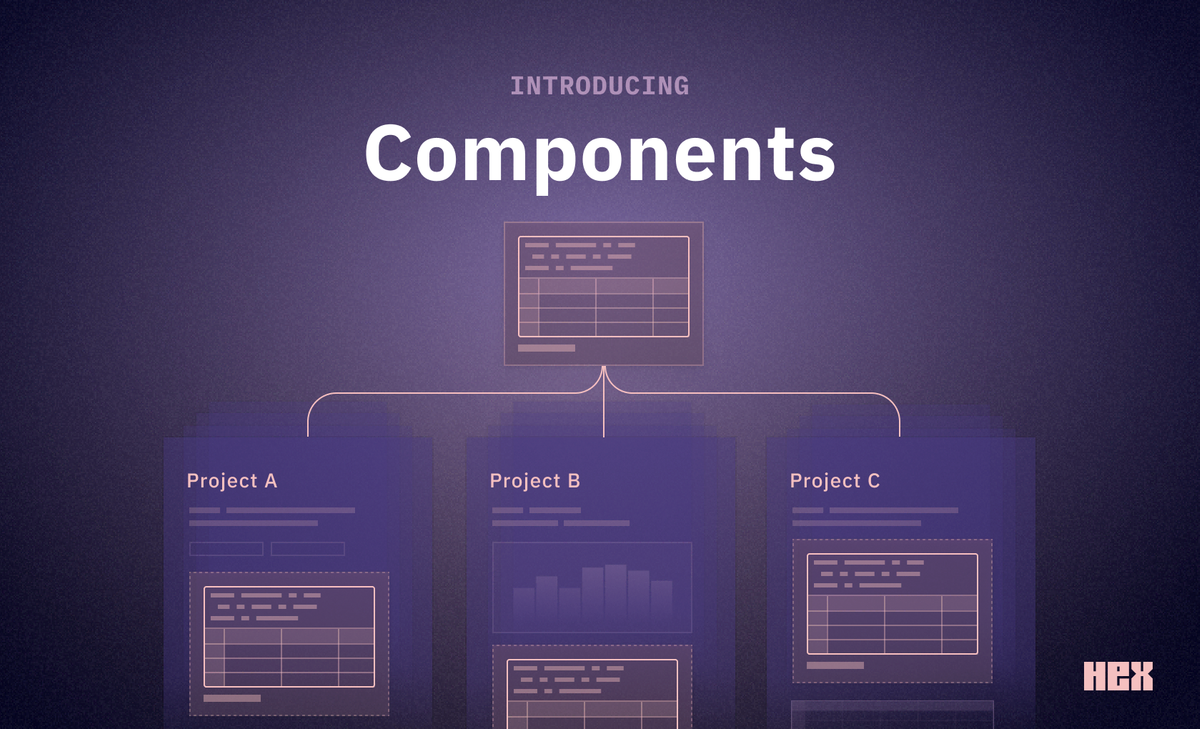
Hex has evolved its collaborative analysis platform by introducing Components, a feature that allows teams to write groups of cells once and re-use them across projects. This promotes consistency, efficiency, and reduces errors by enabling the creation of a centralized repository of reusable logic. Changes to a component propagate to all projects that use it, with options to update or detach imported components. This feature extends the DRY principle to analytics workflows.

1 post · 2023

Timeline

20232026
Feature trailQuiet since 2022

Sentiment Analysis Model

Hex has evolved its natural language processing capabilities by providing a tutorial on building a sentiment analysis model in Python. This post details the process of using pre-trained models from Huggingface, preprocessing text data, and evaluating model performance. It covers techniques for classifying sentiment as positive, negative, or neutral, and demonstrates how to visualize results and common words associated with each sentiment.

1 post · 2022

Timeline

20222026
Feature trailQuiet since 2022

Experimentation

Hex has evolved its experimentation capabilities by providing a comprehensive guide to performing A/B tests. This includes understanding the core concepts of A/B testing, defining hypotheses (null and alternative), selecting appropriate metrics like user retention, and performing exploratory data analysis to check for sample ratio mismatch (SRM). The post details how to handle SRM by random sampling and demonstrates statistical testing using chi-square tests to validate hypotheses. It also covers visualization techniques like kernel density estimation to better understand retention rates across different groups.

1 post · 2022

Timeline

20222026
Feature trailQuiet since 2022

ETL Incident Response

This post details a significant production outage caused by a misconfiguration in the ETL process, specifically related to the PostgreSQL Write-Ahead Log (WAL) growing unboundedly. It covers the root cause (Fivetran connection failure leading to WAL buildup), the impact of auto-scaling limitations during disk optimization, and the challenges encountered when attempting to use a read replica as a failover. The post outlines immediate next steps including better alerting on disk space and Fivetran failures, improving WAL handling (e.g., WAL size limits), and moving non-essential workloads off the production database. It emphasizes the importance of robust incident response and learning from failures.

1 post · 2022

Timeline

20222026
Feature trailQuiet since 2022

Python SQL Integration

Hex has evolved its data integration capabilities by enabling users to connect to and query SQL databases like MySQL and SQL Server using Python. This allows for seamless data loading, manipulation, and analysis directly within the Hex environment, leveraging the robustness of SQL databases for data storage and Python for advanced analytics. The integration supports creating tables, inserting data in bulk, and running complex SQL queries for filtering and sorting.

5 posts · 2022

Timeline

20222026
Feature trailQuiet since 2022

Logistic Regression Tutorial

Hex has evolved its data analysis capabilities by providing a comprehensive guide to logistic regression, a binary classification algorithm. This post details the process of data loading, preprocessing (including handling categorical features with one-hot encoding and binary encoding), determining a baseline accuracy, training the model, and evaluating its performance using a confusion matrix, precision, recall, and accuracy metrics. It also touches upon interpreting the results and briefly discusses data imbalance.

2 posts · 2022

Timeline

20222026
Feature trailQuiet since 2022

Chained SQL

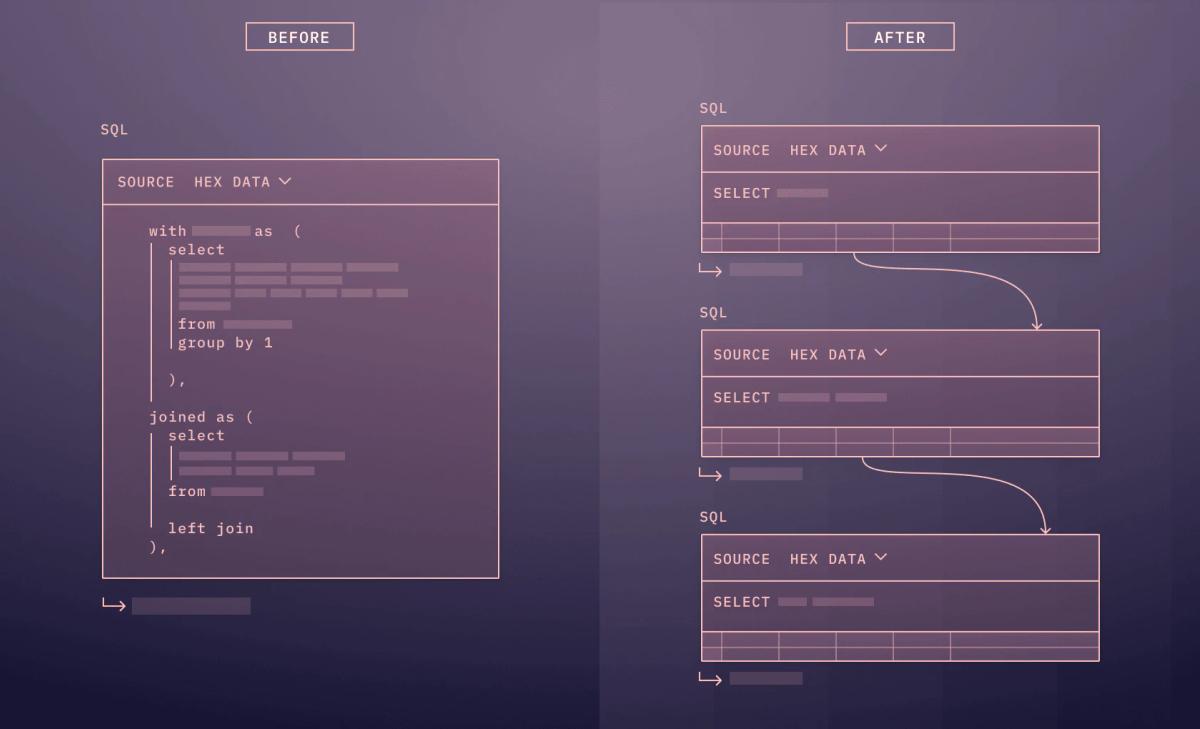
Hex has evolved its data analysis capabilities by introducing Chained SQL, a feature that allows users to break down complex SQL queries into separate, referenceable cells. This enables easier debugging and inspection of data flow by automatically generating CTEs behind the scenes, improving upon the limitations of traditional CTEs which are confined to a single query. This feature enhances the user experience for writing and managing SQL within the Hex notebook environment. Query mode allows us

4 posts · 2021–2022

Timeline

20212026
Feature trailQuiet since 2021

Reactive Compute Engine

Hex has evolved its notebook and data app capabilities by introducing a reactive compute engine. This engine models projects as Directed Acyclic Graphs (DAGs), where each cell's re-execution is triggered only by upstream dependencies. This enhances reproducibility, performance, and interpretability by eliminating the state-related frustrations of traditional notebooks. The system automatically infers dependency relationships between Python and SQL cells, allowing for efficient re-computation of only the necessary downstream logic.

1 post · 2021

Timeline

20212026
Feature trailQuiet since 2020

Live Collaboration

Hex has evolved its collaborative editing capabilities by implementing a pragmatic approach to live collaboration using Atomic Operations (AO). This system breaks down all state mutations to single property updates, ensuring that operations of different types cannot conflict. A central authority manages a monotonically increasing counter per object to determine the 'last writer wins' in cases of same-type operation conflicts. This approach was chosen for its incremental shippability, compatibility with the existing stack (Apollo, GraphQL, TypeScript, PostgreSQL), and developer control over core application foundations.

1 post · 2020

Timeline

20202026