Blogs
Atlassian logo

Atlassian

Engineering blog · atlassian.com/blog

490posts1this week0watchers

Feature trails

114
Feature trailActive

Loom Video Processing and Viewing Reliability

Loom has significantly improved its video processing and viewing reliability. The platform now auto-recovers over 80% of videos experiencing initial processing errors, a substantial increase from 0%. The video player page load time has been reduced by 30%, and the preview experience has been enhanced with higher quality images and MP4 thumbnails. Proactive error messaging has been improved with over 20 new messages to guide users, particularly addressing silent audio issues. The bug fix rate has been improved. The new Loom for Mac desktop app is rebuilt natively, offering faster launch times, reduced memory usage, and support for higher resolution recordings (up to 4K). It features advanced screen capture with automatic decluttering (hiding desktop icons and menu bar), improved camera and audio performance with new bubble shapes, filters, and backgrounds, precise screen capture with drag-to-select functionality, and refreshed speaker notes with a teleprompter. A new 'Record for agents' feature allows users to turn screen recordings into instructions for AI agents, with the ability to mark critical context and convert action items into Jira issues. The app is also approximately 80% smaller in download size.

5 posts · 2021–2026

Timeline

20212026
Feature trailActive

Agentic Pipelines for Maintenance Tasks

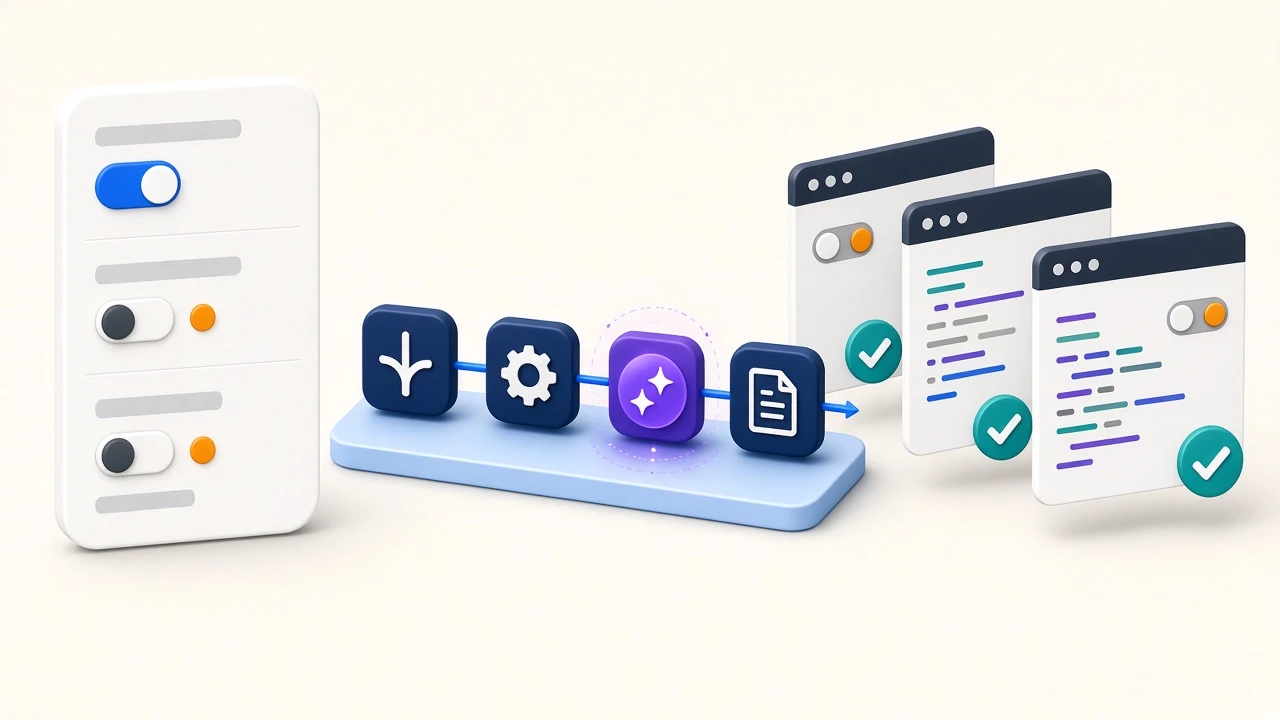
Atlassian is developing Agentic Pipelines to automate recurring maintenance tasks, starting with feature flag cleanup. This capability aims to reduce engineering overhead by using AI agents to prepare code changes, such as removing stale feature flags, and opening pull requests for human review. The system emphasizes a 'thin prompt, rich skill' architecture, robust validation, and scoped permissions to ensure safety and efficiency. This pattern is being explored for other maintenance tasks like turning Loom recordings into dev-ready work items in Jira, capturing technical context for bug reports, and suggesting Jira updates from meeting discussions.

2 posts · 2026

Timeline

Feature trailActive

Synthetic Data Generation Platform

Atlassian is building a scalable, config-driven synthetic data generation platform called Data Brewery. This platform aims to produce high-volume, product-shaped, relationally correct datasets for products like Jira and Confluence, enabling faster and more confident migration testing. The core innovation is a two-phase generation model that separates row generation from foreign key resolution, improving performance and maintainability. The system is designed to be extensible for new entities and data shapes with minimal product-specific engineering.

1 post · 2026

Timeline

Feature trailActive

AI Governance Platform

Atlassian's AI Governance Platform, including Rovo Search, is enhanced with enterprise-ready AI-driven search, interactive chat, and intelligent agents. This post details the platform's approach to AI governance, focusing on securing underlying data, setting boundaries for autonomous behavior, and maintaining a record of AI actions. It introduces controls for data classification, content scanning, agent permissions, tool controls, and audit logs, aiming to provide centralized oversight and risk management. BearQ for Jira is introduced as an assignable agent that integrates directly into the Jira workflow to perform intelligent, end-to-end testing. BearQ parses Jira work items to author test cases, explore user journeys, and adapt tests as applications evolve. It creates Jira issues with reproduction steps and evidence when regressions or issues are found, aiming to scale QA capacity while retaining team oversight.

8 posts · 2025–2026

Timeline

20252026
Feature trailActive

AI-Native Software Development Capabilities in Jira

Atlassian's AI Gateway provides a unified, secure, and reliable abstraction layer for developers to access and manage a curated model garden of 20+ LLMs, audio, and image models from multiple providers. It streamlines model releases, enables automated fallback for reliability, centralizes security and compliance controls, and manages capacity and costs. The gateway supports integration flexibility, shared tooling, and deep integration with Atlassian's AI platform, including evaluation suites and the MCP Server. The MCP Server is now generally available, allowing external AI clients (AWS, ChatGPT, Claude, Cursor, Devin, Docker, Figma, GitHub, Google, Lovable, Mistral, Postman, Resolve, VS Code, WRITER, and more) to connect securely with Jira and Confluence. It enables Rovo search and fetch across Jira/Confluence, creation/update of Confluence pages, and creation/linking of Jira epics and issues directly from AI clients. It also supports MCP apps for tailored UI experiences and provides enterprise-grade security, admin, and AI controls, including trusted client management, usage logging, and alignment with Rovo/Atlassian platform controls. The focus remains on an open ecosystem connecting tools, AI clients, and systems of record.

143 posts · 2023–2026

Timeline

20232026
Feature trailActive

Bitbucket Test Health Dashboards

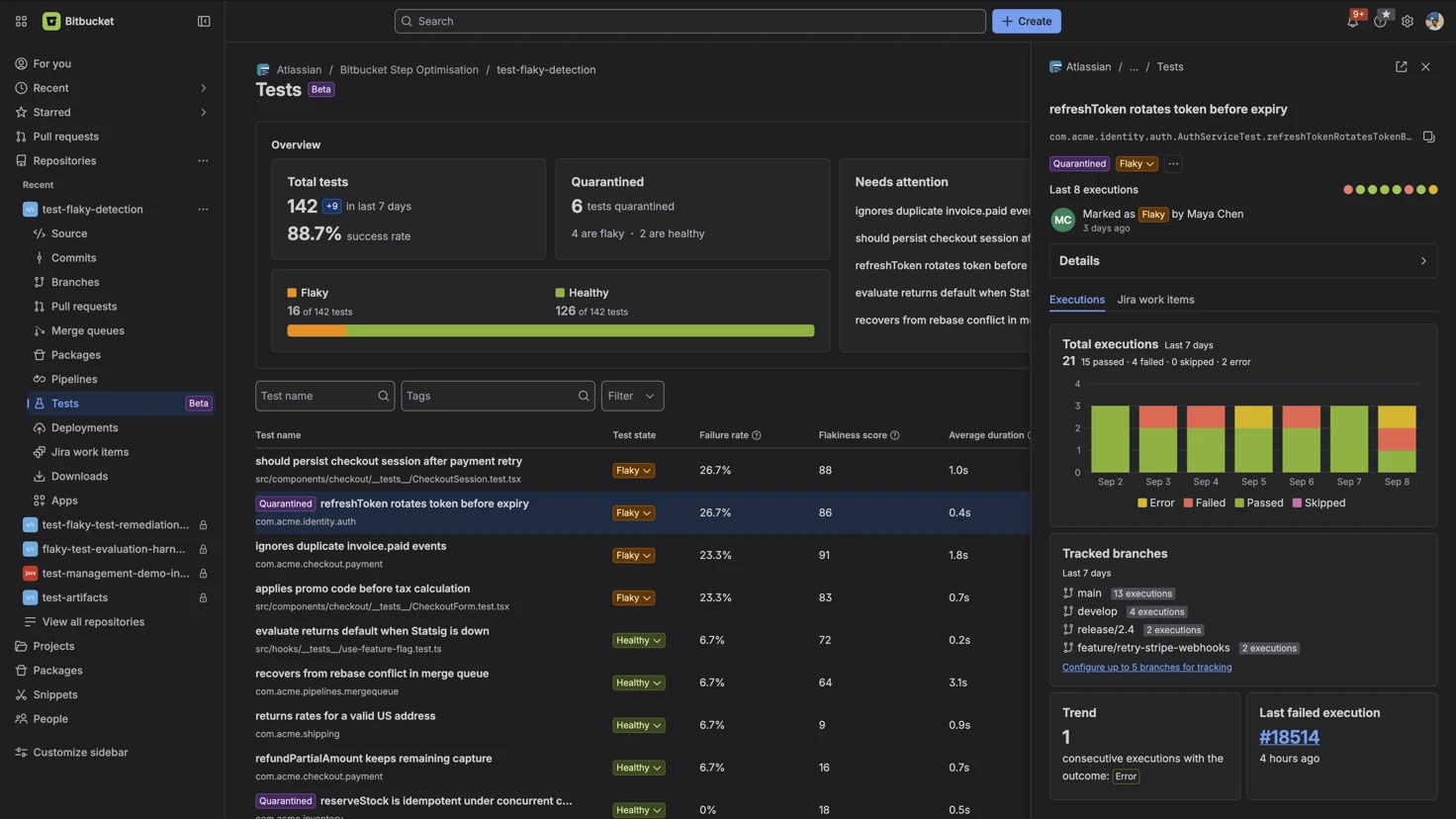
Bitbucket Tests provides visibility into test reliability, historical trends, and suite breakdowns, including flaky and quarantined tests. New dashboards offer an overview of test health, with drill-down capabilities into individual test execution history and summary. The system integrates with Bitbucket Pipelines by consuming JUnit-compatible test reports. This post extends the capability to automatically detect and quarantine flaky tests, reducing CI noise and improving build reliability by enabling the development of a scalable tool called Flakinator to detect, manage, and mitigate flaky tests across all codebases effectively. Flakinator utilizes advanced algorithms and machine learning for efficient identification, quarantine mechanisms, trend analysis, root cause analysis, custom settings, scalability, and seamless integration with other tools like Jira and Slack. It handles over 350 million test executions per day and stores over 3TB of data. Detection algorithms include a retry mechanism with an 81% detection rate for certain products and Bayesian inference for calculating a flakiness score.

7 posts · 2022–2026

Timeline

20222026
Feature trailActive

Teamwork Graph Connector Orchestration

Atlassian's Teamwork Graph Connectors for Forge are generally available, enabling modeling of external data as Teamwork Graph entities. This facilitates ingestion of data from external SaaS products, internal platforms, or custom systems into Atlassian's Teamwork Graph, making it accessible across Rovo Search, Rovo Chat, Rovo Agents, and Atlassian Analytics. The platform handles connection configuration, data modeling, and recurring ingestion jobs. This capability is now integrated with Microsoft 365 Copilot and Teams via the Rovo agent, allowing users to search across Atlassian and Microsoft tools simultaneously, get contextually rich answers, and take action directly from Teams conversations. The Jira Cloud for Microsoft Teams app is enhanced with Rovo's intelligence to understand natural language, enabling users to trigger Jira workflows and assign work to agents without leaving chat.

4 posts · 2026

Timeline

Feature trailActive

Jira Product Discovery Capacity Planning

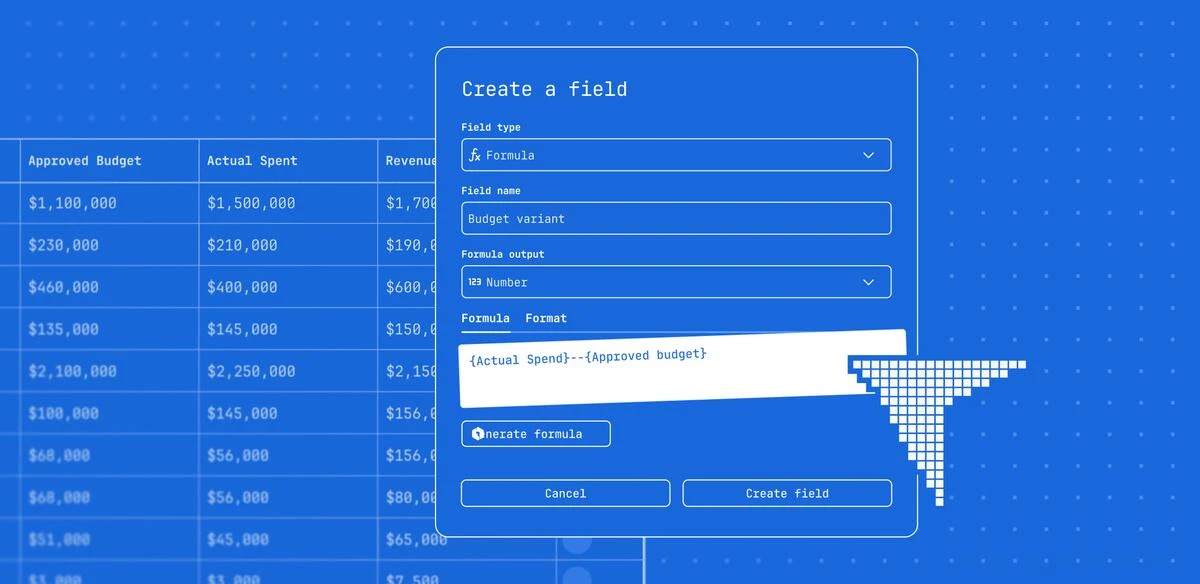
Jira Product Discovery (JPD) is evolving into a comprehensive capacity planning and project budgeting tool. New features include individual capacity planning with detailed bandwidth allocation (hours, percentages, days), accounting for leave and operational work. Formula fields allow for custom calculations directly on work items, enabling dynamic project budgeting, ROI tracking, and at-risk flagging. Space insights provide live, custom dashboards connected to work data, with AI-driven chart generation. This post details how engineering leaders can leverage JPD to create four key views: a helicopter view for strategic alignment, a high-level capacity planning view to identify resource constraints early, a backlog prioritization view for balancing tech debt and new features, and a delivery dashboard for real-time progress updates to stakeholders. These views aim to improve communication, decision-making, and resource allocation for engineering teams.

13 posts · 2018–2026

Timeline

20182026
Feature trailActive

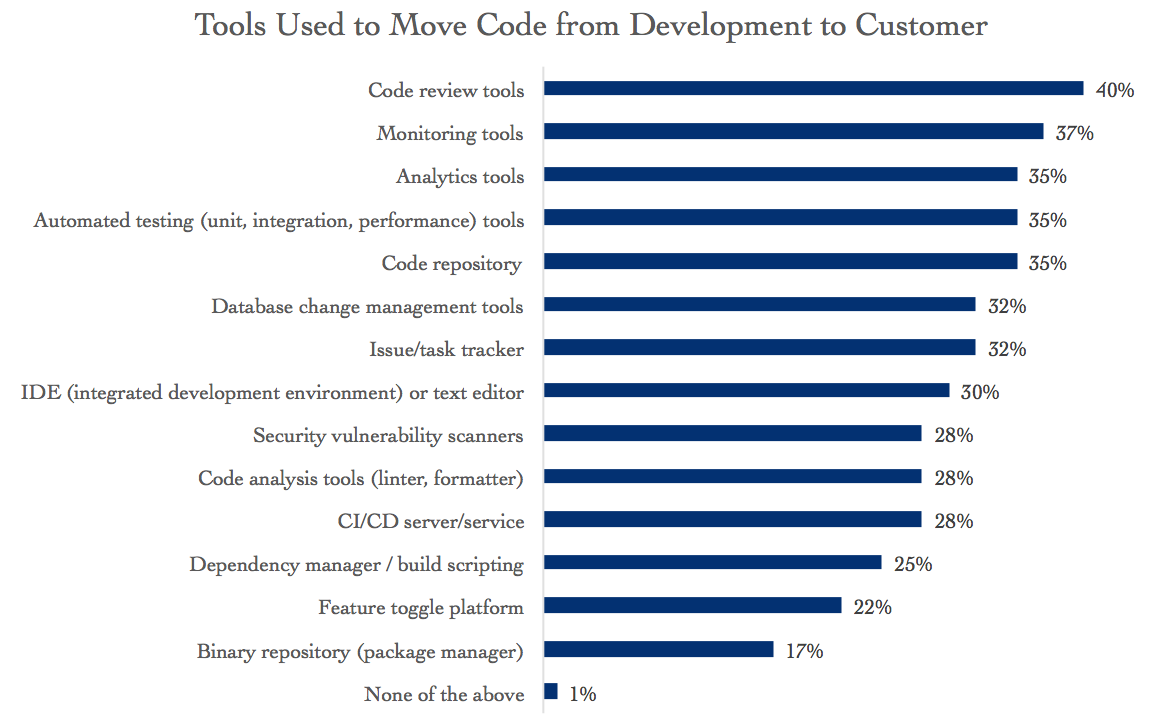
Adopting Forge Features in Connect Apps

Atlassian is guiding app developers in migrating from the Connect framework to Forge, extending support deadlines for Connect to provide ample time for transition. The platform offers various architectural patterns and utility modules to facilitate the development and integration of Forge apps, including patterns for extending Atlassian app UIs, updating app state, reacting to events, defining capabilities, and integrating with external systems via web triggers, API routes, and Forge Remotes. This post details the end-of-support timeline for Connect and provides guidance for custom app developers to migrate to Forge, including auditing existing apps, starting Forge proofs-of-concept, and leveraging Forge resources. It also highlights the differences between Connect (externally hosted) and Forge (Atlassian-hosted) apps.

17 posts · 2023–2026

Timeline
20232026
Feature trailActive

Bitbucket Pipelines Runner

Bitbucket Cloud's CI/CD capabilities are enhanced with a migration tool for Bamboo, supporting build plans, deployment projects, and custom plugins. The tool automates the transition to Bitbucket Pipelines, offering zero wait times, reduced operational overhead, lower costs, and effortless compliance. New features include deployment plan migration, support for custom transformers (Python scripts for mapping plugins to Pipes or shell commands), instance-level migration for entire Bamboo instances. The platform is evolving its runner model to offer a free tier with up to 100 basic runners per workspace and an optional paid Premium runners tier for advanced orchestration, higher limits, and premium support. The billing model for premium runners is shifting to a usage-based approach reflecting maximum concurrent build slots actually used per month. Premium runners will unlock features like dedicated support, pluggable storage, increased runner limits (up to 1,000 per workspace), runner management APIs, runner groups, disabling cloud runners, ephemeral macOS runners, auto-update, and advanced queue management.

95 posts · 2015–2026

Timeline
…20172026
Feature trailActive

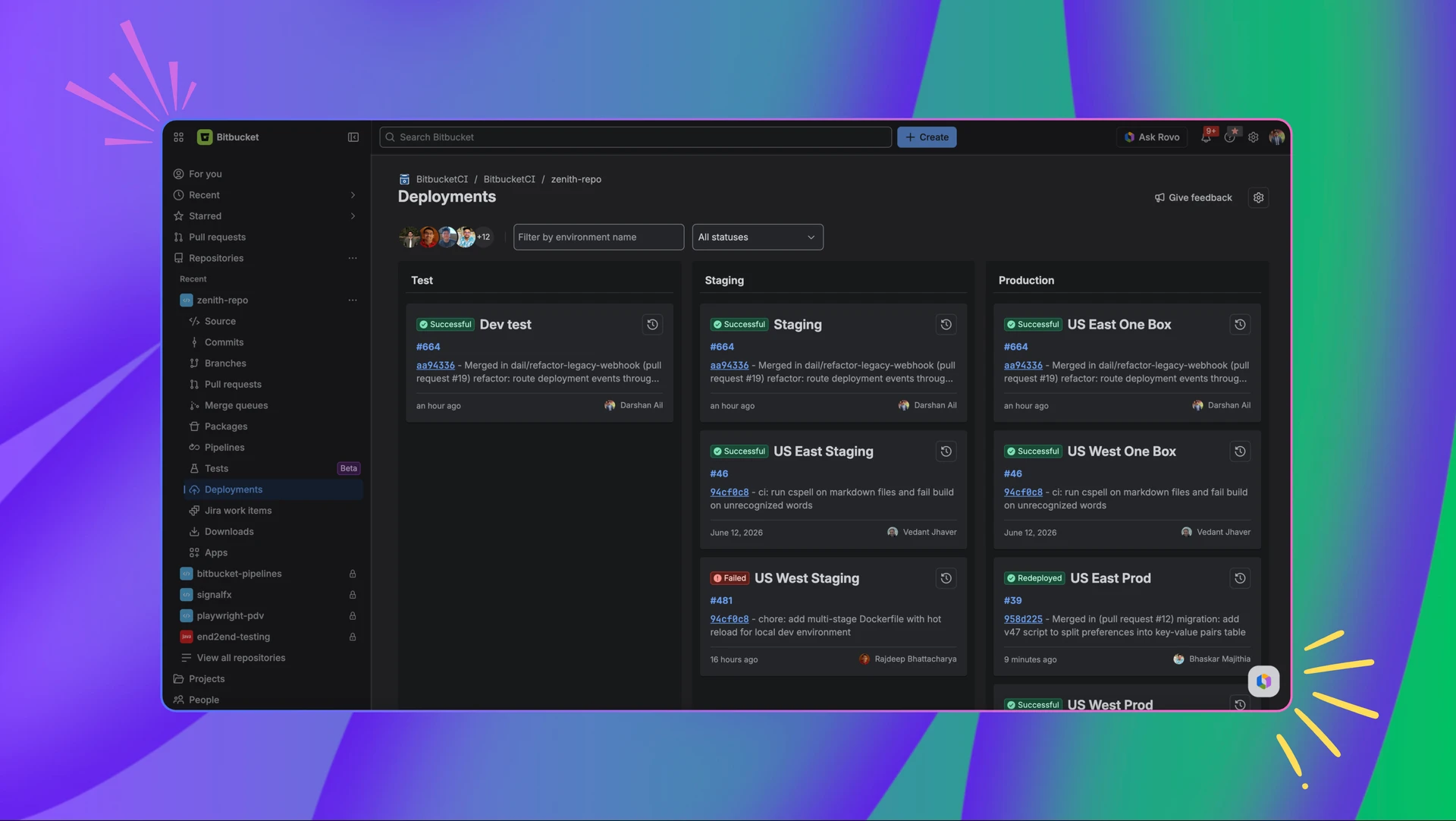
Deployment Orchestration and Health Monitoring

Bitbucket Cloud is evolving its Deployments functionality into a more modular system. This includes introducing Concurrency Groups for managing step execution order and Environments for decoupling environment-specific variables, permissions, and branch restrictions from the full Deployments framework. These features aim to provide greater flexibility and control over CI/CD workflows, allowing users to leverage specific components without being forced into the entire Deployments structure. Dynamic Pipelines extend this by allowing serverless functions to alter pipeline configurations in real-time, enabling advanced organizational CI/CD orchestration and custom workflow logic.

1 post · 2021–2026

Timeline

20212026
Feature trailActive

Unleash Event PWA

The Unleash Event PWA is a real-time, progressive web application built on Atlassian's stack to serve as the central hub for the Unleash 2026 event. It allows attendees to browse the agenda, manage personal schedules, watch session recordings, participate in hands-on challenges, interact with an AI guide, and contribute to production features by shipping code live during the event. The architecture leverages Jira Cloud as the system of record for event data, a thin stateless service for elevated privileges, and Jira Automation for scheduled tasks. The app employs a state machine for readiness, a durable local outbox for capturing user intent, and a materialized view for the leaderboard. Performance optimizations have been implemented to reduce load times and API call duplication.

1 post · 2026

Timeline

Feature trailActive

AI-Assisted Localization

Atlassian is scaling its localization process to keep pace with AI-driven development acceleration. This involves leveraging AI to draft translations and implementing tooling to fix source code issues before translation. The goal is to reduce rework, lower localization costs, and maintain translation quality by combining AI drafting with professional human review. The system gathers context for AI prompts, tracks Translation Edit Rate (TER) to improve AI models, and uses i18n validation to catch

1 post · 2026

Timeline

Feature trailActive

Forge Billing Platform

Atlassian's Forge Billing Platform is evolving to include consumption-based pricing for hosted Forge features, effective January 1, 2026. This includes new pricing for Forge SQL compute duration, compute requests, and data stored, alongside updates to existing pricing for Compute Functions, KVS, and Logs. A generous free tier will be provided for experimentation, with developers only paying for usage above this threshold. New tools like a cost dashboard and cost estimator are being launched to h

7 posts · 2025–2026

Timeline

20252026
Feature trailActive

ML Optimization System for Paid Marketing

Atlassian's ML Optimization System for Paid Marketing has been enhanced with a two-stage ML paradigm for optimal budget allocation. The system comprises a payout model that predicts business outcomes as a function of marketing spend, incorporating global model transfer learning and capturing spend diminishing returns. A budget optimizer then uses these predictions to find the best allocation across all segments simultaneously, maximizing overall business value under real-world constraints. The system operates with offline and online layers and a continuous learning loop, enabling dynamic budget refreshes, cross-channel global optimization, constraint-aware optimization, and multi-objective optimization across funnel metrics. Future work includes better extrapolation handling, incorporating prediction uncertainty into optimization, and feature enrichment.

1 post · 2026

Timeline

Feature trailActive

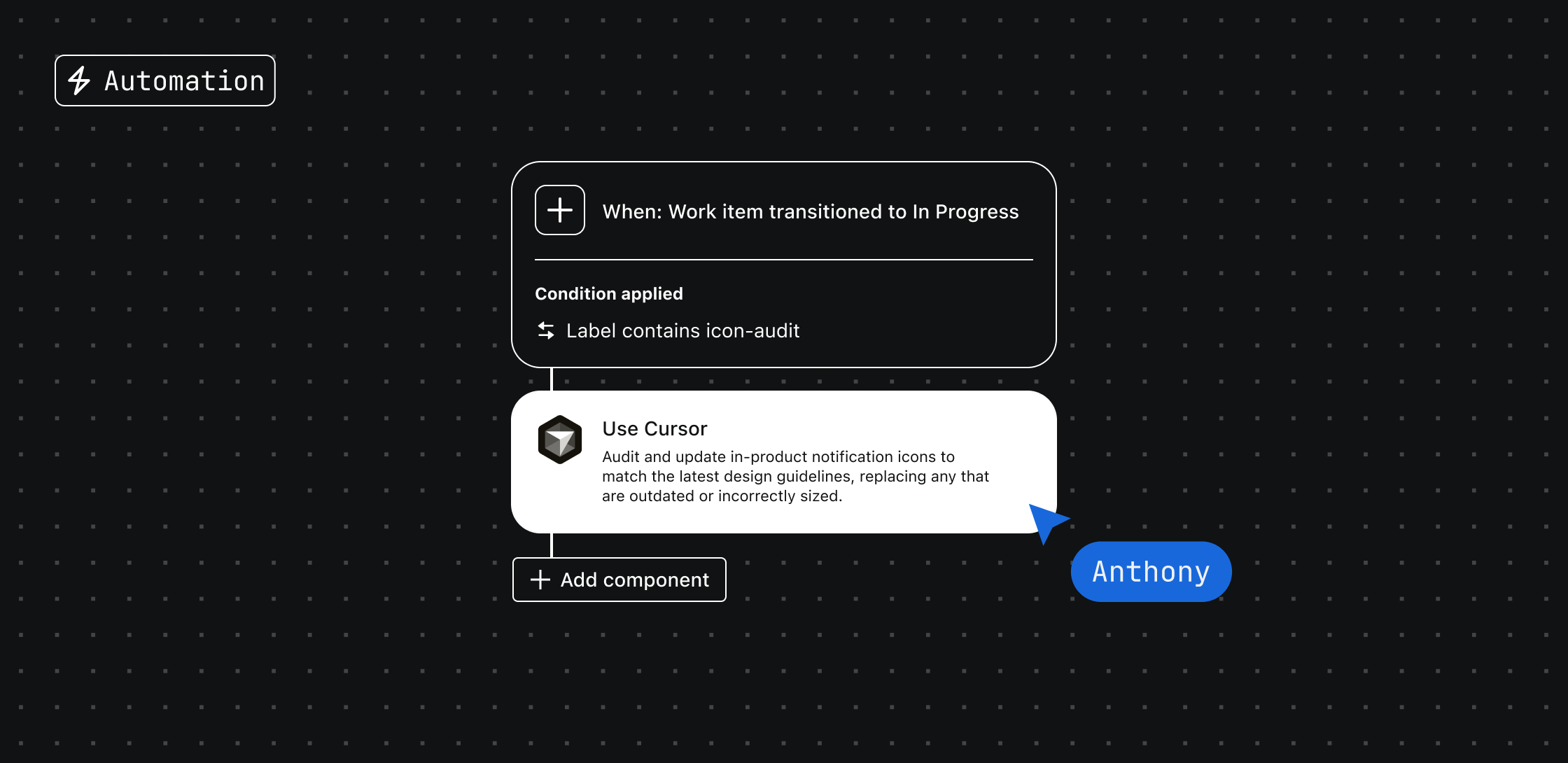
Atlassian Automation Platform

Atlassian Automation is a core platform capability across Jira, Confluence, and Jira Service Management, enabling users to automate repetitive tasks, streamline workflows, and integrate with third-party tools. It features a low-code/no-code visual rule builder, template libraries, and AI-driven rule creation. The platform integrates with Rovo AI Agents for advanced content analysis and manipulation. Key use cases include keeping content and work up-to-date, routing work to the right teams, and a new capability for custom automation steps built with Forge, allowing developers to add their own actions directly into the Automation rule builder. These Forge Automation Actions are configured via a UI provided by the Forge app, executed as Forge functions, and can call Atlassian APIs and external services. They support smart values for inputs and outputs, enabling dynamic and reusable automations.

7 posts · 2020–2026

Timeline

20202026
Feature trailActive

Atlassian Webhook Delivery Platform

Atlassian's webhook delivery platform, the 'events rail', has been architected to handle over 10 billion events per month, serving hundreds of thousands of customer sites across multiple production regions. It reliably delivers events from Atlassian products to Forge apps and other subscribed systems. The platform is designed for extensibility, allowing new event sources and destinations to be added without rebuilding the core infrastructure. Key architectural decisions focus on optimizing subscription management and delivery reliability. This post details the migration of StreamHub from Amazon Kinesis to Apache Kafka (via AWS MSK) to handle 150 billion events per day, leveraging Kafka Tiered Storage for cost reduction, and the resilience challenges encountered at scale, including broker networking limits, S3 request rate behavior, and managed service control plane dependencies. Design patterns for hardening StreamHub are also discussed.

6 posts · 2018–2026

Timeline

20182026
Feature trailActive

Online Index Migration and Shard Scaling for OpenSearch

Atlassian has developed AOSC, an OpenSearch plugin enabling zero-downtime index migration and shard scaling. This system addresses challenges with modifying live indices by leveraging OpenSearch's internal capabilities like Retention Leases and Lucene Changes Snapshots to implement a CDC-like mechanism. It allows for online index reshaping and lays the groundwork for auto-scaling shards, significantly reducing operational burden and risk. Additionally, Atlassian is enhancing OpenSearch cluster management with Admission Control to improve resiliency by rate limiting incoming requests at the rest layer when a node is under high stress, preventing nodes from being overwhelmed and ensuring stable performance even under high demand. This includes tracking rolling average CPU and IO usage to reject search and bulk requests, returning HTTP 429 errors upon rejection. The system supports MONITOR and ENFORCED modes for admission control, with configurable limits for CPU/IO usage for indexing and search requests.

5 posts · 2018–2026

Timeline

20182026
Feature trailActive

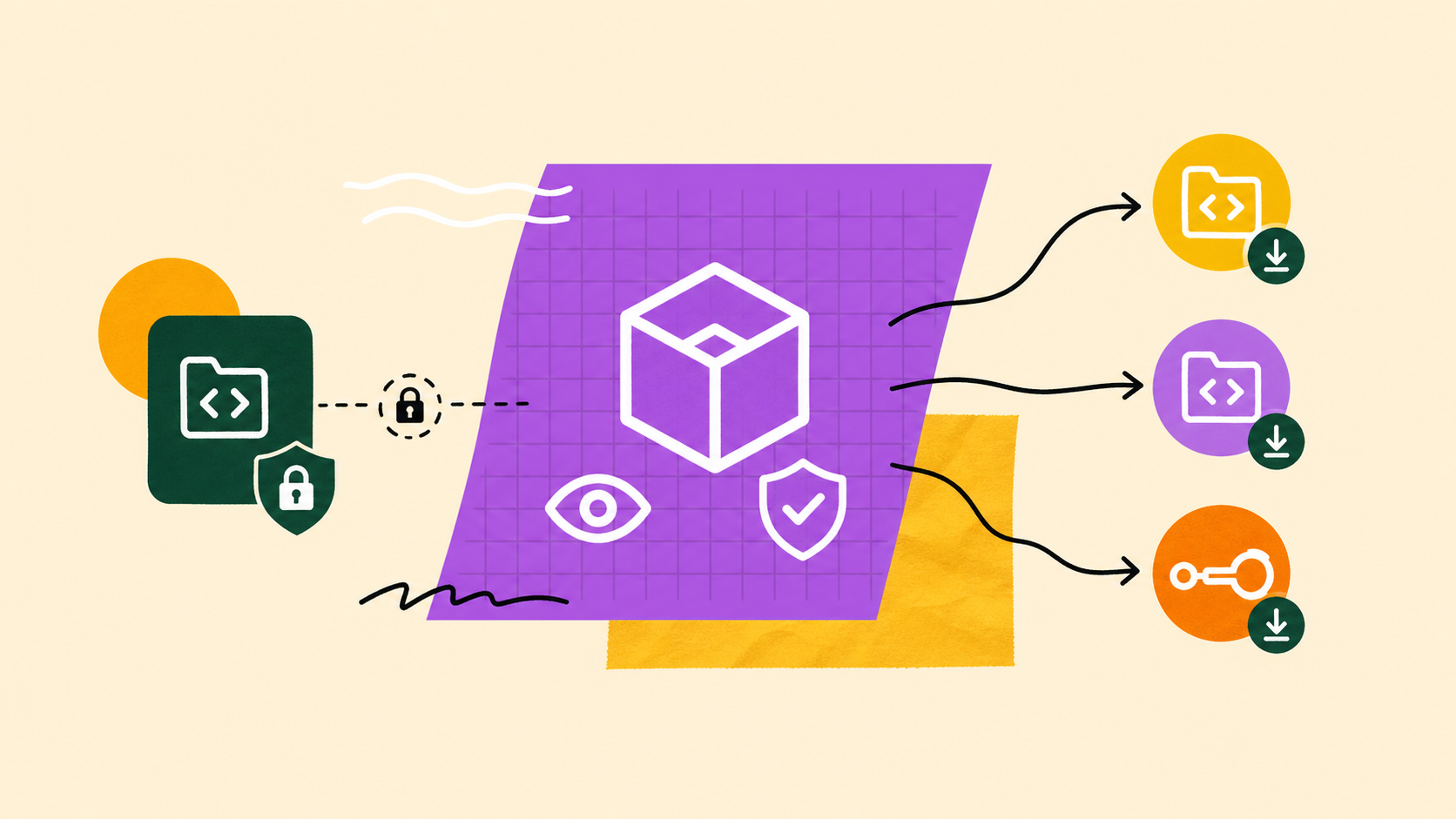
Internal Packages for Bitbucket

Bitbucket Cloud offers a native container registry integrated with Bitbucket Cloud workflows, allowing teams to publish, manage, and consume container images. It supports repository permissions, API token access control, and will transition to consumption-based billing. Recent enhancements include image and tag deletion, automated garbage collection for storage optimization, and preparation for general availability with a consumption-based pricing model for storage and network traffic. The new Bitbucket Packages feature will provide a central place to publish, manage, and consume artifacts, starting with container images, and will expand to cover additional languages and ecosystems.

13 posts · 2024–2026

Timeline

20242026
Feature trailActive

Merge Queues

Bitbucket Cloud's Merge Queues feature automates and sequences pull request merges, validating PRs against the latest target branch state and queued changes before merging to reduce broken builds and merge friction. It supports custom merge strategies and concurrency, integrating with Bitbucket Pipelines for validation. Developers add pull requests to the queue, and Bitbucket handles validation and merging, or ejects failed PRs. This post extends the capability by enabling custom merge checks to be built using Forge and applied at the workspace/project level, offering both required and recommended configurations.

27 posts · 2013–2026

Timeline

…20172026
Feature trailActive

Jira Configuration Optimization Tools

Jira Cloud is introducing optimization tools to combat configuration bloat. These tools help customers understand, identify, and remediate unused or redundant configuration entities like custom fields, work types, screens, and workflows. The system includes reporting, bulk remediation with safety mechanisms, and audit logs. It leverages a pre-computation framework for asynchronous scanning and a tiered state management system for storing usage data. The goal is to improve Jira performance at sca

2 posts · 2025–2026

Timeline

20252026
Feature trailActive

Rovo Dev CLI for Accelerated Debugging

Atlassian's RovoDev Coding Agent is an AI-assisted software development tool designed to work alongside engineers, embedded in Jira. It guides tasks from planning to coding, with a human in the loop for critical decisions. The agent drafts coding plans, generates code validated by tools and human review, and submits it for standard team review. Recent research indicates that RovoDev-generated code is as readable as human-written code across most metrics, supporting its adoption for scaling SWE Agents in the enterprise.

6 posts · 2024–2026

Timeline

20242026
Feature trailActive

Streaming Server-Side Rendering in Confluence

Confluence has significantly improved page load performance by implementing React 18's streaming Server-Side Rendering (SSR) capabilities. This allows for faster First Contentful Paint (FCP) and Time to Interactive (TTI) by rendering and streaming page components as they become available, rather than waiting for the entire page to render. The system also optimizes client asset loading by predicting and preloading necessary JavaScript bundles during the streaming process, further reducing interaction-ready time. This builds upon previous performance improvements and the adoption of React hydration and Suspense boundaries.

2 posts · 2020–2026

Timeline

20202026
Feature trailActive

Mutation Testing for Test Effectiveness

Atlassian is scaling its testing practices by integrating mutation testing, particularly with tools like Pitest, to improve the effectiveness of test suites beyond traditional coverage metrics. This approach aims to identify tests that do not adequately protect against code changes. The Rovo Dev CLI is being leveraged to automate the process of writing new tests to catch these mutants, thereby enhancing code quality and developer velocity. This initiative is being rolled out across backend codebases, with a focus on improving testing for new and changed code by setting mutation coverage threshold gates in pull requests. The Rovo Dev CLI, combined with MCP tools, can parse Pitest reports, identify areas with low mutation coverage, and automatically generate tests to catch surviving mutants, aiming to reach an 80% mutation coverage threshold before raising a pull request. Future plans include expanding this to frontend mutation testing.

1 post · 2025–2026

Timeline

20252026
Feature trailActive

Multi-Region Bitbucket Cloud Architecture

Bitbucket Cloud is evolving into a multi-region platform to enhance scalability, resiliency, and enable data residency. This involves restructuring core services to run independently in multiple regions, improving customer isolation and reducing the impact of noisy neighbors or regional issues. The platform will support data residency for EU and India-based customers by storing source code and other Bitbucket data within those regions. Key architectural changes include dropping support for cross-region replication for certain data types and a focus on regional self-sufficiency. This post details the migration of AWS CodeCommit repositories to Bitbucket Cloud, including cloning, adding remotes, pushing code, and migrating pull requests using a Python script and Bitbucket APIs. It also covers verification steps and updating remote URLs.

5 posts · 2021–2026

Timeline

20212026
Feature trailActive

Per-Tenant Performance Regression Detection

Atlassian is enhancing its performance monitoring capabilities with a new system for detecting and mitigating performance regressions at the per-tenant, per-endpoint level. This system aims to catch issues that are often missed by aggregated metrics, especially in complex, multi-tenant products like Jira Cloud. It leverages detailed metrics, statistical process control, and AI-powered root cause analysis to quickly identify and resolve performance degradations, ensuring a better experience for all users. The system has been integrated with Rovo Dev CLI for automated root cause analysis, successfully identifying and mitigating multiple production regressions by correlating performance metrics with feature flag evaluations and source code changes.

1 post · 2026

Timeline

Feature trailActive

Bitbucket Pipelines OIDC Audience Support

Bitbucket Pipelines now supports third-party secrets integration, allowing secure retrieval of secrets directly from external secret stores. This enhances security by preventing secrets from being stored within the Pipelines platform and provides greater control over secret access per repository. The integration works by generating an OIDC token for runners, which is then validated by the secrets integration service to fetch and return secrets from the configured vault. This feature is configurable for both cloud and self-hosted runners and requires enabling OIDC in the pipeline configuration.

2 posts · 2024–2026

Timeline

20242026
Feature trailActive

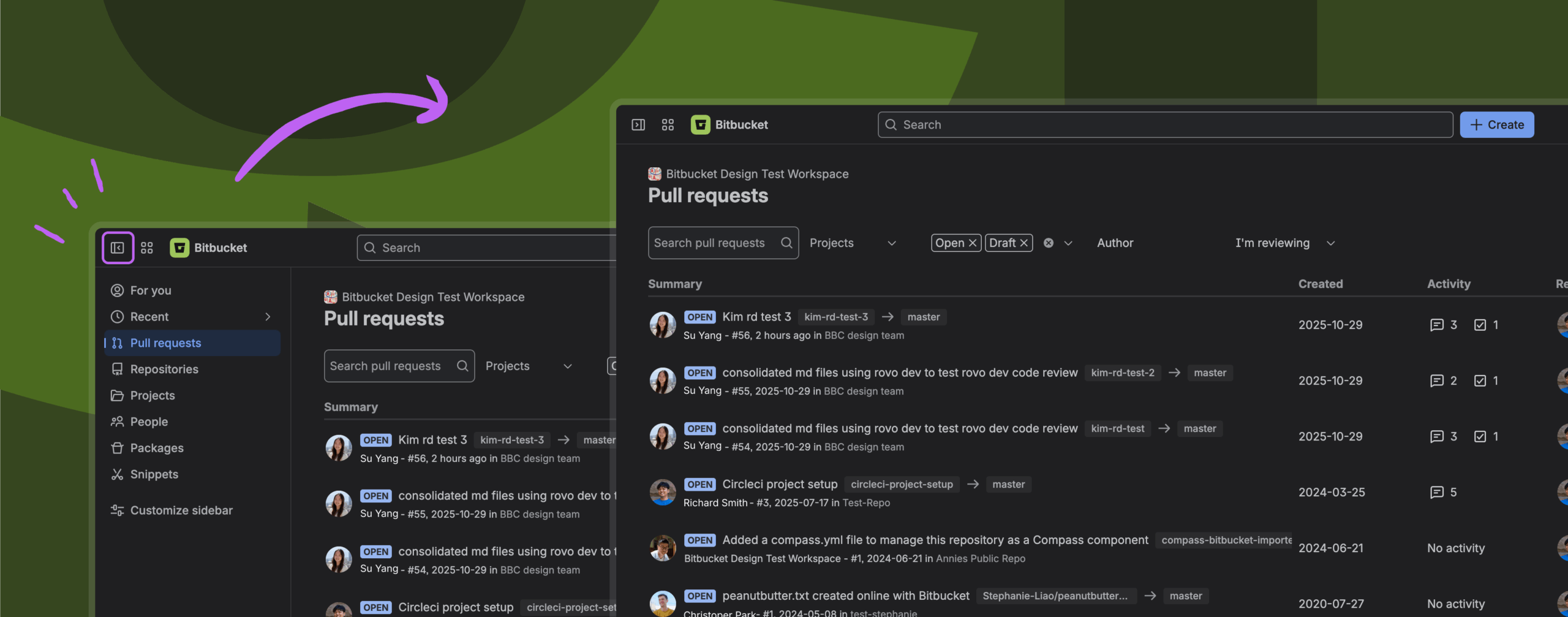
Unified Product Navigation

Atlassian is building a unified navigation system across its product suite to improve cross-product discoverability and user experience. This initiative aims to create a cohesive system that works for all teams, from software developers to business functions, by providing a single entry point and consistent interaction model. The project involves significant cross-team collaboration, a focus on balancing speed and quality in delivery, and a data-driven approach to gathering and interpreting user feedback. Bitbucket's new navigation aligns with this platform-wide effort by introducing a simplified top navigation with prioritized search, a flexible and customizable left sidebar for accessing recent items and personalized hubs, and a consistent experience across Atlassian applications.

2 posts · 2025–2026

Timeline

20252026
Feature trailActive

Jira Platform Re-architecture for Scale

Jira Cloud continues its evolution from a monolithic architecture to a more scalable, microservices-based system. This post details the migration of the Jira database platform from AWS RDS PostgreSQL to AWS Aurora PostgreSQL, involving the conversion of millions of single-tenant databases. Key challenges included managing a massive number of files per database, which required a 'drain-promote-refill' strategy to reduce file counts before conversion. The migration process was orchestrated via AWS Step Functions and leveraged feature flags for rapid cutovers, limiting downtime to under 3 minutes per tenant. The new Aurora clusters offer improved SLAs, autoscaling capabilities, and cost efficiencies by allowing for smaller instance sizes with dual writer/reader access.

6 posts · 2020–2025

Timeline

20202026
Feature trailActive

Design System Accessibility Foundations

Atlassian's Design System has evolved its icon system to improve clarity, cohesion, and quality at scale. This includes refining stroke width and alignment to 1.5px on a 16px canvas, creating a unified brand and product expression. The system now offers a core 16x16px set and downscaled 12x12px versions for tighter spaces. A taxonomy of single-purpose and multi-purpose icons drives consistent usage. Icon Lab centralizes contributions with a Figma plugin and automated export. Migration tooling, i

5 posts · 2024–2025

Timeline

20242026
Feature trailActive

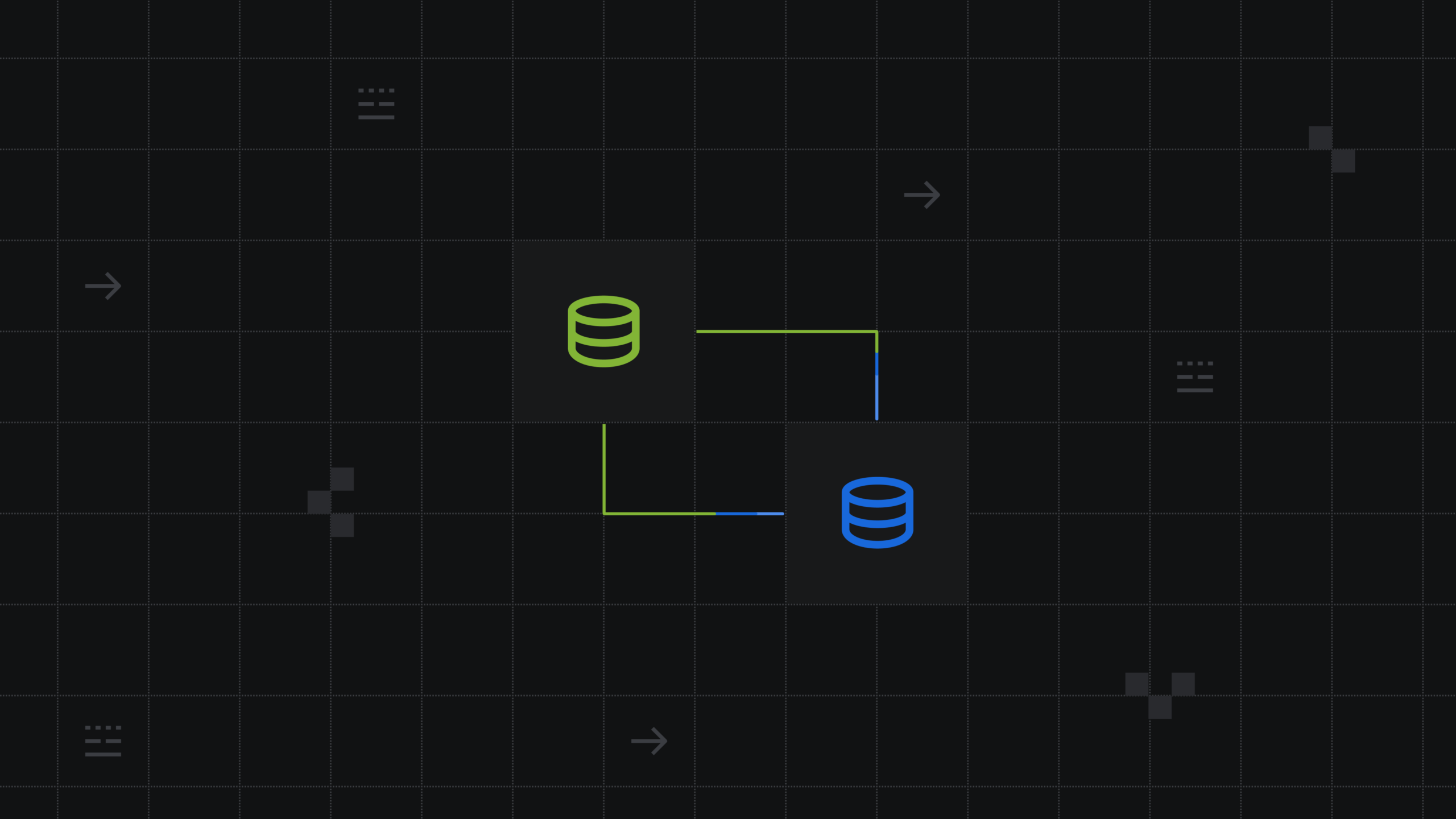
Data Pipeline Deployment Capability

Atlassian's data platform has evolved to include an opinionated deployment capability inspired by Kubernetes and Micros. This capability provides a declarative, metadata-driven, self-serve system for provisioning data pipelines, an extensible abstraction over execution capabilities, and a single governed deployment experience. It aims to address challenges of data discovery, trust, and user experience by modeling the user's natural workflow and collecting rich metadata for data discovery purposes.

2 posts · 2019–2025

Timeline

20192026
Feature trailActive

Bitbucket Cloud API Rate Limiting

Bitbucket Cloud API rate limits have been scaled based on the workspace's paid user count, with a new points-based model for API usage and shared rate limits for global and per-tenant quotas. New rate limit headers have been added to help users monitor their API usage. This post extends the capability by introducing a points-based model for API usage, tiered global and per-tenant quotas, and shared rate limits for clustered apps. API token traffic is being evaluated for a quota-based approach.

6 posts · 2022–2025

Timeline

20222026
Feature trailActive

Confluence Whiteboards Mini-Game

Confluence whiteboards now support interactive mini-games, starting with 'Race Mode', a car racing game. This feature leverages existing Entity Component System (ECS) and Finite State Machine (FSM) architectures for high-performance, precise game inputs. It includes dynamic asset preloading, framerate-independent physics, and a tuning panel for gameplay adjustments. Visuals and audio are carefully crafted, with features like a spring-mass-damper model for UI elements and anti-cheating mechanisms. This post details the sound design process, focusing on creating an 8-bit chiptune aesthetic using a single synthesizer in Logic Pro, and composing a full track with melody, harmony, bass, percussion, and sound effects.

3 posts · 2025

Timeline

20252026
Feature trailActive

Scheduled Pipelines

Bitbucket Pipelines now supports dynamic step conditions based on boolean expressions evaluated during pipeline execution, allowing for more flexible and intelligent workflow control. This builds upon previous capabilities for manual triggers, Git tag triggers, and concurrency groups, enabling steps to be skipped or executed based on runtime variables, scan results, or combined conditions with file changesets. The system provides detailed logging for troubleshooting and handles race conditions a

2 posts · 2017–2025

Timeline

20172026
Feature trailActive

Platform Dependency Management and Recoverability

Atlassian's CPR program has significantly improved platform reliability and recoverability by systematically removing dependency tangles in its services architecture. This involved developing new platform services and tools for dependency analysis, rearchitecting the cloud infrastructure into distinct layers (the 'Layer Cake' model), and conducting extensive tabletop exercises to simulate disaster recovery. The program focuses on breaking circular dependencies, particularly hard dependencies, and reducing the blast radius of incidents.

2 posts · 2022–2025

Timeline

20222026
Feature trailActive

Jira and Confluence AWS Graviton Migration

Atlassian has successfully migrated over 3000 EC2 instances for Jira and Confluence to AWS Graviton, achieving significant improvements in performance, reliability, and cost efficiency. This migration involved overcoming previous challenges related to CPU cache L3 miss-prediction and optimizing JVM settings for the Arm architecture. The initiative leveraged Graviton4 instances and a refined testing methodology focusing on 'Throughput at breaking latency' and low-level hardware metrics.

1 post · 2025

Timeline

20252026
Feature trailCooling

CI/CD Cost Optimization

This capability tracks the evolution of CI/CD systems, focusing on cost-effectiveness, scalability, and developer productivity. It encompasses comparisons between self-hosted solutions (like Jenkins) and SaaS offerings (like Bitbucket Pipelines), analyzing total cost of ownership (TCO) beyond raw compute costs. Key aspects include managing variable CI/CD loads, the operational overhead of self-hosted platforms, and the benefits of elastic scaling provided by SaaS solutions. The capability also includes tools and strategies for migrating between CI/CD platforms, such as the Jenkins to Bitbucket Pipelines Migration Tool, which automates the conversion of Jenkinsfiles to Bitbucket Pipelines YAML syntax, offering extensibility for custom plugins and configurations.

1 post · 2024–2025

Timeline

20242026
Feature trailCooling

DevMate CLI for Accelerated React Native Development

Atlassian's Mobile Platform team developed DevMate, an in-house CLI tool to accelerate React Native development. DevMate streamlines environment setup, reduces build times, and improves consistency by automating dependency installation, intelligent dependency management, and smart build skipping. It addresses challenges like complex environment setup, inconsistent workflows, long build times, cross-platform testing overhead, and onboarding friction. DevMate complements existing tools like Expo CLI and React Native CLI by providing native-aware features and a tailored experience for internal workflows, particularly for working with native code and optimizing for internal workflows.

1 post · 2025

Timeline

20252026
Feature trailCooling

DevMate CLI for React Native Development

Atlassian's Mobile Platform team developed DevMate, an in-house CLI tool to accelerate React Native development. DevMate streamlines environment setup, reduces build times, and improves consistency by automating dependency installation, intelligent dependency management, and smart build skipping. It addresses challenges like complex environment setup, inconsistent workflows, long build times, cross-platform testing overhead, and onboarding friction. DevMate complements existing tools like Expo CLI and React Native CLI by providing native-aware features tailored for Atlassian's internal workflows.

1 post · 2025

Timeline

20252026
Feature trailCooling

Bitbucket Cloud API Token Authentication

Bitbucket Cloud is transitioning from app passwords to API tokens for authentication, enhancing security and control. This includes disabling the creation of new app passwords, requiring new integrations to use API tokens with scopes, and eventually disabling all app passwords. API tokens offer expiration control, centralized management, and modern scopes. Token rotation has been introduced, allowing users to generate a new secret and expiration date for existing tokens without reconfiguring scopes.

5 posts · 2016–2025

Timeline

…20172026
Feature trailCooling

Forge SQL Optimistic Locking

Forge SQL now supports optimistic locking for reliable data storage in concurrent update scenarios. This feature addresses race conditions by using a versioning mechanism (either updated_at timestamp or an integer version) to ensure that updates are only applied if the data has not been modified since it was last read. This is particularly useful in Forge SQL's constraint of single query per .query() call, enabling robust data integrity without traditional transactions.

1 post · 2025

Timeline

20252026
Feature trailCooling

Frontend Build Performance Optimization

Atlassian's frontend performance efforts have focused on reducing JavaScript bundle sizes and improving build times. This includes developing Webpack plugins to deduplicate transitive dependencies, leading to significant reductions in bundle sizes and faster local development tools and CI builds. The strategy involves stopping the introduction of new barrel files, gradually transforming existing imports to direct imports, and deleting unused barrel files. This is achieved through a combination of code modification tools like ESLint and a phased landing strategy to manage large-scale refactoring during active development.

1 post · 2025

Timeline

20252026
Feature trailCooling

Atlassian Command Line Interface (ACLI) for Jira

Atlassian is introducing the Atlassian Command Line Interface (ACLI) for Jira Cloud, a new tool for admins and technical users to manage Jira tasks via text-based commands and scripts. ACLI supports a growing set of commands for managing projects, work items, users, dashboards, and filters, enabling automation, bulk operations, and parallel execution. It aims to provide speed and precision for managing complex Jira environments, complementing existing UI-based tools like Jira Automation and Site Optimizer.

1 post · 2025

Timeline

20252026
Feature trailCooling

Software Bill of Materials (SBOM) Platform

Atlassian has built a platform to generate Software Bill of Materials (SBOMs) for its repositories. This platform automates the process of creating SBOMs based on incoming commits, leveraging multiple open-source tools like Syft, cdxgen, and cyclonedx-maven-plugin to ensure comprehensive coverage across various technology stacks. The generated SBOMs are stored in S3 buckets and processed into a data lake for aggregation and analysis. This initiative aims to enhance software supply chain transparency.

2 posts · 2024–2025

Timeline

20242026
Feature trailCooling

Jira Cloud Data Export Service

The Jira Cloud Data Export Service has evolved to improve export throughput and handle Jira's data constraints. The service now employs a hybrid architecture, leveraging Atlassian's Lithium streaming platform for high-volume entities (like issues, comments, and change history) and HTTP Batch APIs for low-volume, complex entities. This evolution includes optimizing extraction by splitting tasks into parallel jobs executed by multiple threads and compute nodes, leading to a 5x improvement in throughput. This post details the architectural evolution and engineering enhancements of a new external migration platform, which has significantly optimized the migration process for Jira users. With this new platform, migrations are now 20 times faster and achieve a data throughput that is 30 times better than the legacy data importer. Furthermore, a 95% improvement in the reliability rate of migrations has been realized.

2 posts · 2025

Timeline

20252026
Feature trailCooling

Project and Workspace Access Tokens

Bitbucket Cloud enhances its authentication and access management capabilities by introducing Project and Workspace Access Tokens. These tokens extend the functionality of Repository Access Tokens, allowing for more scalable and granular control over API access and Git operations at the project and workspace levels. This evolution aims to simplify token management for users with multiple repositories and projects, improving security and operational efficiency. This post introduces default grant types for tokens and enforces expiry durations for all newly created tokens, with configurable policies for admins.

3 posts · 2022–2025

Timeline

20222026
Feature trailCooling

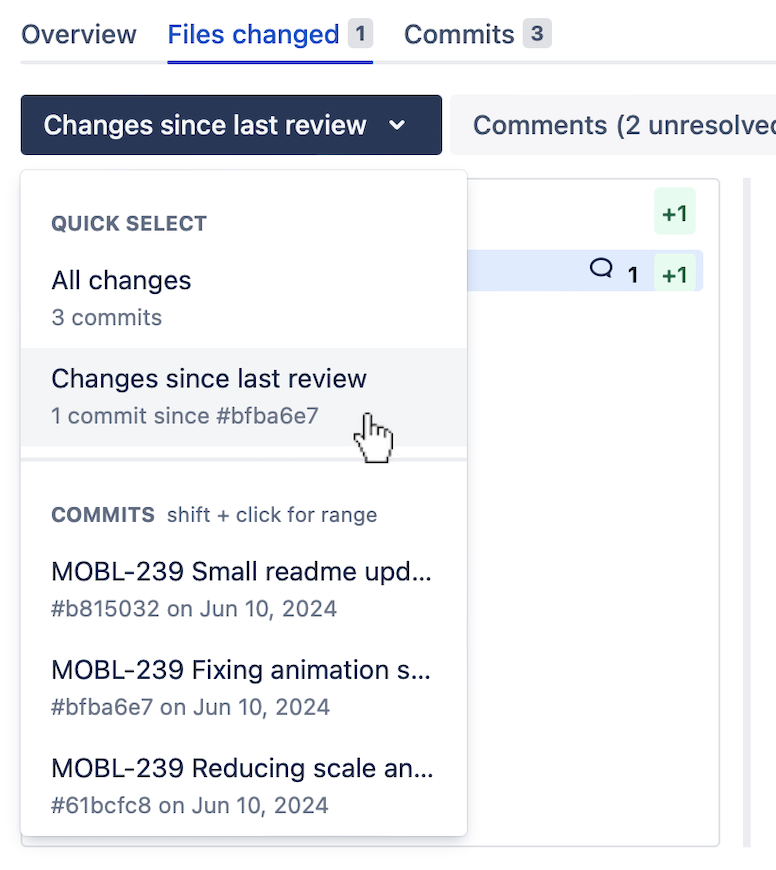
Draft Pull Requests and Branch Deletion Control

Bitbucket Cloud enhances its pull request workflow with draft pull requests (non-mergeable, silent notifications until ready) and configurable default branch deletion upon merge. This post introduces the ability for repository admins to set a default description for all new pull requests, providing a template with predefined text to guide authors on including essential information like screenshots, links, and business context, thereby improving reviewer understanding and speeding up the review process. Future enhancements include code suggestions for reviewers to commit directly on a PR.

8 posts · 2019–2025

Timeline

20192026
Feature trailCooling

SSH Key Commit Signing

Bitbucket Cloud now supports SSH keys for signing commits, in addition to GPG keys. This enhances code security by allowing developers to verify the authenticity of their contributions. Repository administrators can enforce signed commits, providing increased control, stronger security, and better traceability. Future enhancements include system-signed commits for UI merges.

2 posts · 2024–2025

Timeline

20242026
Feature trailCooling

Envoy Proxy Migration for Bitbucket Cloud

Bitbucket Cloud has successfully migrated its public-facing edge load balancing and proxy solution to Envoy Proxy. This migration addresses previous limitations in auto-scaling and regional constraints, leading to improved reliability, cost efficiency, and performance. The new architecture leverages Envoy's extensible platform for high performance and scalability. Self-hosted Varnish Cache has been introduced for content caching, and complex routing logic has been translated into Envoy and Varnish configurations. The migration also included support for SSH and IPv6 traffic, and a phased rollout strategy to ensure zero downtime.

3 posts · 2020–2025

Timeline

20202026
Feature trailCooling

Confluence Admin Experience

Confluence is evolving its admin experience with 'Mission Control' for Premium and Enterprise plans, providing a centralized workspace for site-level alerts, insights, and actions. This includes features for managing engagement metrics, external access, beta features, and Confluence admins. It also offers streamlined content management insights for assessing stale content, planning new content, identifying inactive page owners, and uncovering popular search terms. Space-level Mission Control is also now available for space admins.

1 post · 2025

Timeline

20252026
Feature trailCooling

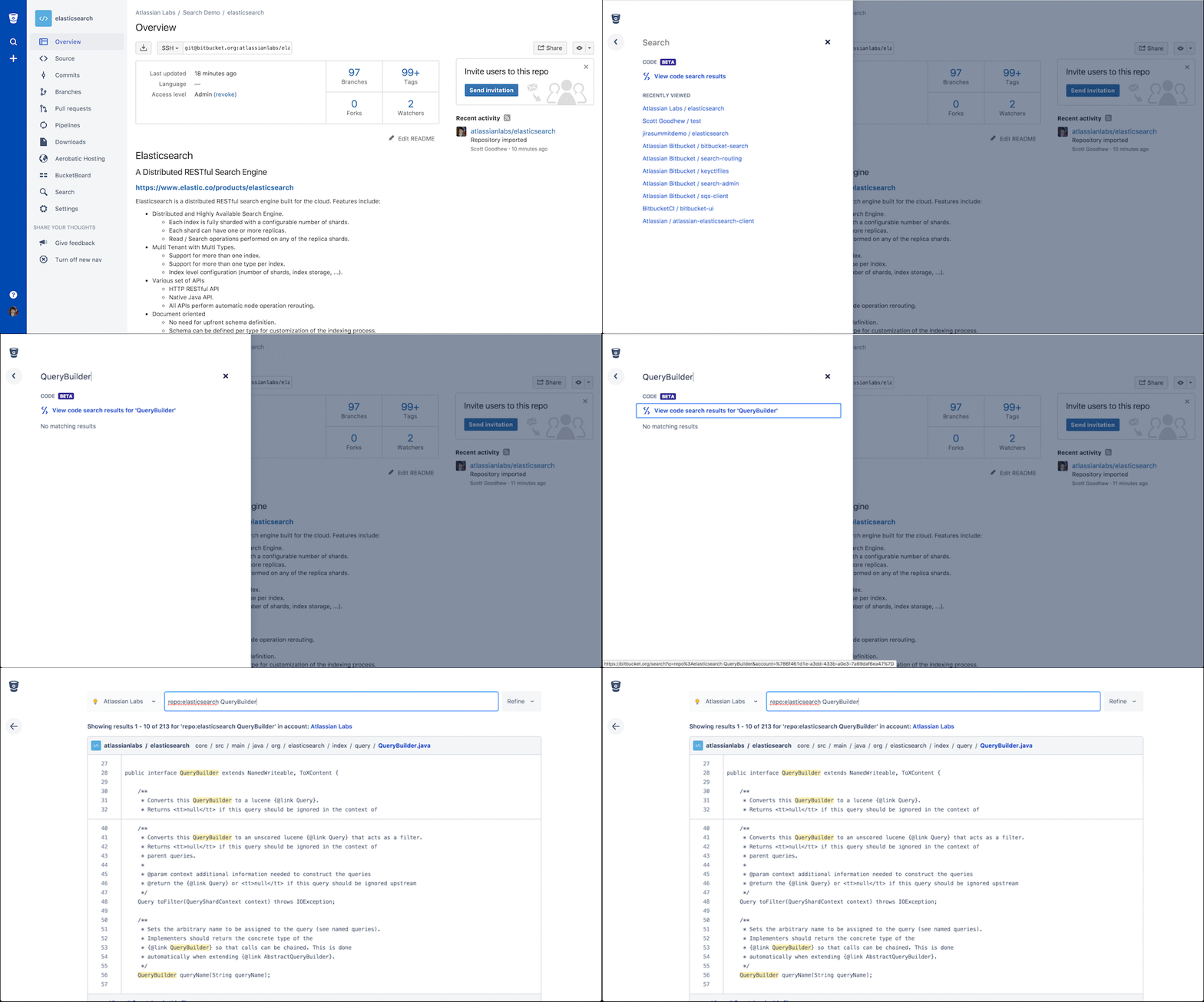
Workspace Scoped Navigation

Bitbucket Cloud's navigation has evolved to be single workspace scoped, improving user experience and performance by aligning with other Atlassian products and reducing the amount of data queried for each view. Users can now easily switch between workspaces and have a clearer indication of their current context. This post introduces a horizontal navigation bar, moving from a vertical layout to a top bar, and integrates search across Bitbucket, Jira, and Confluence.

2 posts · 2021–2024

Timeline

20212026
Feature trailCooling

Pragmatic Drag and Drop

Atlassian has developed and adopted a single, open-source drag and drop solution called Pragmatic Drag and Drop. This solution aims to improve performance by reducing shipped code, enhance visual consistency across products through a design framework and Figma tooling, and provide a great experience for all users, including those using assistive technologies. It leverages browser primitives with workarounds for inconsistencies and offers modularity for flexibility and performance. The design decisions have continued to evolve as they iterate based on how things feel in products, user feedback, as well as the creation of novel experiences. With Pragmatic drag and drop, they have intentionally decoupled design outputs from behavior outputs to give them the room to iterate and experiment on their design without needing to impact the underlying behavior. This decoupling also allows them to create separate design outputs for unique experiences. In order to help promote consistency in what they design and what they ship to their users, they created Pragmatic drag and drop tooling for Figma. Having Figma tooling enables their designers and engineers work with the same visual design language. The modular nature of Pragmatic drag and drop posed a challenge for their Figma outputs, so they focused on simplicity over fidelity. They knew it would be challenging to create a rich drag and drop prototype in Figma that would just 'work' — instead, they broke the components down into each part and state of the drag process. They also recorded Looms to provide guidance on how to show the different stages of a drag experience.

1 post · 2024

Timeline

20242026
Feature trailCooling

App Data Residency

Atlassian Marketplace partners are implementing data residency for their apps, enabling customers to keep their data in a region they trust. This involves supporting realm pinning and realm migration, with partners sharing their motivations, supported regions, and technical approaches to infrastructure setup, region-specific base URLs, and handling Connect lifecycle requests. Challenges include managing region-specific base URLs, handling Connect lifecycle requests for region identification, and the introduction of a new 'Runs on Atlassian' badge for Forge apps that do not transmit data outside the Atlassian environment and provide data residency.

2 posts · 2023–2024

Timeline

20232026
Feature trailCooling

Atlassian Cloud Engineering Overview

Atlassian's cloud platform, Micros, has evolved its multi-account strategy to address AWS API and resource limits. Initially operating within three large AWS accounts, the platform experienced significant rate-limiting issues impacting deployment speed and reliability. The 'Account Sharding' project incrementally addresses this by introducing new accounts across development, staging, and production environments. This strategy aims to gradually reduce the number of services per account, enhance scalability, and enable future account-per-service models. The migration focuses on compute workloads, with careful consideration for ephemeral and persistent resources, and prioritizes minimizing disruption to service owners.

1 post · 2021–2024

Timeline

20212026
Feature trailQuiet since 2024

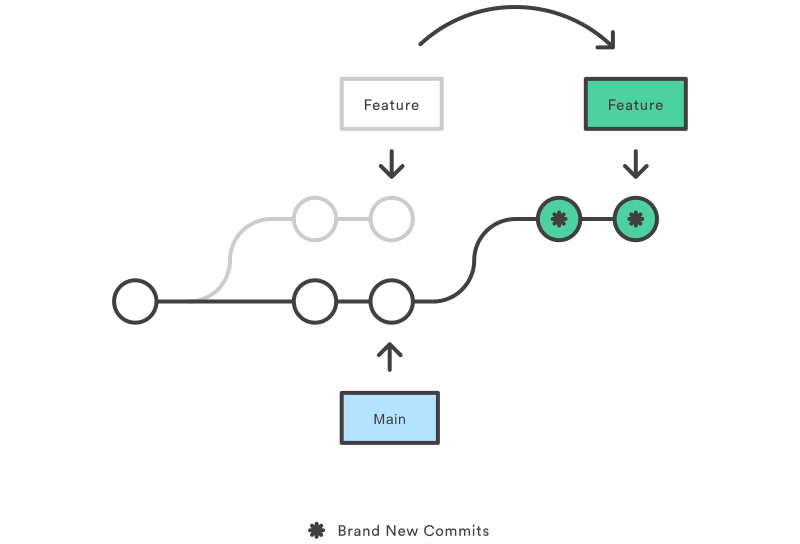
Automated Git Branch Merging

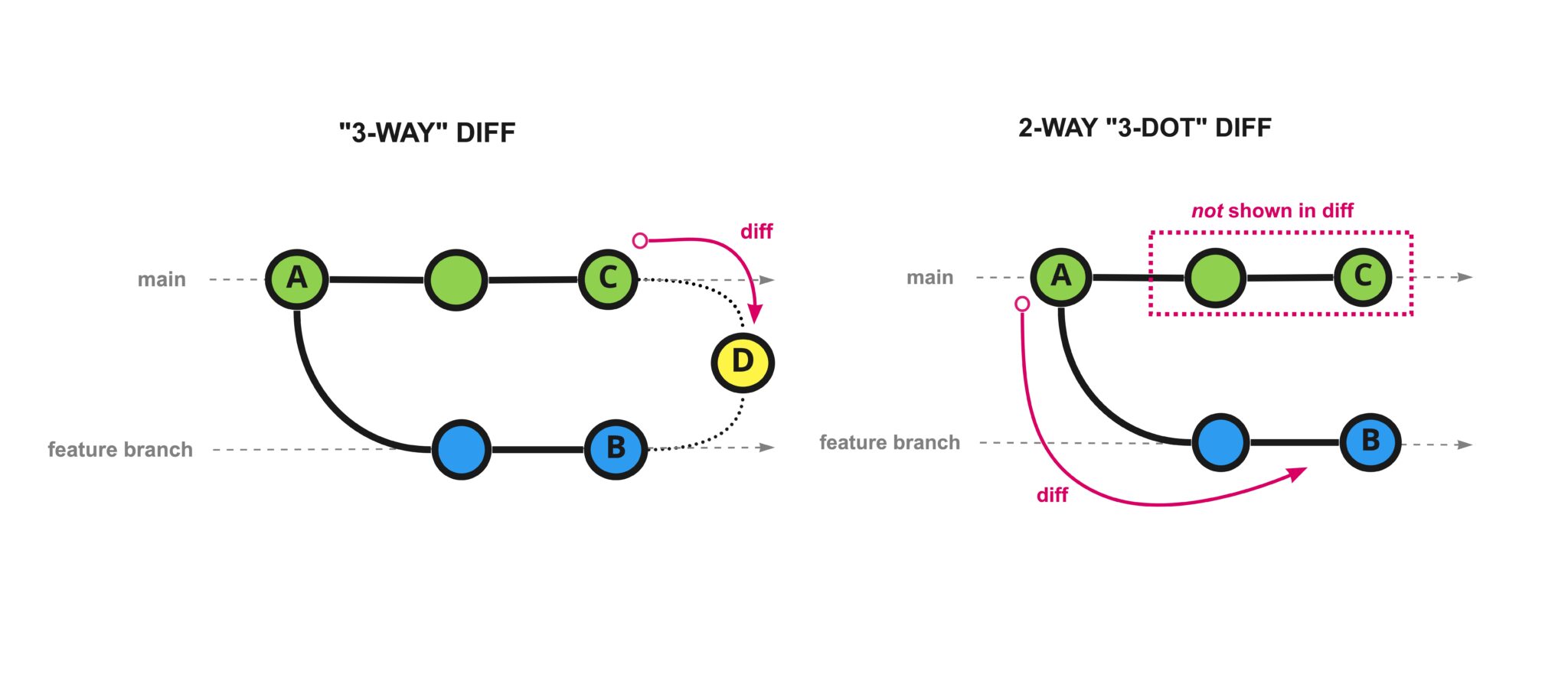
Bitbucket Cloud enhances its pull request experience with automated merging of branches and forks. This feature allows users to sync their feature branches and forks with the main branch with a single click, reducing merge conflicts and simplifying workflow management. It also enables direct merging from the compare view and deletion of feature branches directly from the feature branches page. This post introduces the ability to create pull requests between branches, streamlining collaboration and adding rebase sync and expanded merge strategies (rebase + merge, rebase + fast forward, squash (fast forward only)).

3 posts · 2012–2024

Timeline

…20172026
Feature trailQuiet since 2024

Shadow IT Controls for Bitbucket

Bitbucket Cloud is enhancing its security controls by allowing workspace admins to prevent users from creating new Bitbucket workspaces without approval. This feature, available on the Bitbucket Premium plan, expands the existing 'product requests' functionality to Bitbucket, building upon similar controls for Jira, Confluence, and JSM. Admins can configure a policy in Atlassian Admin to 'Require admin review' or 'Allow new products'. When 'Require admin review' is selected, users must submit a request for admin approval before a new workspace can be created.

4 posts · 2024

Timeline

20242026
Feature trailQuiet since 2024

Cloud Product Security Practices

Atlassian's cloud products are enhanced with advanced security features including mandatory two-step verification (2FA) and IP whitelisting for teams. These features aim to bolster account security beyond passwords, protecting private code and sensitive data from unauthorized access. The Premium plan offers these capabilities, alongside other administrative and performance features, to support growing teams with complex security requirements. This post introduces two-step verification (also know as MFA) and IP allowlisting as configurable security controls within Bitbucket Cloud, complementing platform-level security measures like encryption and RBAC. It also details CI/CD integrations for security scanning (secret, infrastructure-as-code, and dependency scanning) and workspace-level merge checks to enforce security policies at scale.

4 posts · 2013–2024

Timeline

…20172026
Feature trailQuiet since 2024

Inline Comments for Pull Requests and Commits

Bitbucket Cloud supports inline comments on pull requests and commits, allowing developers to provide line-specific feedback during code reviews. This feature addresses 'comment drift' caused by subsequent commits by implementing algorithms to track comment relevance and display them even when lines change or are removed. Performance optimizations include reducing SQL queries, simplifying activity tab logic, implementing template caching, and separating slow-loading diffs from general comments. The new UI introduces a tabular design with a prominent activity feed and a dedicated diff tab for full-screen code review, inspired by Bitbucket Data Center.

3 posts · 2011–2024

Timeline

…20172026
Feature trailQuiet since 2024

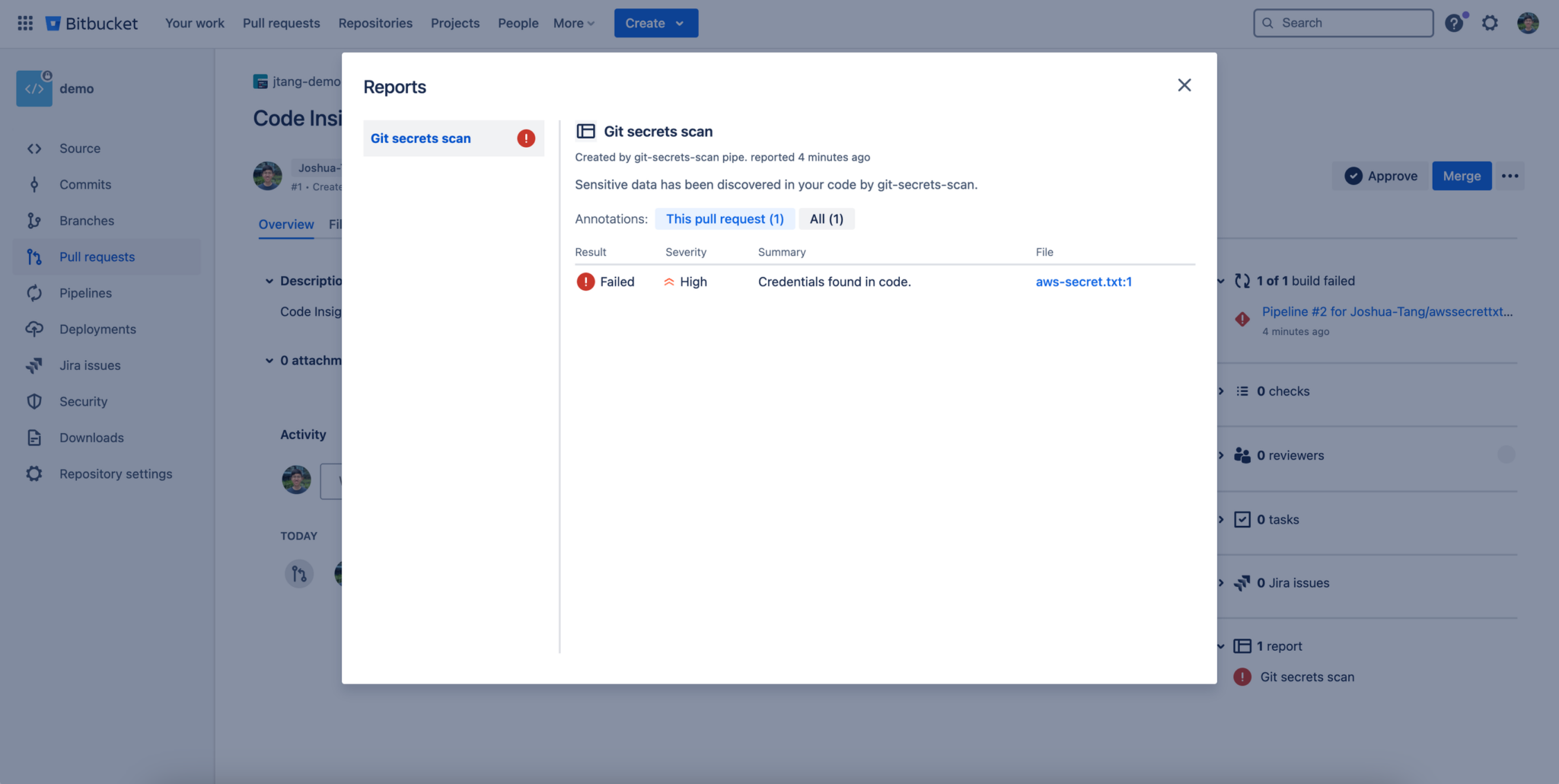
Bitbucket Cloud Code Insights

Bitbucket Cloud's Code Insights functionality automatically displays artifacts such as static analysis reports, security scan results, artifact links, unit test results, and build status updates directly within the pull request screen. This provides reviewers with comprehensive context before approving code changes. The system consists of reports and annotations, with annotations capable of being attached to specific files and even specific lines of code. The integration with Bitbucket Pipelines is facilitated by a proxy server and the `bitbucket-pipes-toolkit` package.

4 posts · 2018–2024

Timeline

20182026
Feature trailQuiet since 2024

Software Catalog Integration

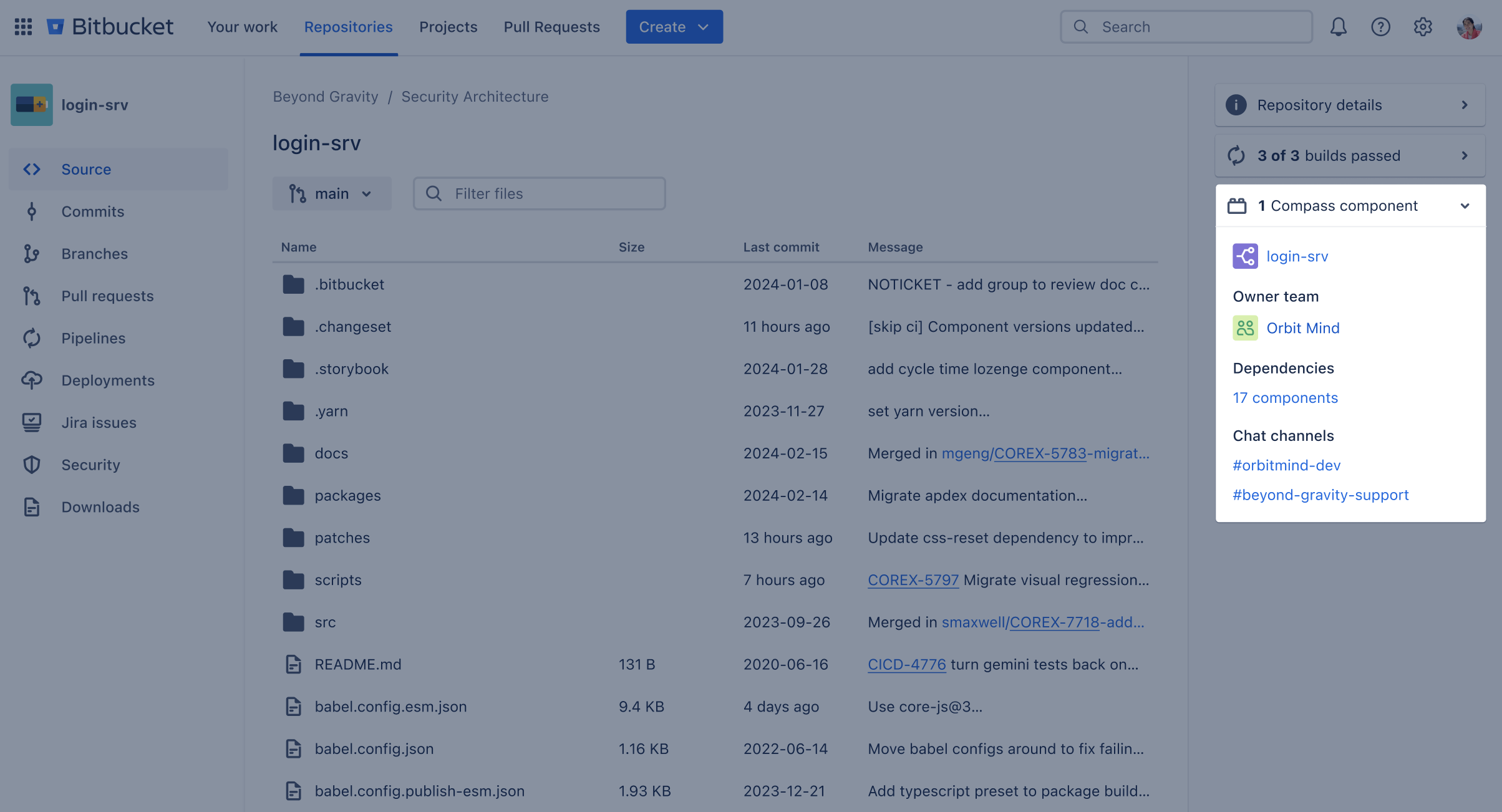
Atlassian's Compass platform integrates with code repositories (like Bitbucket) to enrich them with metadata from the toolchain, such as owner teams, dependencies, and chat channels. This provides developers with context directly within their code repositories, reducing search time and improving development flow. The platform also supports tracking DORA metrics for performance measurement.

1 post · 2024

Timeline

20242026
Feature trailQuiet since 2023

GPU Rendering for Confluence Whiteboards

Confluence whiteboards leverage a WebGL graphics pipeline for efficient rendering of shapes and connectors, including polygon triangulation, dynamic resizing, rendering hollow shapes, and dynamic connectors with smoothly rendered arcs.

3 posts · 2023

Timeline

20232026
Feature trailQuiet since 2023

End-to-end testing for Confluence Forge apps

This post details how to implement end-to-end testing for Confluence Forge apps using Webdriver.io and Mocha. It covers setting up the testing environment, logging into Confluence, and writing tests for both Custom UI and UI Kit apps. The post provides code samples and explains how to handle different UI approaches, iframe switching, and element selection strategies. It also offers observations on selector choices and best practices for test execution.

2 posts · 2023

Timeline

20232026
Feature trailQuiet since 2023

Git Blame Discoverability on Bitbucket Cloud UI

Bitbucket Cloud UI has improved the discoverability of the 'git blame' functionality by renaming the 'Annotate' button to 'Annotate/Blame', leading to a 15% increase in feature usage. This change clarifies the button's purpose for users familiar with 'git blame' terminology.

2 posts · 2023

Timeline

20232026
Feature trailQuiet since 2023

Bitbucket Project Permissions

Bitbucket Cloud now supports project-level permissions and permission inheritance, aligning with Bitbucket Server and Data Center. This allows project admins to manage access to all repositories within a project, old and new, simplifying administration and enhancing security. New roles like 'Project Admin' and 'Repository Create' are introduced to facilitate delegation and control. Workspace admin permissions are inherited by projects and repositories, ensuring centralized control and preventing unauthorized access. This post extends the capability by introducing a feature to require issue keys in commit messages, ensuring each change links to an issue in commit messages and automatically converting mentioned issue keys into links to the issue tracker.

3 posts · 2017–2023

Timeline

20172026
Feature trailQuiet since 2022

Atlassian Multi-Factor Authentication Library (1time)

Atlassian has developed and open-sourced its own multi-factor authentication (MFA) library, named '1time', to handle Time-based One-Time Passwords (TOTP). This library strictly adheres to RFC standards (RFC-6238, RFC-4226), addresses issues found in previous libraries such as integer overflow for epoch seconds and lack of support for time windows, and uses property-based testing for extensive validation. The library generates TOTP URLs in Google's Key Uri Format and supports multiple HMAC algorithms.

1 post · 2022

Timeline

20222026
Feature trailQuiet since 2022

Tenant Context Service (TCS) Availability and Scalability

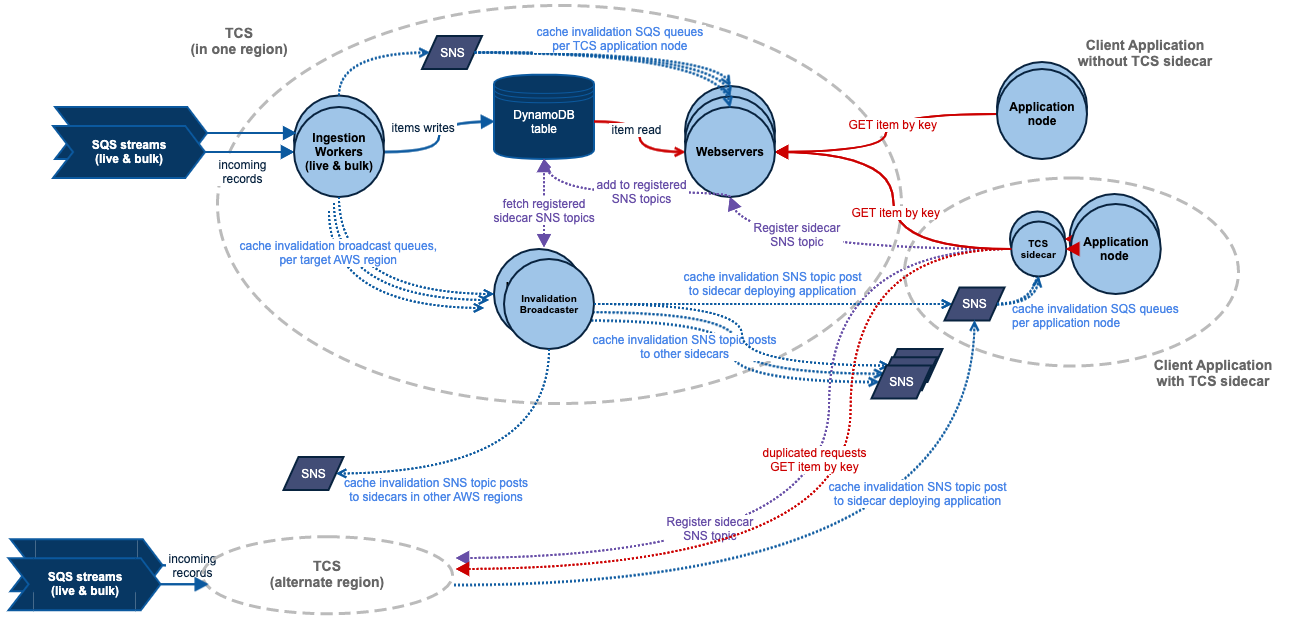
The Tenant Context Service (TCS) has evolved into a highly available and resilient infrastructure service at Atlassian, serving as a critical component for request routing and metadata provision across cloud products. Recent improvements have focused on enhancing its availability to consistently exceed six nines (99.9999%), achieving this through advanced isolation techniques in both the sidecar and server components, robust scaling of the invalidation broadcast system, and sophisticated strategies for managing outstanding requests and defending against traffic blackholes. The service now handles billions of requests daily across thousands of compute nodes, with cache hit ratios generally exceeding 99.5%.

1 post · 2022

Timeline

20222026
Feature trailQuiet since 2022

Unreproducible React Bug Debugging

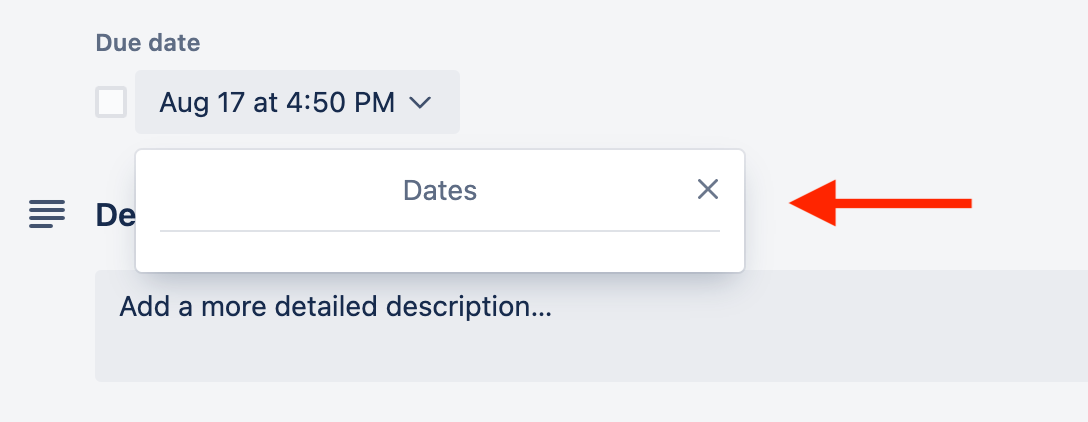
This post details the process of debugging and fixing an unreproducible React bug in Trello's date picker. It highlights strategies for investigating issues that are difficult to reproduce, including analyzing customer clues, using support impersonation, and simulating browser-specific behaviors. The core of the fix involved identifying an infinite loop in a Trello-specific Popover component that was triggered by inconsistent viewport measurements, leading to a one-line code change.

1 post · 2022

Timeline

20222026
Feature trailQuiet since 2022

Trello Theming with CSS Custom Properties

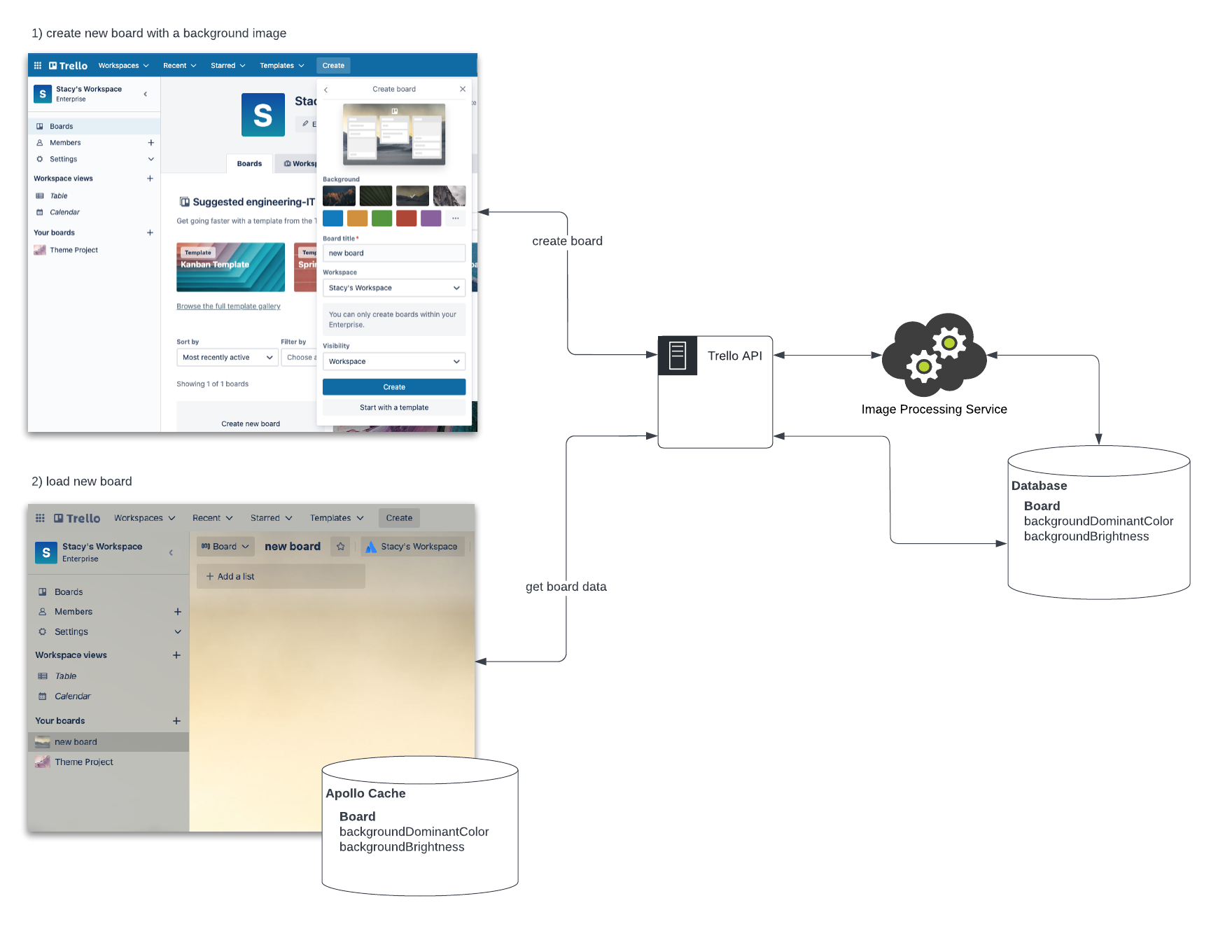
Trello has implemented a new theming system for its UI components, allowing for dynamic and accessible color schemes. This system leverages CSS custom properties to adapt themes based on the dominant color and brightness of user-selected board backgrounds. The architecture involves an image processing service to extract color data, which is then stored and retrieved via the Trello API and cached by Apollo Client. This data is used to dynamically set CSS custom properties, enabling consistent theming across different UI components and technical stacks within Trello.

1 post · 2022

Timeline

20222026
Feature trailQuiet since 2022

Bitbucket Pull Request Diff Performance

Bitbucket Cloud is enhancing its pull request experience with performance improvements in diff rendering and merge execution times. This involves optimizing API response times for diffs and diffstats, reducing timeouts, and streamlining backend hooks and locking mechanisms for merges. The platform is also addressing issues with background task scheduling and execution on the new cloud infrastructure to ensure faster and more reliable operations. This post details improvements to the file system

5 posts · 2011–2022

Timeline

…20172026
Feature trailQuiet since 2021

Bitbucket Cloud Security Scanning Integration

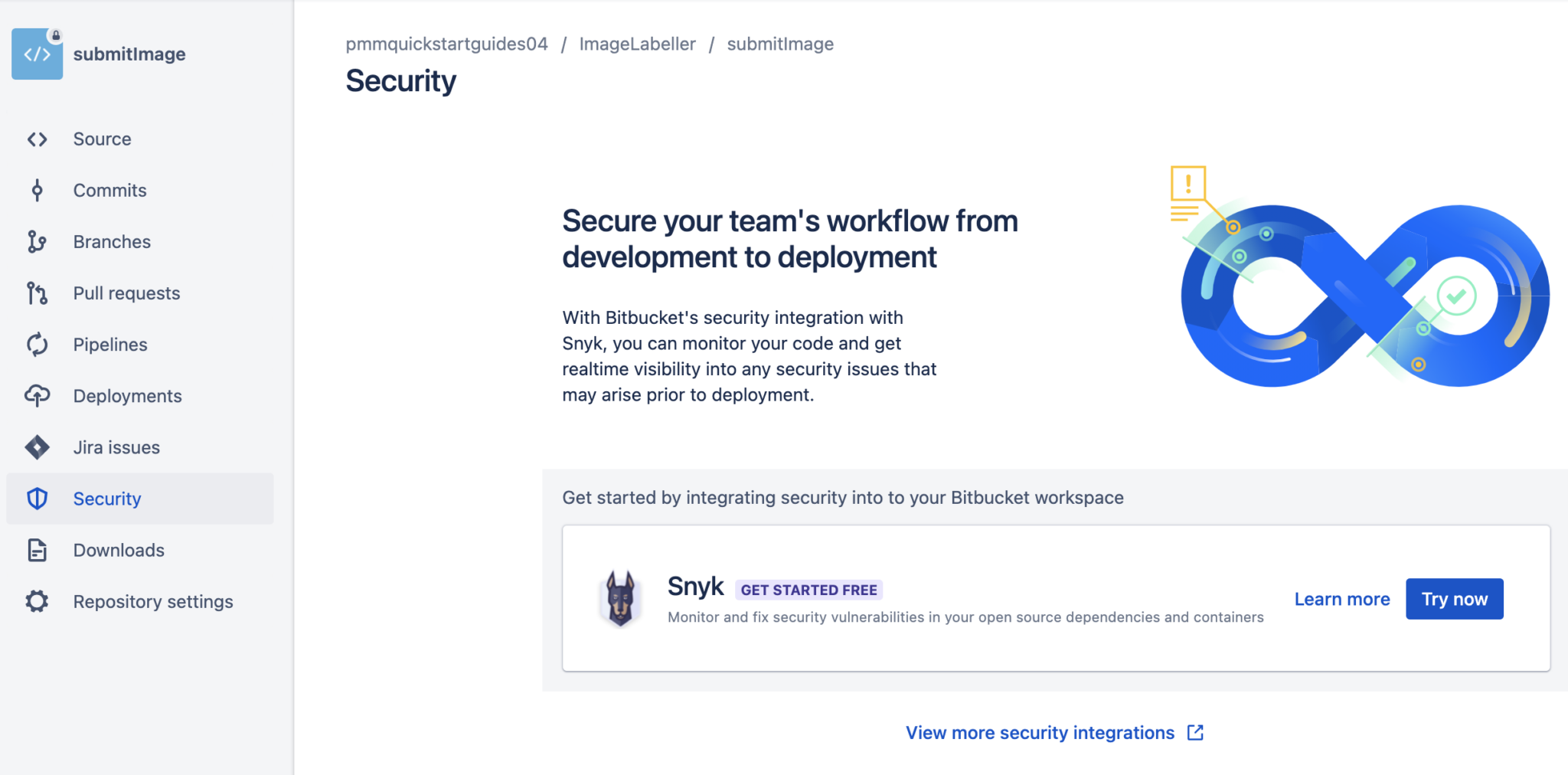
Bitbucket Cloud integrates with Snyk to provide automated security scanning of code and dependencies, helping users identify and remediate vulnerabilities like Log4Shell. This capability extends to various security aspects, including vulnerability detection and remediation workflows, and can be integrated into CI/CD pipelines. The integration includes a new security tab for repository-level vulnerability visibility, PR scanning within Code Insights, and a Snyk Pipe for Bitbucket Pipelines. This post introduces Snyk's Auto Upgrade feature, which automatically creates pull requests to update outdated npm and Maven-central dependencies, listing remediated vulnerabilities and ensuring no new vulnerabilities are introduced.

5 posts · 2019–2021

Timeline

20192026
Feature trailQuiet since 2021

Experimentation

Atlassian's experimentation capability enables product teams to design, implement, and analyze A/B tests to drive product growth and user experience improvements. This includes defining hypotheses, selecting target metrics, implementing solutions with feature flags for gradual rollouts, and collecting de-personalized analytics data for analysis. The process emphasizes careful opportunity analysis, hypothesis formulation, and robust measurement to ensure strategic bets lead to significant wins.

1 post · 2021

Timeline

20212026
Feature trailQuiet since 2021

Confluence Cloud Search Platform

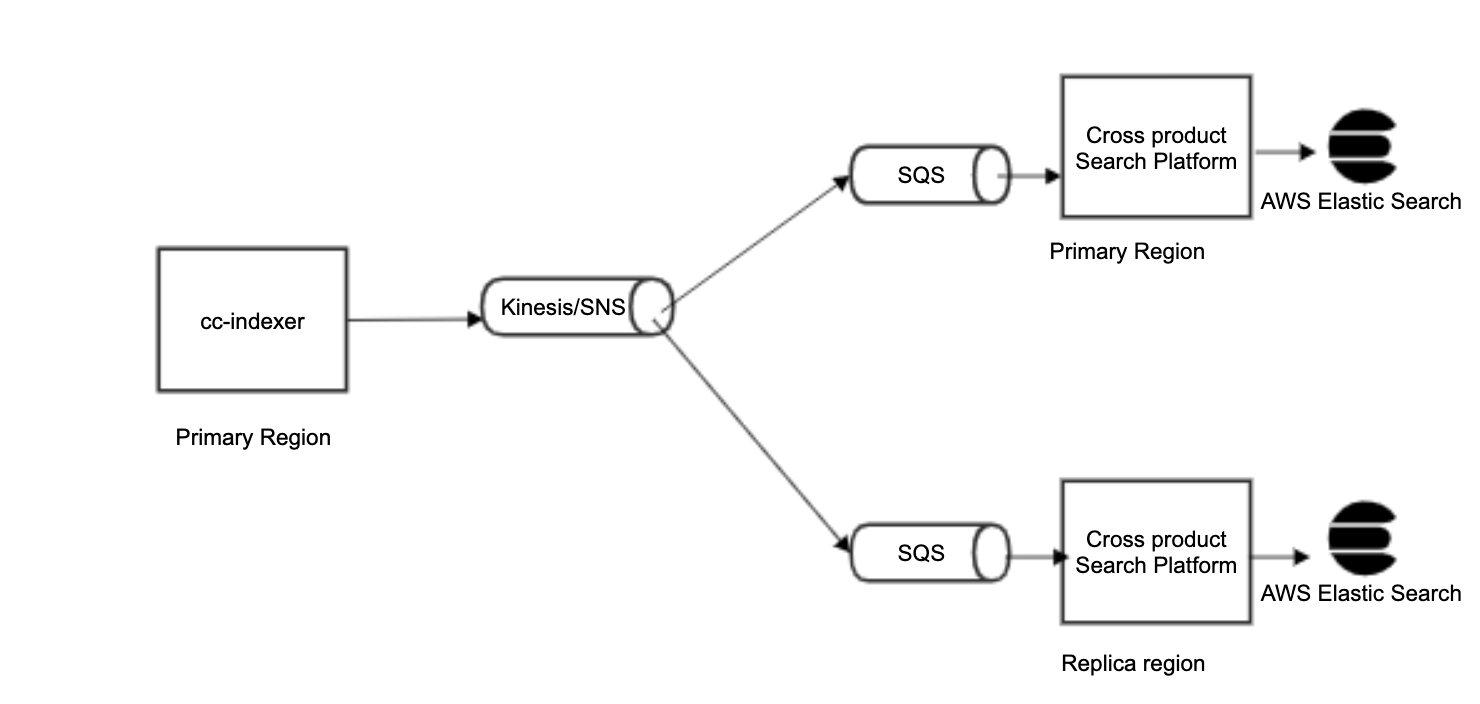
Confluence Cloud Search has been revamped with a new, scalable, and improved platform powered by AWS-managed Elasticsearch. This platform aims to provide a unified search experience across Atlassian products, offering better operational stability, improved relevance, enhanced scalability for large customer growth, reduced monolithic code complexity, and centralized search expertise. Key architectural changes include multi-region availability with zero-downtime failover, efficient sharding strategies based on tenant size to handle noisy neighbors and optimize performance, and an optimized permission checking mechanism that transforms linear time complexity to logarithmic time complexity.

1 post · 2021

Timeline

20212026
Feature trailQuiet since 2021

JVM Continuous Profiling

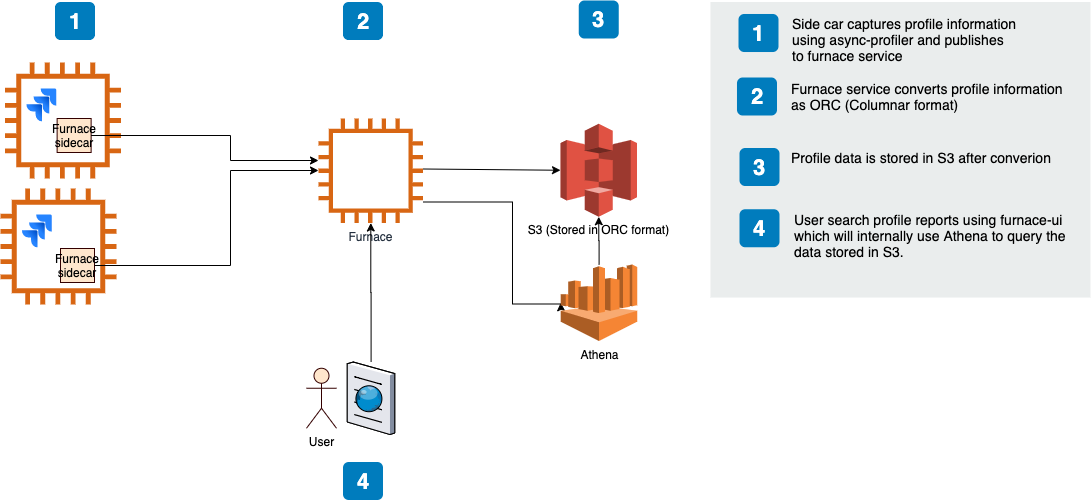
Atlassian has developed and adopted a continuous profiling system for JVM applications to improve incident diagnosis and performance engineering. Initially, an in-house solution using AWS Systems Manager, Linux perf, and async-profiler was built to provide CLI-based profiling and flame graph visualization. Limitations in capturing transient issues and providing baselines led to the development of a continuous profiling system that scheduled regular profiling runs, stored data in Apache ORC format on S3, and enabled querying via AWS Athena. The team then evaluated and adopted Amazon CodeGuru Profiler as a platform-level solution, integrating it to provide continuous profiling capabilities to all Atlassian service teams. This has been used to identify and resolve issues such as excessive thread blocking due to synchronized EnumMaps by migrating to ConcurrentHashMap.

1 post · 2021

Timeline

20212026
Feature trailQuiet since 2021

Interactive Git Rebase with Sourcetree

This post introduces interactive rebase functionality within Sourcetree, a Git UI tool. It details operations like squashing, editing, rewording, deleting, and reordering commits. The post also provides guidance on avoiding common pitfalls such as rebasing upstream commits and handling 'mine' vs. 'theirs' conflicts.

1 post · 2021

Timeline

20212026
Feature trailQuiet since 2021

Caching

Atlassian is implementing a JQL Subscription Service (JQS) to cache JQL query results, significantly reducing database load and improving response times. The initial approach involved a read-through cache with TTL or event-based invalidation, but this proved insufficient due to JQL's per-user, temporal, and equivalence complexities. The second iteration, JQL Splitting, parses JQL into Stage 1 (non-dynamic clauses cached) and Stage 2 (dynamic clauses executed at request time), resolving most caching issues. Permissions are handled by executing Stage 2 with per-user context.

1 post · 2021

Timeline

20212026
Feature trailQuiet since 2020

Frontend Bundle Deduplication

Atlassian's frontend performance efforts have focused on reducing JavaScript bundle sizes. This post details the development of a Webpack plugin to deduplicate transitive dependencies, leading to approximately 10% reduction in bundle sizes for key pages like Jira Issue view. This builds upon previous work in reducing overall JavaScript downloaded and modernizing bundles.

3 posts · 2020

Timeline

20202026
Feature trailQuiet since 2020

Bitbucket Database Read/Write Splitting

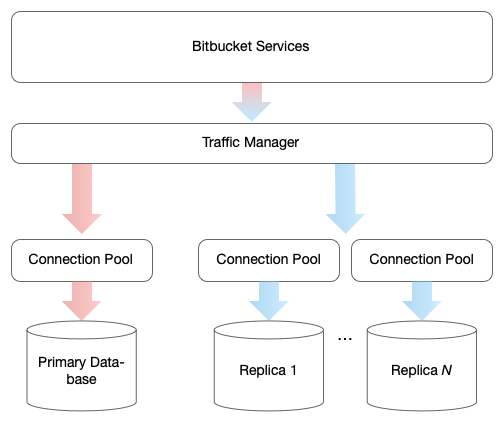
Bitbucket is evolving its database architecture to improve scalability and performance by implementing read/write splitting. This involves routing read operations to replicas and write operations to the primary database, with a mechanism to ensure data consistency by using Write-Ahead Log (WAL) sequence numbers (LSNs) to select up-to-date replicas. This approach aims to significantly reduce the load on the primary database and improve overall system responsiveness.

1 post · 2020

Timeline

20202026
Feature trailQuiet since 2020

Identity Platform Migration to AWS

Atlassian's Identity Platform, responsible for authentication, user management, and product authorization, has undergone a significant architectural evolution. This includes migrating from on-premises data centers to AWS, transitioning from a single-tenant to a multi-tenanted architecture, and decomposing a monolithic User Management service into smaller, multi-tenanted services. The platform has adopted guiding principles for feature development and API exposure, and utilizes EventStorming for shared understanding. Decomposition strategies include vertical and horizontal slicing, prioritizing functionality, and migrating business logic before domain models.

1 post · 2020

Timeline

20202026
Feature trailQuiet since 2020

Git Internals Exploration

This post introduces the concept of exploring the initial commit of Git to understand its fundamental workings. It details how to obtain the initial codebase, breaks down the components of a Git repository (objects, object database, cache, working directory), and explains the structure of blobs, trees, and commits. The post also maps the initial C code files to their modern Git command equivalents.

1 post · 2020

Timeline

20202026
Feature trailQuiet since 2020

Infrastructure as Code with Pipelines and AWS CloudFormation

This post introduces the use of Infrastructure as Code (IaC) with Bitbucket Pipelines and AWS CloudFormation to automate the provisioning and management of test infrastructure for the AWS Elastic Beanstalk pipe. It details the steps involved in configuring AWS accounts, defining CloudFormation templates, and integrating these into Bitbucket Pipelines for on-demand setup and teardown of test environments. The benefits highlighted include reduced costs, maintenance, and risk.

1 post · 2020

Timeline

20202026
Feature trailQuiet since 2019

Loom Desktop Client

Loom has developed and launched a desktop client for its screen recording software, built using Electron. This client addresses limitations of the previous browser-based extension, such as the camera bubble being left behind when switching applications, and issues with recording resolution and clarity at higher screen resolutions. The desktop client enables 4K recording and provides features like click highlighting and annotation drawing. It features a scalable windowing system where each UI component is managed independently.

2 posts · 2019

Timeline

20192026
Feature trailQuiet since 2019

Bitbucket Pipelines ECR Integration

Bitbucket Pipelines can now automate the build and push of Docker container images to AWS Elastic Container Registry (ECR). This integration streamlines CI/CD workflows for containerized applications by allowing developers to define Dockerfiles and configure pipeline steps to build and push images to ECR, leveraging IAM credentials for authentication and authorization. The system supports mutable and immutable tag strategies, with considerations for multi-region deployments and disaster recovery.

1 post · 2019

Timeline

20192026
Feature trailQuiet since 2019

IDE Integration for Jira and Bitbucket

Bitbucket Cloud and Server now offer direct integration with Xcode, allowing users to clone repositories directly into Xcode. This simplifies the workflow for iOS and macOS developers by enabling them to open their Bitbucket code within Xcode, leveraging their existing Bitbucket credentials for authentication. This builds upon existing integrations like 'Clone in Sourcetree' to provide a more seamless developer experience for users of Apple's development environment. This post extends the capability by integrating with Codio and Codeanywhere, allowing users to clone and edit files directly in these cloud IDEs from the Bitbucket repository view.

4 posts · 2015–2019

Timeline

…20172026
Feature trailQuiet since 2019

Angular App CI/CD with Bitbucket Pipelines and Firebase Hosting

This post details the setup of a CI/CD pipeline for an Angular application using Bitbucket Pipelines and Firebase Hosting. It covers creating an Angular app, configuring Bitbucket for CI/CD, setting up Firebase Hosting, and integrating them to automate build, testing (unit and e2e), and deployment processes. The pipeline is triggered on code pushes, ensuring continuous integration and delivery.

2 posts · 2019

Timeline

20192026
Feature trailQuiet since 2019

Confluence Server to Cloud Migration Strategy

Atlassian has significantly improved the Confluence Server to Cloud migration path by releasing the Confluence Migration Assistant. This involved addressing challenges with product divergence, large file sizes, bad data, and inflexibility. The solution developed a server plugin for incremental data migration, enabling users to select data, create migration plans, and trigger migrations from their server instance. The system coordinates exports, uploads to the Atlassian Media Platform, and initiates imports. To handle scalability and reliability, a distributed queue-based system was implemented for managing migration steps across multiple nodes, with controlled concurrency for different step types. Further optimization focused on handling attachments independently to address large file sizes.

1 post · 2019

Timeline

20192026
Feature trailQuiet since 2019

Express.js on AWS Lambda with Serverless Framework

Atlassian's CI/CD capabilities are enhanced with the ability to automate serverless framework deployments. This includes integrating Bitbucket Pipelines with AWS Lambda and API Gateway, allowing for declarative stack definition and automated resource management. The system supports custom IAM permissions and can be extended with pre-built Pipes for streamlined deployments. This post details the use of Bitbucket Pipes to automate AWS Lambda deployments, including creating a test function, configuring AWS credentials, and writing a pipelines file that utilizes the `atlassian/aws-lambda-deploy` pipe.

3 posts · 2019

Timeline

20192026
Feature trailQuiet since 2019

Cross-repository Git automation

This post introduces a method for automating Git commands across multiple local repositories using batch scripts and Windows Task Scheduler. It provides two script approaches: one for sequential execution of predefined commands and another for dynamic command input. The scripts iterate through directories containing repositories, execute specified Git commands within each, and display results. The post also details how to schedule these scripts using Windows Task Scheduler for automated tasks like fetching remote changes or pushing commits.

1 post · 2019

Timeline

20192026
Feature trailQuiet since 2019

RTC Jazz to Bitbucket Git Migration

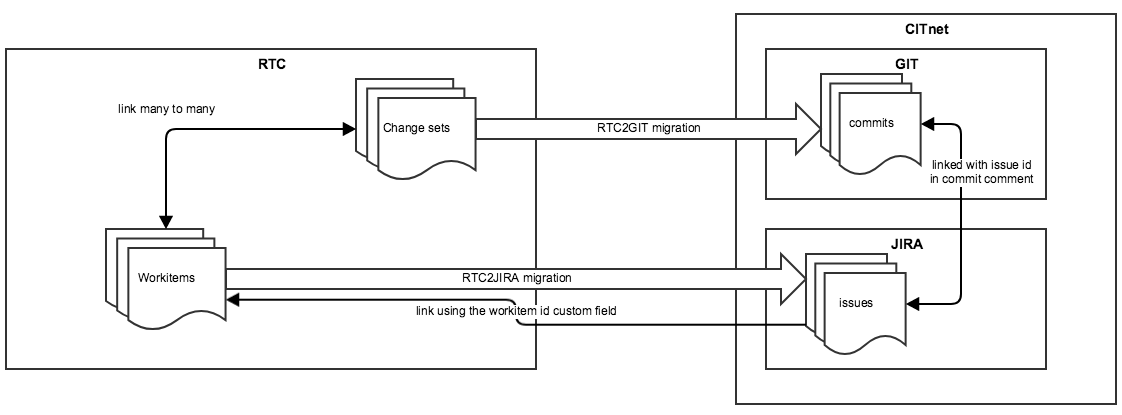
This post details the process of migrating from IBM RTC Jazz to Bitbucket Git, including entity mapping, requirement gathering, tool selection, and the development of a custom migration tool using RTC's internal REST API and bash scripting. It covers handling work item to Jira issue linking, baseline to tag conversion, and optimizing migration speed through parallel execution and intermediate result storage.

1 post · 2019

Timeline

20192026
Feature trailQuiet since 2019

Git rerere (Reuse Recorded Resolution)

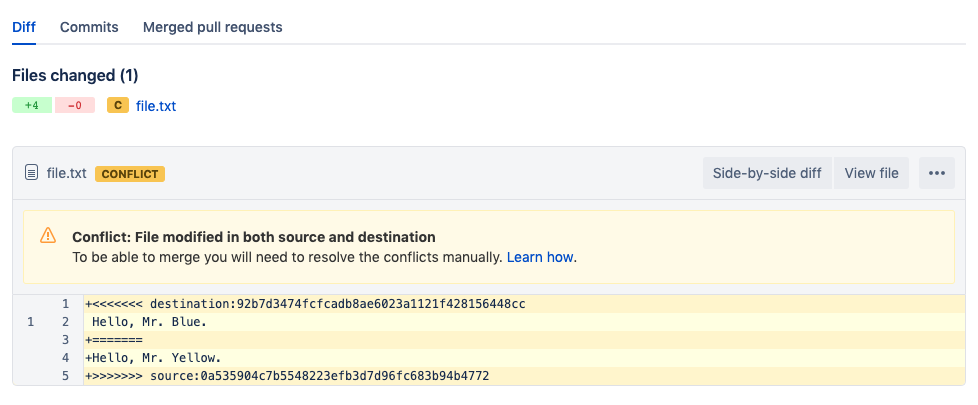
Git rerere is a feature that records and automatically reapplies conflict resolutions. When enabled, it captures the state of a file before a conflict and the resolved state after a human intervenes. The next time the same conflict occurs, rerere automatically applies the previously recorded resolution, saving engineers time and effort, especially in scenarios involving frequent rebasing or long-lived feature branches.

1 post · 2019

Timeline

20192026
Feature trailQuiet since 2019

CI/CD Code Quality Reporting

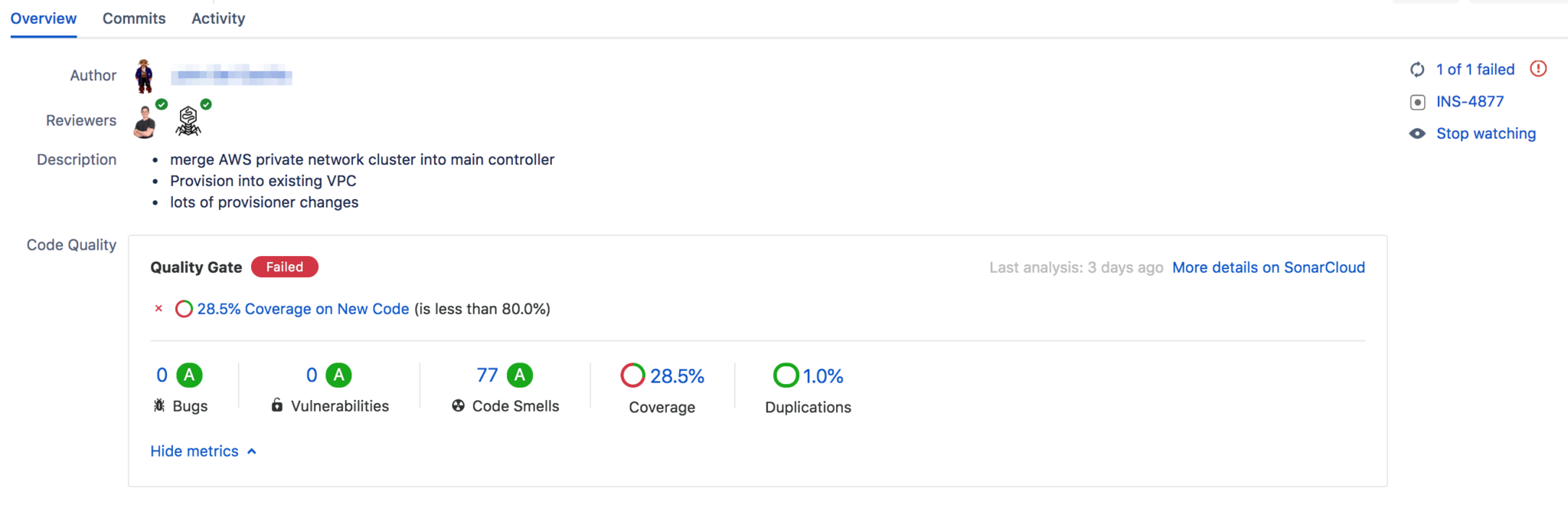
This post describes the integration of Jenkins and SonarCloud with Bitbucket to automate static code analysis and expose metrics like test coverage and code quality directly within pull requests. This enhances the code review process by providing immediate feedback on new code introduced in pull requests, helping to identify issues early and improve overall code quality.

1 post · 2019

Timeline

20192026
Feature trailQuiet since 2019

gRPC Microservice Development in Golang

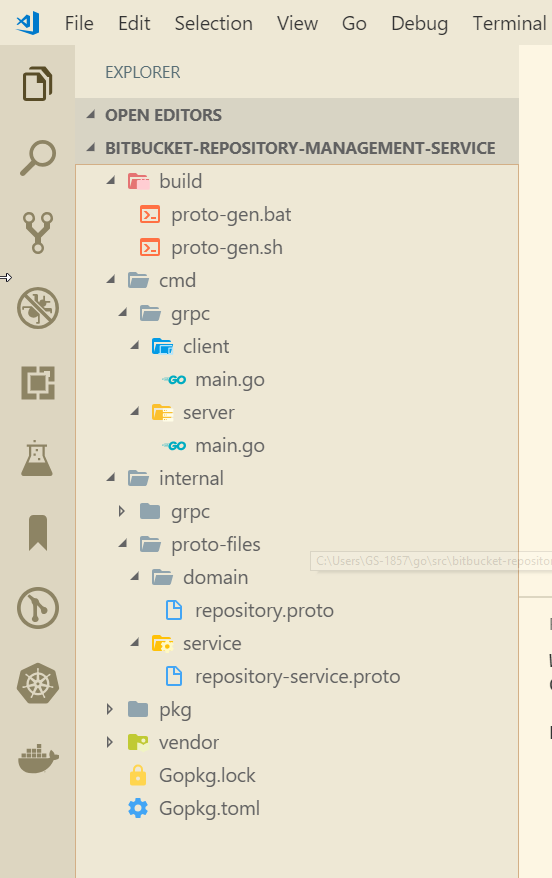
This post introduces the foundational concepts and implementation steps for building a microservice in Golang using gRPC for inter-service communication. It covers defining messages and services using Protocol Buffers, setting up the project structure, installing the gRPC compiler and Go bindings, generating stubs, and implementing the gRPC service logic. The example focuses on a repository management service, laying the groundwork for subsequent posts on security (Keycloak) and client implementation.

1 post · 2019

Timeline

20192026
Feature trailQuiet since 2019

iOS App CI/CD with Bitbucket and Bitrise

This post introduces a CI/CD workflow for iOS applications using Bitbucket Webhooks, Bitrise, and fastlane. It details the setup of a feedback loop for developing, releasing, and testing iOS apps, enabling automated builds, testing, and deployment to App Store Connect and TestFlight.

1 post · 2019

Timeline

20192026
Feature trailQuiet since 2019

Code Style Enforcement Tooling

Atlassian is implementing a suite of tools to automate code style enforcement across its engineering teams. This includes leveraging Prettier for code formatting, ESLint for JavaScript linting and bug detection, import-sort for organizing import statements, EditorConfig for editor-specific settings, and Csscomb for CSS organization. These tools are integrated into Git hooks (pre-commit, pre-push) to ensure consistent code styling and reduce manual review overhead for stylistic issues. The goal is to allow engineers to focus on architectural and bug-finding aspects of code reviews.

1 post · 2019

Timeline

20192026
Feature trailQuiet since 2019

Sourcetree UI Enhancements

Sourcetree for Windows has received significant UI updates, including a dark theme and the reintroduction of a repository sidebar/split view, to improve developer experience and efficiency. This builds upon previous UI enhancements and performance improvements.

3 posts · 2017–2019

Timeline

20172026
Feature trailQuiet since 2018

Bitbucket Cloud Branching Model Support

Bitbucket Cloud introduces a branching model feature to enforce consistent branch naming conventions, improving workflow efficiency and reducing confusion. This feature allows teams to define default branch types (Bugfix, Feature, Hotfix, Release), which can be customized or disabled. It integrates with Jira Software for smart mapping of issue types to branch types and can be combined with Branch Permissions to enforce merge rules. This is the first step in a series of features aimed at simplifying branch management.

1 post · 2018

Timeline

20182026
Feature trailQuiet since 2018

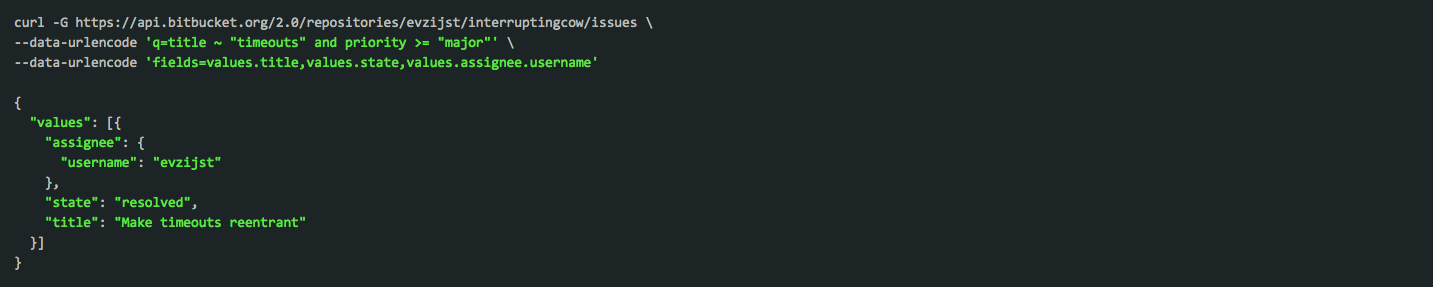
Bitbucket Cloud V2 APIs

Bitbucket Cloud has updated its V2 API to provide a more robust and consistent developer experience. This includes the introduction of Bitbucket Query Language (BBQL) for filtering results, partial responses for requesting specific fields, and improved developer documentation based on the OpenAPI Specification. The API Proxy module for Bitbucket Connect has also been enhanced to offer tighter integration between applications and Bitbucket Cloud, simplifying authentication, authorization, and data.

2 posts · 2013–2018

Timeline

…20172026
Feature trailQuiet since 2018

Sourcetree Performance Enhancements

Sourcetree for Windows has undergone significant performance improvements, including optimizations to UI rendering, Git operations, and caching mechanisms. Version 2.0 introduced a holistic approach to reduce visual complexity and improve the speed of Git operations by rewriting the file diff and sidebar to use virtualized components. Caching of file lists between views was implemented to eliminate stuttering. A hybrid LibGit2 handler was added for most Git operations to improve performance, with many operations seeing almost 2x speed increases. The UI has also been redesigned with a tab-centric approach, improved contrast, and per-monitor DPI support.

4 posts · 2017–2018

Timeline

20172026
Feature trailQuiet since 2018

Trello Real-time Delta Queue

Trello has evolved its real-time update mechanism by migrating its delta queue storage from Redis to a Mongo TTL collection. This change allows for persistent storage of delta queue items for a week and querying up to 1000 items, significantly reducing the 'disconnected' red box errors caused by Redis memory limits and eviction. The web client's reconnect logic has also been optimized to reduce transient connection failures.

2 posts · 2017–2018

Timeline

20172026
Feature trailQuiet since 2017

Phased App Updates

Atlassian has open-sourced a framework for implementing phased rollouts of app updates, building upon the Sparkle framework and integrating with fastlane for distribution. This system allows for incremental release of new versions to user groups, providing a safety valve for issues not found during testing. The initial implementation in SourceTree has demonstrated its effectiveness in managing disruptive changes and improving reliability through controlled user exposure.

1 post · 2017

Timeline

20172026
Feature trailQuiet since 2017

Trello Background Integration

Trello integrated with Unsplash to provide users with a dynamic background selection feature. This involved building a React component for the background selector, utilizing the unsplash-js library for API communication, and implementing an infinite scroll for background options using the IntersectionObserver API. The development process emphasized dog-fooding and centralized specification management via a Trello board.

1 post · 2017

Timeline

20172026
Feature trailQuiet since 2017

Sync State Indicators

Atlassian products display sync state indicators to communicate data synchronization status to users. This includes visual cues for queued, syncing, and synced states across boards, cards, comments, and attachments. The system aims to provide clear feedback without overwhelming the user, ensuring they are aware of data consistency. This post details the implementation of background downloading for Trello's mobile applications, focusing on optimizing bandwidth and battery usage through scheduled syncs, and introduces robust failure handling mechanisms for network requests, including temporary/permanent error categorization, exponential backoff, idempotence via client-generated UUIDs, and a 'last-writer wins' conflict resolution strategy for most data types.

3 posts · 2017

Timeline

20172026
Feature trailQuiet since 2017

Offline Mode Identifier Handling

Trello's offline mode has been implemented, with the database acting as a simulacrum of the Trello server. Changes made offline are stored locally and will be synced with Trello servers in subsequent articles. The system handles local, client-generated IDs and server-assigned IDs, distinguishing between them using a 'local-server barrier' architecture and an annotation-based ID converter. The current implementation focuses on managing deltas for syncing offline changes.

3 posts · 2017

Timeline

20172026
Feature trailQuiet since 2016

Git Large File Storage (Git LFS) Support

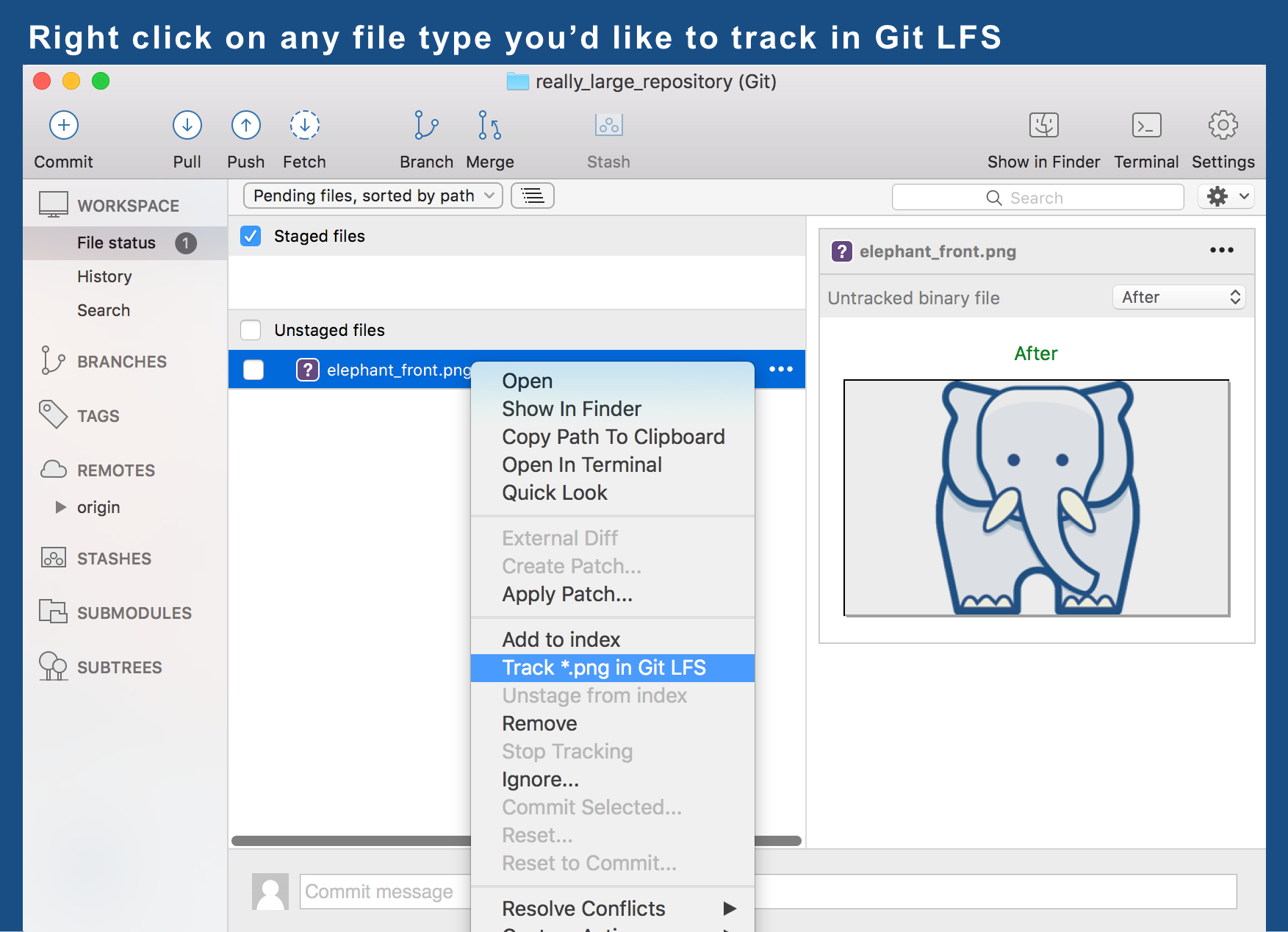
Bitbucket Cloud now supports Git Large File Storage (LFS) to efficiently store, version, and collaborate on large assets alongside source code. This feature keeps Git repositories lightweight by storing large files in parallel storage and only downloading necessary files for the checked-out revision, improving clone and fetch times. It integrates with SourceTree for easy file type tracking.

1 post · 2016

Timeline

…20172026
Feature trailQuiet since 2015

Bitbucket Webhooks

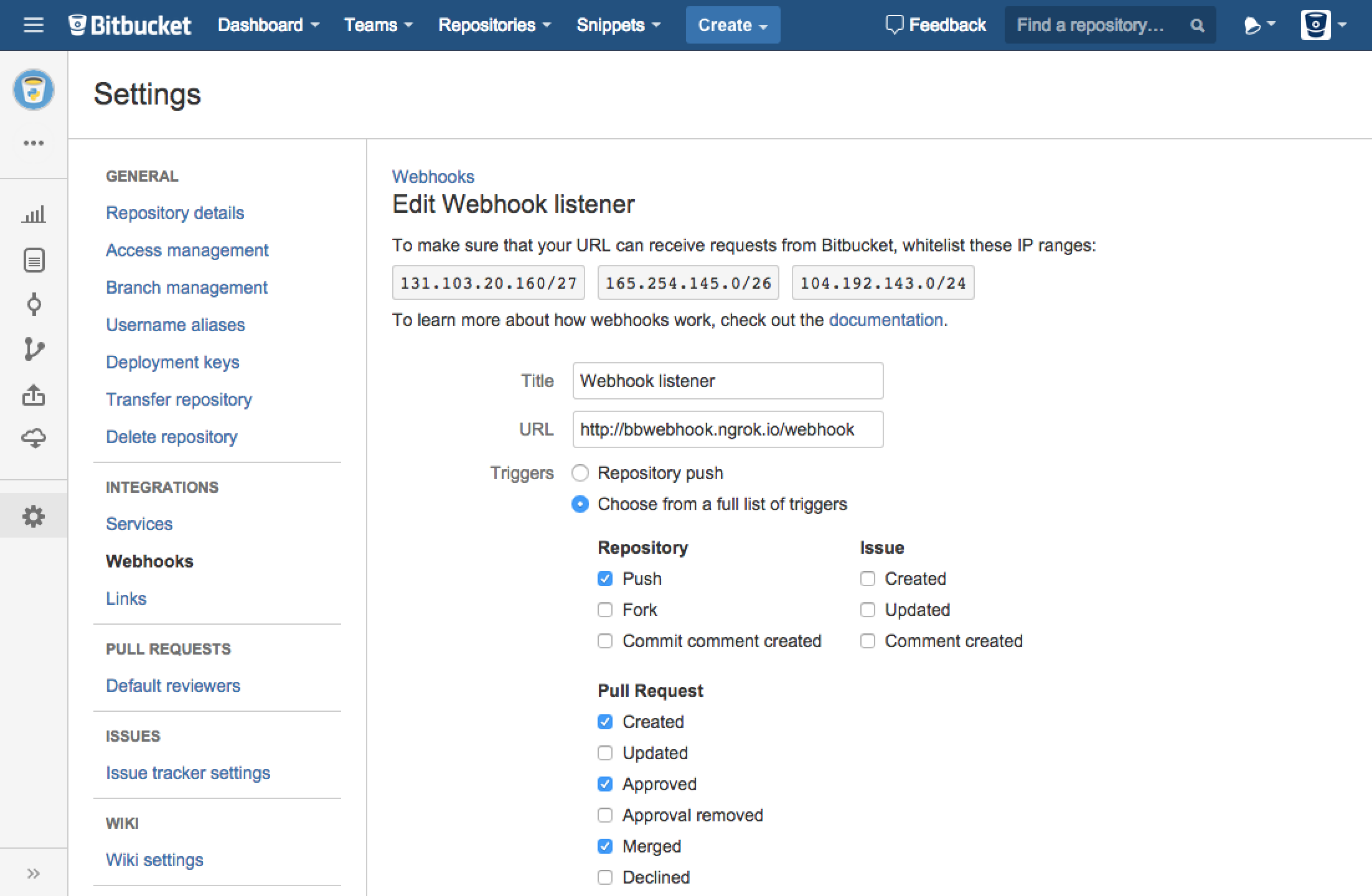
Bitbucket webhooks have been significantly improved with more descriptive payloads, finer-grained control over event triggers, and enhanced troubleshooting capabilities. The new webhooks are built on the Atlassian Connect platform, offering a foundation for powerful add-ons and integrations. Future enhancements include viewing request details, retrying requests, and advanced queuing.

1 post · 2015

Timeline

…20172026
Feature trailQuiet since 2015

Trello Apple Watch App Development

This post details the initial development of Trello for Apple Watch, focusing on leveraging ReactiveCocoa for UI updates and state management, managing context objects for navigation, and optimizing performance for the constrained environment of the Apple Watch. It highlights strategies for image compression, efficient data updates, and the use of groups for complex layouts.

1 post · 2015

Timeline

…20172026
Feature trailQuiet since 2015

Team Snippets

Bitbucket Snippets provides a platform for teams to create, manage, and share multi-file code snippets, configuration files, and other important information. It supports team-level sharing, versioning, and media types, with a rich API for programmatic access and integration. Snippets can be managed via a web interface or command-line tools.

1 post · 2015

Timeline

…20172026
Feature trailQuiet since 2013

Online Code Editor

Bitbucket Cloud introduces an online code editor for direct in-browser file editing, enhancing the developer experience by allowing users to clone repositories directly into Xcode and manage code without local cloning. This feature supports syntax highlighting, intelligent indentation, and integrates with pull request workflows for code review and contribution.

2 posts · 2013

Timeline

…20172026
Feature trailQuiet since 2012

Gitflow Branching Model Integration

SourceTree 1.5 introduced integration with the git-flow branching model, providing a GUI for managing development, production, feature, release, and hotfix branches. This aimed to standardize branching and merging for cleaner repositories, clearer procedures, and faster onboarding of new developers.

1 post · 2012

Timeline

…20172026
Feature trailQuiet since 2012

Per-repository SSH keys for Git/Hg

Bitbucket supports per-repository SSH keys (Deployment Keys) for secure, unmetered cloning/pulling of repositories via SSH for Git and Hg. This is particularly useful for build servers and CI/CD systems, allowing them to authenticate without consuming plan user limits. Deployment keys can be added to multiple repositories but cannot conflict with account-level SSH keys.

1 post · 2012

Timeline

…20172026
Feature trailQuiet since 2012

SourceTree Commit Text Replacements

SourceTree allows users to configure text replacements within commit messages, enabling automatic linking to external systems like Jira and Crucible, or custom regex-based transformations. This enhances the discoverability of related information directly from the commit log.

1 post · 2012

Timeline

…20172026
Feature trailQuiet since 2012

Git Submodules and Subrepositories

SourceTree 1.3 introduced support for Git submodules and Mercurial subrepositories, allowing developers to nest other repositories within their project structure. This feature simplifies managing dependencies and external codebases by tracking them from their original sources rather than duplicating files. The functionality includes adding, committing, changing tracked commits, and modifying source URLs for submodules. This capability enhances code organization and dependency management for developers.

1 post · 2012

Timeline

…20172026
Feature trailQuiet since 2012

Keyboard Shortcuts

Bitbucket Cloud enhances user experience and efficiency through the introduction and expansion of keyboard shortcuts across various sections of the platform, including the source code browser, commit history, pull requests, and search functionality. These shortcuts allow for faster navigation and execution of common actions without relying on the mouse.

1 post · 2012

Timeline

…20172026
Feature trailQuiet since 2010

Repository Search Filtering and Access Control API

This post introduces new filtering options for the repository explorer, allowing users to discover popular, existing, and trending repositories by date and activity. Additionally, it adds a new feature to manage the access control list (ACL) of public and private repositories via the REST API, enabling programmatic addition, modification, or removal of user access levels (read, write, admin).

1 post · 2010

Timeline

…20172026